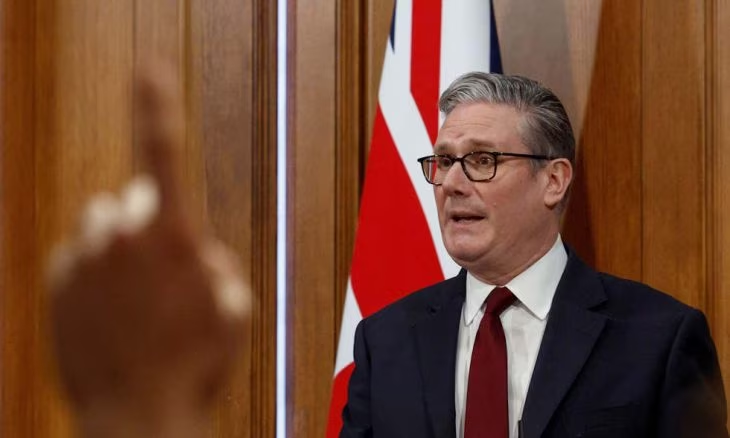







Diplomatic reports indicate that pro-Palestinian activists anticipate fundamental shifts in the policy of the British Labour government led by Keir Starmer. These expectations come amidst the Green Party's victories in local elections based on a program supporting Gaza, which has created direct electoral pressure on the ruling party's leadership.
Recent opinion polls among Labour Party members showed an overwhelming desire for punitive measures against the Israeli occupation. Approximately 87% of members supported banning trade with illegal settlements, while 78% went further, demanding a complete and comprehensive halt to all arms shipments to Israel.
Observers believe that the potential departure of Keir Starmer from the premiership could open the door for more radical leaders in their handling of the Middle East file. Wes Streeting and Andy Burnham emerge as prominent candidates to succeed him, both of whom have previously expressed more sympathetic positions towards the Palestinian cause compared to the current leadership.
Wes Streeting, the former Health Secretary, had earlier described Israel's behavior as resembling that of a 'rogue state,' considering it justification for imposing widespread sanctions. He also accused Israel of committing war crimes in Gaza and circulated medical reports documenting atrocities committed against civilians to cabinet members.
For her part, Emily Thornberry, Chair of the Foreign Affairs Committee, criticized the party's performance, asserting that it had failed the Palestinians at crucial stages. She indicated that British recognition of a Palestinian state last autumn should have been merely a first step, followed by practical steps to halt settlement expansion.
Thornberry questioned the absence of effective government action to end the political stalemate amidst continuous Israeli threats to divide the West Bank. She considered that what is happening within the Gaza Strip cannot be overlooked internationally, demanding a clear timetable for Israeli withdrawal and de-escalation of the crisis.
In a related context, experts believe that the British government lost its diplomatic momentum after the decision to partially suspend arms exports in September 2024. Activists are demanding the full publication of the government's response to the International Court of Justice's decision, which affirmed the illegality of the Israeli occupation of Palestinian territories.
Sources indicate growing frustration within party circles with the policy of 'hollow statements' that merely express concern without taking concrete action. The progressive wing of the party is demanding the adoption of deterrent measures to prevent British companies from participating in major settlement projects such as the (E1) project.
On the ground, the killing of more than 900 Palestinians since the last ceasefire announcement has increased the British government's embarrassment before its voters. The 'Peace Council,' supported by the previous US administration, failed to achieve any significant progress on the ground, reinforcing the conviction that the diplomatic approach needs to change.
Historians and political project managers in London believe that change within the government is imminent and inevitable due to electoral pressures. They see that the disparity in the leadership's handling of the Ukrainian and Palestinian files has eroded the party's credibility in adhering to international law among its youth base.
Former negotiators suggested that Britain should focus its efforts on directly influencing Israel's ability to evade international accountability. They considered that imposing symbolic sanctions on some settlers is not enough; rather, the political leadership that directly legitimizes these violations must be targeted.
Calls have also emerged for Europe to regain the diplomatic initiative in the Palestinian issue after a period of American dominance over resolution paths. Britain, by virtue of its historical relations, is expected to play a leading role in building an international coalition that imposes a trade ban on settlement products.
At the 'British Palestine Project' conference, it was emphasized that Israeli security cannot be achieved through continued military occupation. Participants concluded that practical measures, such as banning goods manufactured in settlements, are the only message that might change public opinion calculations within Israel.
In conclusion, it appears that the Labour Party stands at a historic crossroads, requiring it to balance its foreign relations with its stated principles and the pressures from its popular base. The coming days will reveal the extent to which the potential new leadership can translate electoral promises into tangible foreign policies that uphold Palestinian rights.
There is an imminent radical change within the British government, and it would be surprising if it did not happen because most dynamics are moving in one direction towards supporting Palestinian rights.
שתף את דעתך
Internal Pressures and Electoral Decline Push British Labour Party Towards a Stricter Stance on Israel