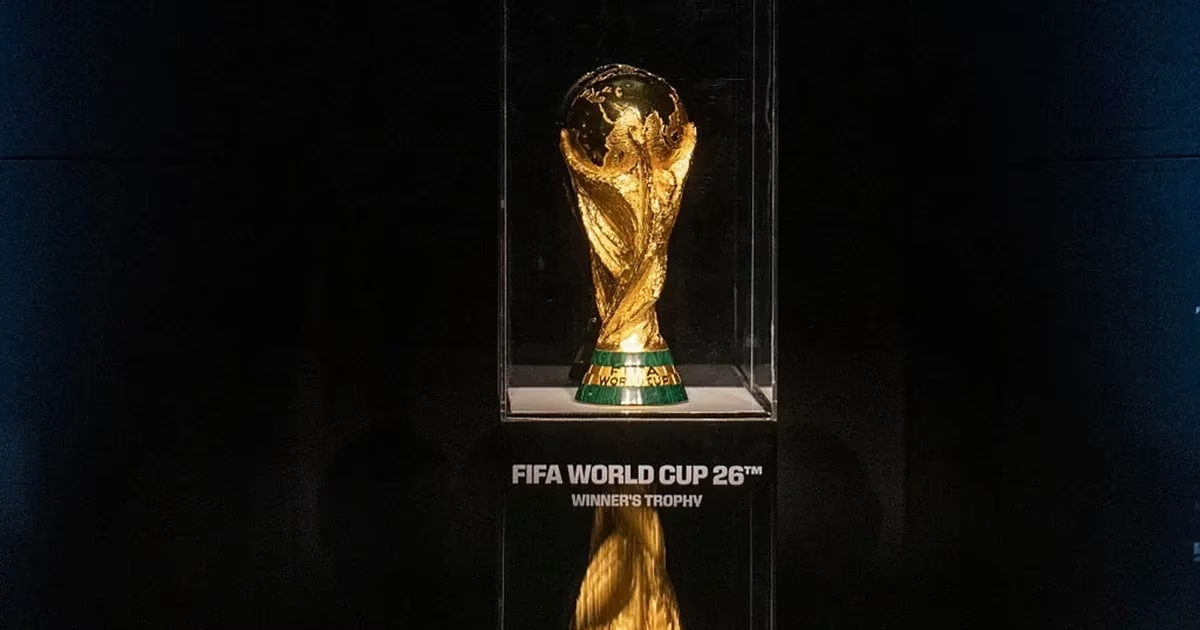







Football is no longer just a sporting competition within the green rectangle; it has transformed into a mirror reflecting political conflicts and global power balances. With the launch of the American edition of the 2026 World Cup, deep questions arise about the ability of sport to remain a neutral space away from ideological tugs-of-war.
The first weeks of the tournament are witnessing widespread controversy regarding difficulties in obtaining visas, especially for delegations coming from the African continent and the Middle East. These procedures, which American authorities justify on national security grounds, have created an impression that political criteria now precede the spirit of sport.
The very idea of the World Cup is based on breaking down borders and fostering human communication between different races and cultures. But when discussions about border restrictions and passports dominate the atmosphere of the matches, the essential message of the global event is shaken and distorted.
It cannot be definitively stated that there is a systematic racist policy, but the disparity in treatment between different nationalities has sparked widespread international discontent. The impressions left by these obstacles directly affect the image of the United States, which has long presented itself as a model of pluralism and openness.
In contrast, many recall the experience of Qatar 2022, which succeeded in presenting a different cultural narrative despite the media campaigns that preceded it. Doha managed to create an Arab and Islamic space that allowed millions of visitors to discover the values of coexistence without the need for cultural assimilation.
The Qatari edition proved that success is not limited to organizational aspects alone, but extends to breaking the Western narrative's monopoly on the concept of globalism. It presented a model that confirms that the world can meet and celebrate away from the usual cultural centrality in major capitals.
In the current edition, the challenge does not lie in the quality of the stadiums or the advanced infrastructure that the United States possesses. The fundamental question concerns the extent to which the superpower can isolate its internal and external conflicts from the atmosphere of the global tournament.
The case of the Iranian national team embodies this complex intertwining of sport and politics, as the team participated amid extremely complex regional and international circumstances. Every movement or symbol emanating from the Iranian delegation became rich material for intense political and media discussion.
When Iranian players raised symbols referring to war victims, it was a humanitarian cry that transcended the boundaries of the game to reach the conscience of the world. This stance reaffirms that football is not an isolated island, but a natural extension of lived political reality.
Despite the continuous attempts by FIFA to raise the slogan 'No Politics in Sport,' reality proves the impossibility of this separation. How can politics be isolated from an event where the participation of players and fans depends on sovereign decisions related to visas and borders?
What the World Cup is experiencing today is a reflection of major transformations in the international system, which has begun to revert to the language of identities and geopolitical divisions. The World Cup, as the most watched event, has become the ideal stage where these stark contradictions are clearly displayed.
The comparison between the Qatari and American editions confirms that material power and enormous technologies alone are not enough to create a positive image for countries. The feeling of discrimination or exclusion is enough to overshadow any organizational success, no matter how massive and high-quality it may be.
True power in the modern era lies in the ability to persuade and make guests feel welcome regardless of their political or ethnic background. This is the real test facing the United States in organizing this edition of the global tournament.
The question remains open about the final image that will be imprinted in the memory of peoples after the tournament's halfway point and its end. Will it be a story about celebrating sport, or will it remain a memory of a tournament dominated by discussions of borders and sharp political polarization?
True power in our era is no longer just the ability to organize, but the ability to persuade and make guests feel welcome, regardless of their religion or color.
שתף את דעתך
World Cup 2026: Have Politics and Borders Overcome the Spirit of Sport in the American Edition?