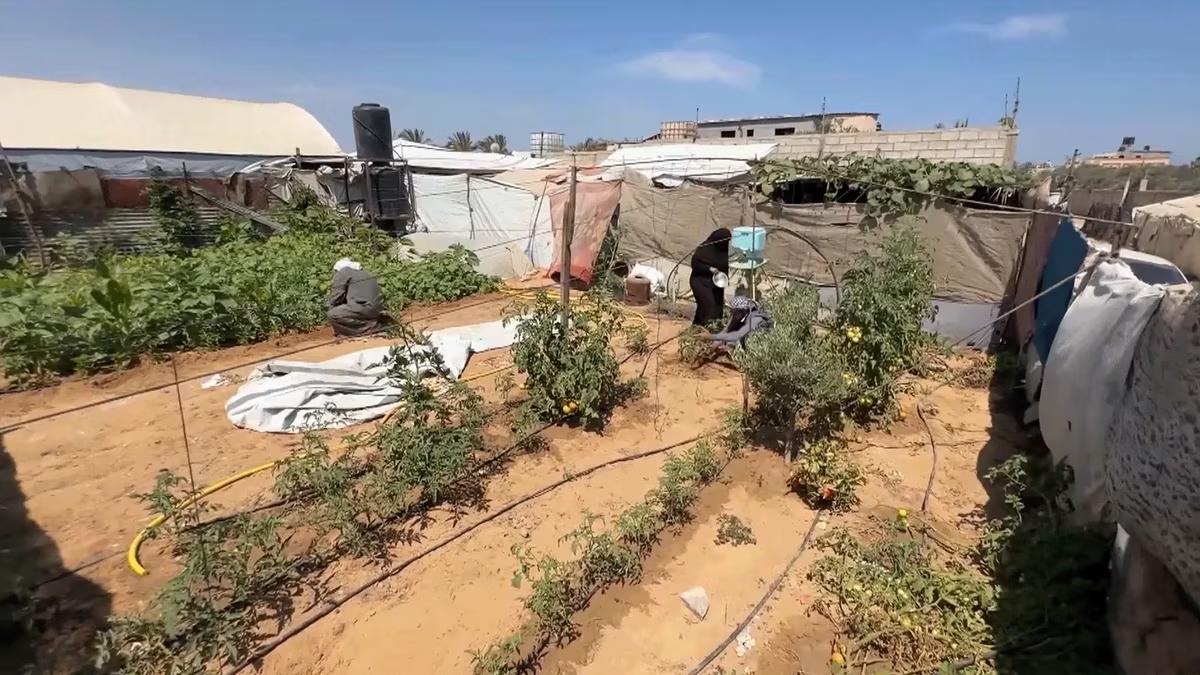







Displaced Palestinians in the camps of the Gaza Strip are fighting a unique battle for survival, as the surroundings of their canvas tents have been transformed into miniature agricultural fields. This step comes as an urgent attempt to secure a minimum amount of food for children, amidst the insane rise in prices of basic commodities and their disappearance from markets due to the strict siege.
Inspiring human stories emerge from the heart of suffering, where citizen Abu Khader and his wife rented a small plot of land adjacent to their tent in the town of Al-Zawaida in the central sector. The family diligently cares for tomato and eggplant seedlings daily, considering that obtaining a few fruits is a victory over hunger and provides a breakfast meal that would have cost exorbitant amounts.
These individual initiatives are not limited to one area but extend to include empty spaces near what is known as the 'Yellow Line'. These dusty patches have been transformed into small green oases producing chard, spinach, and arugula, contributing to feeding families suffering from the قطع of international and supply aid.
Despite the importance of these attempts, they face harsh field challenges, most notably the severe shortage of suitable irrigation water for agriculture and the absence of chemical fertilizers. Displaced farmers are forced to use old local seeds and very primitive equipment to maintain the continuity of these modest crops under the burden of war.
Security concerns cast a shadow over these small fields, as displaced people work in a state of constant fear of advancing military vehicles. Farmers on the ground confirm that they work 'hour by hour,' as they may be forced to displace again at any moment if the occupation approaches their areas, which means losing their efforts and crops.
Officially, the Ministry of Agriculture in Gaza revealed shocking figures reflecting the scale of the disaster that has befallen the food system. Responsible sources in the ministry explained that the occupation currently controls more than 63% of the total agricultural land area in the sector and prevents the entry of any agricultural production supplies through the crossings.
In Gaza City, specifically in the coastal Sheikh Ajlin neighborhood, residents launched initiatives to reclaim vineyards that tanks had repeatedly bulldozed. Farmers return immediately after the withdrawal of military forces to clean the soil and repair destroyed irrigation networks, in a clear insistence on replanting grapes and figs and preserving the historical identity of the land.
Data issued by the Government Media Office indicates that the occupation systematically destroyed about 94% of agricultural land in Gaza, estimated at 178,000 dunams. This destruction led to the collapse of annual agricultural production from 405,000 tons before the war to only about 28,000 tons at present.
The war machine did not stop at bulldozing the soil but extended to uprooting and destroying about 4 million fruit trees, including historical olive groves and citrus fields. This plan aims, according to experts, to impose complete food dependency on the residents of the sector and transform Gaza from a self-sufficient area into a hotbed suffering from real famine.
These local data intersect with international reports issued by the 'FAO' and 'UNRWA' organizations, which confirmed a decrease in arable land to less than 5%. These organizations emphasize that most of the remaining agricultural land is either completely destroyed or located in closed military areas inaccessible to farmers.
If we get three tomatoes every day, they make a salad for the family, and we take one or two eggplants for breakfast.
שתף את דעתך
Tent Farming in Gaza.. Displaced People's Weapon to Confront the War of Starvation and Siege