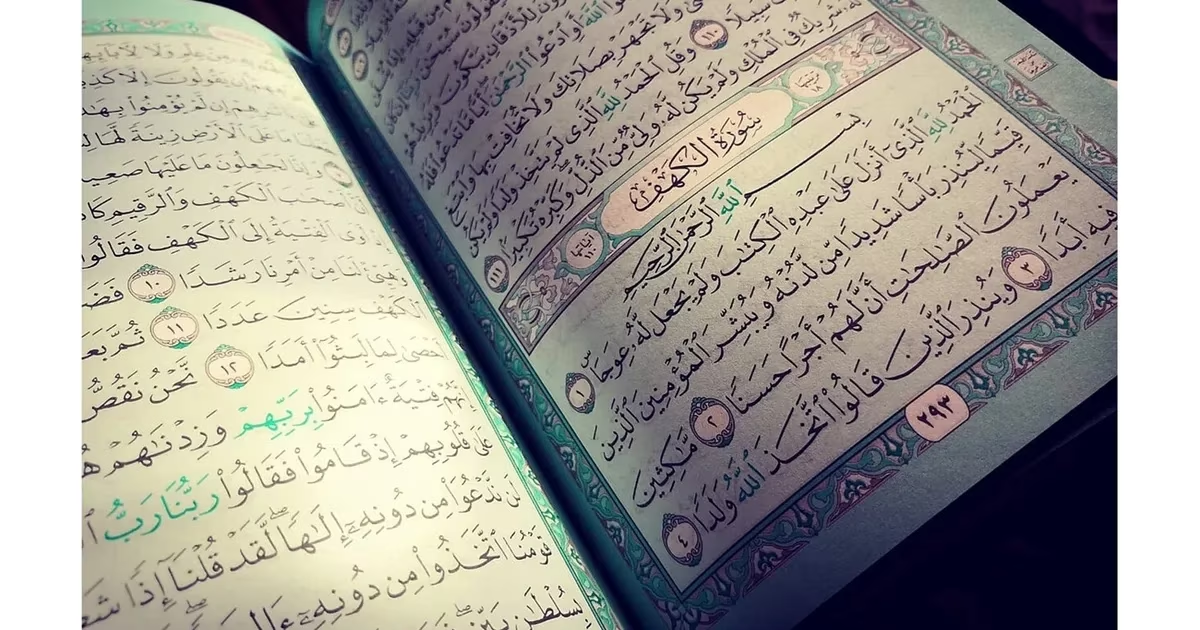







Modern intellectual readings raise fundamental questions about the transition from established terms like 'jurisprudence of cosmic laws' to the realms of 'proceduralism' and 'architecture'. The epistemological essence of this shift lies in the distinction between mere awareness of something and the mechanisms of its actual operation in physical reality.
The procedural approach represents the process of strict executive transition from intentions and mental awareness to the material and practical formulation of causes. In this context, Surah Al-Kahf does not offer a cold 'justificatory jurisprudence' that rationalizes a state of weakness, but rather outlines a dynamic guide that connects revelation with reality.
The Quranic text shows great care in helping the contemplator understand how the miracle of protecting the youths was achieved through a precise physical explanation. The verses detailed the movement of the sun and its relationship to the angular space of the cave, in addition to the mechanism of vital movement to prevent tissue damage through continuous turning.
These details confirm that divine providence did not bypass the laws of matter, but managed them with the highest possible physical efficiency. This leads us to procedural thinking, which views divine laws as strict principles that must be dealt with intelligently and with full understanding of their material requirements.
The Surah begins by declaring the authority of revelation as a universal measuring standard that regulates the angles of human movement and protects it from deviation. This governing pattern represents the nomothetic rectitude that establishes a value framework seeing empowerment as the fruit of a correct response to cosmic laws.
The Surah connects the reality of creation with the trial of action, and regulates the relationship between divine will and human kinetic consciousness. The mention of divine will is not intended to disable the future or encourage passive reliance, but rather to regulate the equation of action by exerting maximum physical and mental effort with certainty in divine care.
The architecture of empowerment in the Surah is formed through four structural stages that transition the believing community from weakness to sovereignty. The first stage begins with protecting the solid core, where security awareness and disciplined executive steps are manifested to ensure physical and doctrinal survival.
In the second stage, the economic test emerges through the story of the owner of the two gardens, which presents a precise distributive structure for resources. Despite fulfilling the material causes, separation from the authority of revelation and intellectual arrogance led to the complete destruction of the material structure.
The Surah moves in its third stage to cognitive training through the journey of Moses and Al-Khidr (peace be upon them). Here, the cognitive axis is revealed to regulate the relationship between the apparent judgment and the inner wisdom, where physical causes move under a higher unseen management that limited sight cannot perceive.
In this stage, the concepts of 'preventive management through partial loss' and 'arduous constructive industry' are manifested. The scuttling of the ship was a conscious defect to protect the source of livelihood, and the repair of the wall was a muscular effort to preserve the deposits of the future, connecting human effort with overall unseen engineering.
The architecture reaches its peak in the fourth stage with Dhul-Qarnayn, who applied the law of 'he followed a way' in its most splendid form. He rejected the model of dependency based on 'ready-made tribute', and preferred to build societal self-reliance by transferring technical knowledge and localizing tools of resistance.
Dhul-Qarnayn relied on mobilizing the physical energies of society and transforming them into active partners in the construction process. The outcome was the production of a solid physical barrier of iron and copper, which thwarted the threat of external domination and established comprehensive political and technical empowerment.
The structural approach of the Surah proves that empowerment is an integrated system that begins with safeguarding consciousness and ends with the collective localization of technology. It is a journey that passes through testing and ethically regulating resources, then practicing acceptance of the wisdom of the unseen, leading to resistance built on knowledge and strength.
In conclusion, righteous action merges with sincerity to declare the triumph of insightful response under the banner of monotheism. The Surah confirms in its concluding verses that guidance is inseparable from causality, and that true empowerment is achieved only by exerting all available human effort.
Surah Al-Kahf does not offer a justificatory jurisprudence that rationalizes weakness, but rather alerts us to a dynamic nomothetic guide that is organized within its joints.
שתף את דעתך
The Architecture of Empowerment in Surah Al-Kahf: From Justificatory Jurisprudence to Nomothetic Proceduralism