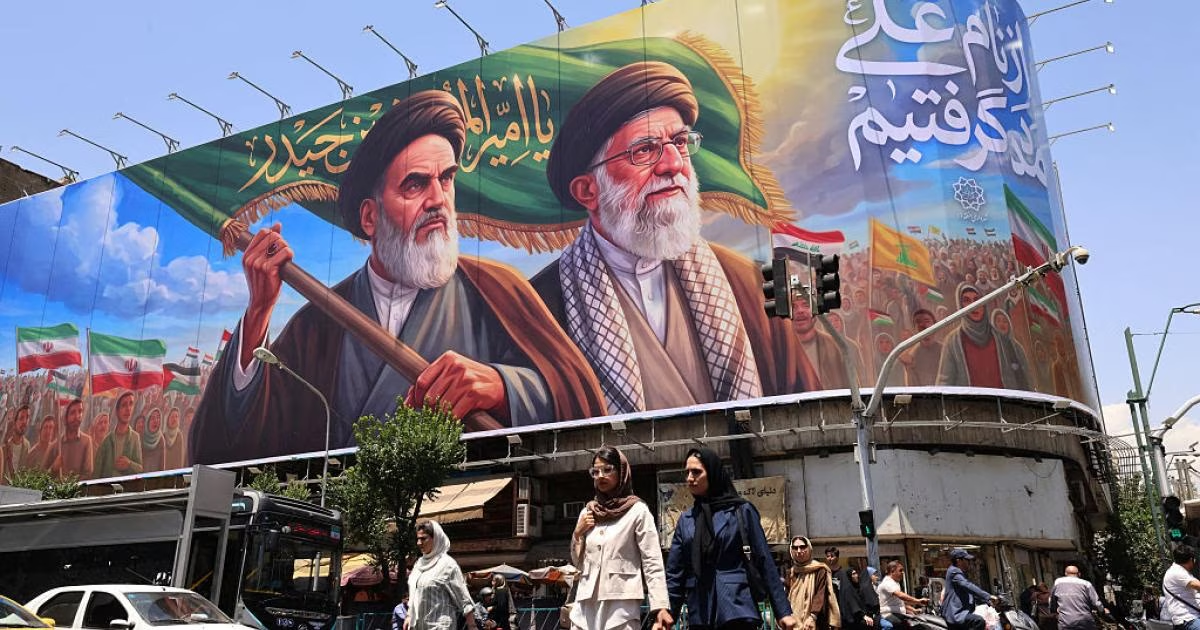







The region is experiencing a state of sharp fluctuation between the drums of war beating and talk of imminent diplomatic deals, as US President Donald Trump quickly moved from threatening to strike vital facilities on Iran's Kharg Island to announcing tangible progress in negotiations. This dramatic shift led to the cancellation of previously scheduled military strikes, reflecting the nature of the current moment, which lacks military decisiveness or stable peace.
For its part, Tehran adopts a cautious discourse, emphasizing the continuation of discussions without a final decision being made yet, stressing its desire to end the state of 'no war, no peace.' Iranian President Masoud Pezeshkian clarified that his country will not accept negotiations under threat, indicating Iran's adherence to rules of engagement that prevent offering free concessions despite increasing economic and military pressures.
On the ground, escalation has not ceased despite open diplomatic channels, as US forces launched raids on Iranian sites after accusing Tehran of shooting down an 'Apache' helicopter near the Strait of Hormuz. Iran responded by targeting bases in the region, while regional parties entered the fray with Bahrain announcing the interception of Iranian drones, proving that the field remains the primary driver of negotiation terms.
Iran's current strategy relies on the principle of 'remaining under pressure,' as Tehran bets that the inability of US and Israeli military power to undermine the regime gives it additional leverage. Iran uses sensitive issues such as navigation security in the Strait of Hormuz and global energy prices as pressure tools to make any comprehensive confrontation costly for the global economy and the American domestic front.
In contrast, American influence faces a difficult test in its attempt to balance military force and diplomatic mediation, as Washington seeks to prevent Iran from acquiring nuclear weapons and securing international navigation. However, contradictions appear in Washington's ability to control the course of the conflict, especially with differing priorities between it and its ally Israel, which seeks to achieve battlefield gains before any agreement.
Reports and sources indicate the existence of a draft understanding that may be signed in Geneva, including a 60-day ceasefire and the reopening of the Strait of Hormuz to international navigation. The draft also includes provisions related to lifting oil sanctions and releasing frozen Iranian funds, which Washington sees as a way out of the current crisis, while other parties view it with extreme caution.
Israel, for its part, distanced itself from these understandings, as Benjamin Netanyahu's office confirmed that Tel Aviv is not a party to the memorandum proposed between Washington and Tehran. This position reflects Israel's desire to continue military operations to weaken the capabilities of Iran and its regional allies, especially Hezbollah in Lebanon, before entering any political framework that might freeze the current situation.
And the Strait of Hormuz remains the beating heart of this confrontation, where Washington demands guarantees of freedom of navigation as a basic condition for any de-escalation, while Tehran links this issue to ending the naval blockade imposed on it. The strait has transformed from a waterway into a political card that directly links the war to global fuel prices, election calculations, and international markets.
Lebanon is not far from these calculations, as Lebanon represents an integral part of the Iranian deterrence system, and any regional understanding will necessarily reflect on the southern front. Tehran is trying to prevent Lebanon from being turned into a solitary attrition arena, linking the fate of de-escalation in the Gulf to the cessation of Israeli military operations on Lebanese territory.
Countries such as Qatar and Pakistan play active roles in mediation to bridge viewpoints and close gaps in the proposed text of the agreement, despite the fluctuating American positions that the Iranian side describes as unstable. Mediators aim to reach a formula that guarantees the minimum demands of both parties to avoid the region sliding into a comprehensive confrontation that no one desires.
Inside Washington, Trump faces pressure from conservative currents and pro-Israel figures who question the utility of the agreement and consider it a concession to Tehran. However, the current US administration seems to prefer the diplomatic path that offers a quick 'political achievement' to ease regional tensions and lower energy prices.
The absence of a single, clear path for the conflict leaves the region in a vicious circle, where every military strike changes the terms of negotiation, and every political statement reshapes the field. This collective inability to control the course of the war pushes parties to seek temporary exits that prevent maximum cost without any party appearing to be the loser.
Ultimately, it seems that the bet on a quick military decisive victory has collided with the limits of air power and Iran's ability to absorb strikes and turn them into negotiating gains. While Iran's military infrastructure has been damaged, it has not been exhausted to the point of surrender, making the 'gray area' the preferred arena for managing the conflict currently.
The region remains at a very delicate stage, as possible understandings are still fragile and prone to collapse with any miscalculation on the ground or political setback. While the world awaits the G7 meeting in Geneva, the question remains whether this deal will withstand Israel's battlefield ambitions and Iran's domestic concerns.
Iranian President Masoud Pezeshkian: Our country wants to get out of the state of 'no war, no peace' but will not succumb to threats or pressures.
שתף את דעתך
Between the language of war and de-escalation deals... The Middle East awaits the outcomes of the American-Iranian understanding