






Washington Message
Washington – Said Arikat – 11/6/2026
News Analysis
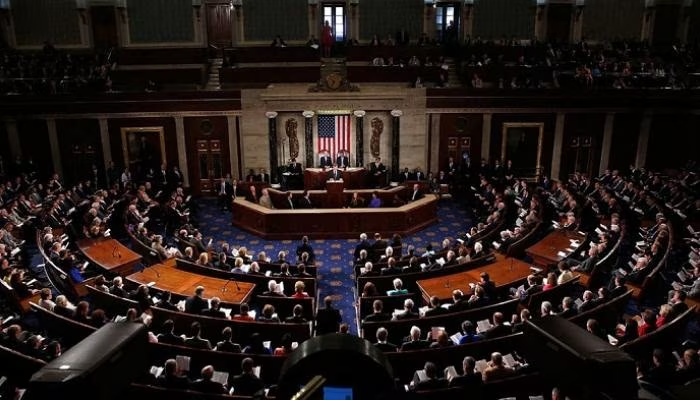
A bill before the US Senate is sparking growing controversy within political and security circles in Washington, after it included a clause that could force the US administration to expand the sharing of sensitive intelligence information with Israel in an unprecedented way. Critics see this as an infringement on the independence of US intelligence decisions and a potential threat to the national security of the United States.
According to an analysis published by Paul Pillar, a former official at the US Central Intelligence Agency (CIA), on the "Responsible Statecraft" website, Article 622, included in the 192-page Intelligence Authorization Act, is titled “Enhancing Intelligence Sharing Between the United States and Israel.” However, in his view, it goes beyond mere traditional cooperation to the level of obliging the US administration to expand the scope of information exchange with the Israeli government on most Middle East issues.
The bill is backed by Republican Senator Tom Cotton, chairman of the Senate Intelligence Committee, who proposes preventing any US administration from suspending or reducing this intelligence cooperation unless the President determines there is a specific and clear threat to US national security. Even in this case, the White House would have to submit a detailed report to Congress within fifteen days explaining the reasons for the decision, the nature of the information affected by it, and its potential repercussions on regional security.
It is worth noting that Senator Tom Cotton is considered one of Israel's staunchest friends and the Palestinians' fiercest enemies, and owes his position largely to the "AIPAC" organization, which provided him with extensive support during his many years in the Senate.
Critics of the bill argue that this formulation makes any future attempt to restrict intelligence cooperation with Israel politically and procedurally complex, transforming an issue that should remain within the purview of the executive branch and security agencies into a matter subject to pressure from Congress and pro-Israel lobbying groups.
This move comes at a time when opinion polls indicate a significant decline in Israel's popularity among the American public, especially after the war on Gaza and the accompanying international accusations of widespread human rights violations. Pillar believes that Israel's defenders in Washington are trying to compensate for the decline in popular support by strengthening other forms of strategic ties between the two countries, which are less visible to the public than direct military and economic aid.
After decades of American support exceeding hundreds of billions of dollars, the relationship began to move towards deeper forms of military and security integration that are difficult for the public to monitor or hold accountable. From this perspective, Article 622 appears to be an attempt to transfer this integration to the intelligence field, which is the most opaque and least subject to popular oversight.
From Support to Integration
The debate in Washington is no longer just about the amount of US aid to Israel, but about the nature of the relationship itself. The new bill reflects a shift from the concept of “support” to the concept of “institutional integration” between the two countries. While Congress and the public can monitor financial and military aid, intelligence cooperation takes place behind closed doors and away from the spotlight. Therefore, opponents of the bill fear that legislating information exchange will create a permanent commitment that successive administrations cannot easily modify, even when Israeli policies conflict with US interests or regional security priorities.
Pillar emphasizes that intelligence relationships are inherently highly complex and cannot be managed through rigid legislative texts. Intelligence agencies build their cooperation with other countries based on changing considerations related to common interests, the level of trust, and the risks associated with revealing secret sources and methods.
He points out that US intelligence agencies manage a wide network of relationships with multiple countries, and any legal obligation to give special priority to one country could disrupt this network and affect Washington's relations with other partners in the region and the world.
The author goes further when he talks about Israel's record of spying on the United States. He cites the case of spy Jonathan Pollard, who was convicted of delivering massive amounts of American secrets to Israel during the 1980s, in one of the most serious espionage cases the United States has faced from an allied country.
Pillar reminds us that senior American officials considered the damage caused by Pollard to be exceptional in terms of scale and seriousness, while Israel later welcomed him as a national hero after his release.
A Crisis of Trust within the Alliance
The repeated return to the Pollard case reveals a deeper dilemma than just a historical espionage incident. The core of the problem lies in the absence of complete trust between the two allies in the intelligence field. Countries exchange sensitive information when they are convinced that the other party will not use it in a way that harms their interests or transfer it to third parties. When former American officials raise the issue of Israeli espionage or the leakage of American technology to other countries, they highlight an existing gap within the security relationship itself, no matter how solid it may appear on the surface.
The author warns that the danger is not limited to the possibility of information leakage, but also includes how it is used. Information provided by the United States may be used in military or political operations that are inconsistent with American interests or regional stability goals.
In this context, Pillar links the bill to the growing differences between the administration of US President Donald Trump and the government of Israeli Prime Minister Benjamin Netanyahu regarding regional issues, especially Iran and Lebanon.
He believes that the recent war with Iran revealed fundamental differences between Washington's goals and Tel Aviv's goals, despite the continued close alliance between them. He believes that Israel often seeks to expand the scope of regional confrontations, while the United States tries to avoid sliding into open and long-term conflicts.
Restricting the White House
The most dangerous aspect of Article 622, according to its critics, is not the expansion of information exchange itself, but the restriction of the US President's ability to use intelligence cooperation as a political leverage. US administrations usually resort to adjusting the levels of military or security cooperation with allies to influence their behavior when necessary. However, if information exchange becomes mandatory by law, this margin will be significantly reduced. Instead of intelligence cooperation being a foreign policy tool, it could become a fixed commitment that grants Israel permanent strategic advantages, regardless of the nature of its policies or their compatibility with US interests.
Ultimately, Pillar believes that the bill is not just about intelligence sharing, but reflects a broader battle over the future and limits of the US-Israeli relationship. While its supporters present it as a necessary step to enhance Israel's security, its critics view it as an attempt to enshrine a long-term institutional link that could restrict American decision-making freedom and make Washington more attached to Israel's regional policies at a stage when questions are increasing within the United States itself about the usefulness of this path and its consequences for security and stability in the Middle East.
שתף את דעתך
Senate bill raises fears of opening US secrets to Israel