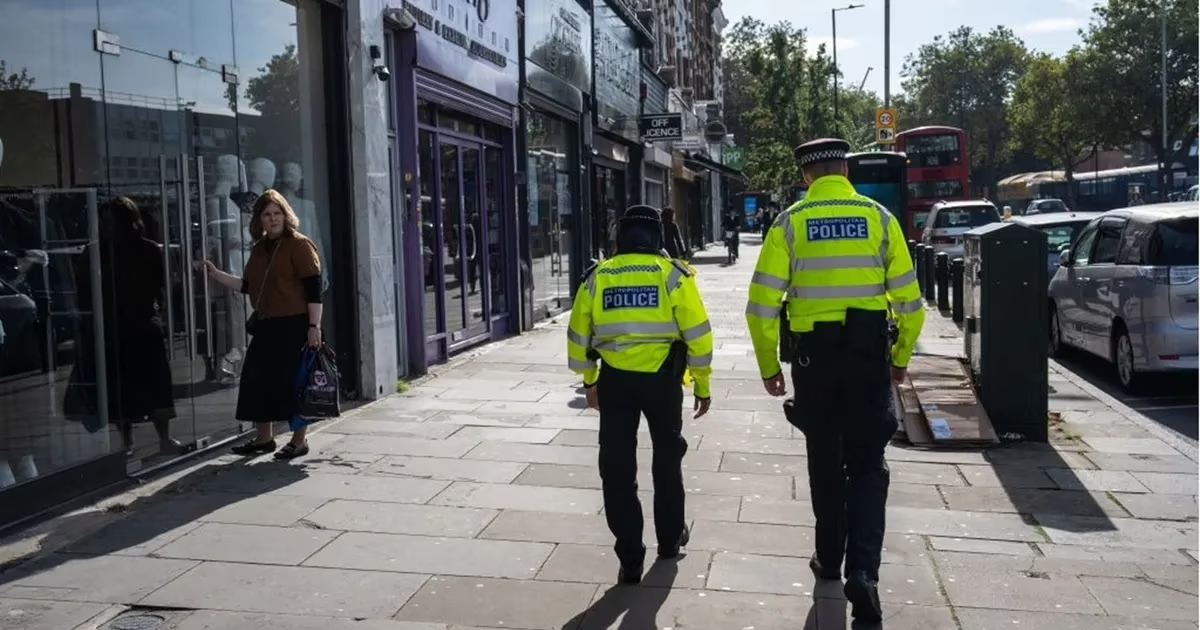







Political and security circles in Britain are in a state of turmoil following the leak of an internal policy document issued by the National Association of Muslim Police, which included strong positions regarding the ongoing war in the Gaza Strip. The document, revealed by the British newspaper 'The Telegraph', sharply criticized the Israeli occupation army, describing it as a 'Zionist terrorist group', raising major questions about professional neutrality within law enforcement agencies.
Reports indicated that the leaked paper defended Hamas in the face of what it described as 'unsubstantiated narratives' that spread after the October 7, 2023 attack. The document considered that the circulation of some media reports about widespread violence directly contributed to fueling feelings of hatred against Islam and Muslims in Western societies.
The document, drafted by Khaldoun Qabbani, then Vice President of the Association, went further by considering Zionism a form of hostility towards Muslims. This proposition provoked the indignation of official institutions and Jewish bodies in the United Kingdom, which saw these statements as a blatant deviation from the professional standards that police personnel should adhere to.
In terms of content details, the document questioned the accuracy of Israeli and Western narratives that spoke of large numbers of children killed during the initial attack by Palestinian factions. The paper indicated that some of these figures were later questioned, claiming that only one child's death was confirmed two days after the attack, which contradicts international and UN reports.
The document also included sharp criticism of Western media, accusing it of adopting narratives aimed at 'demonizing Palestinians' and portraying them as perpetrators of atrocities against civilians. The paper used strong language in comparing Israeli practices in the Gaza Strip to the mechanisms of 'dehumanization' used by historical oppressive regimes, referring in the context of comparison to the Nazi Holocaust in Auschwitz.
The sensitivity of this document lies in the role played by the National Association of Muslim Police, as it has cooperative relations with several police forces in England and Wales. The association provides advisory and training services related to personnel matters and worship needs, making its political positions potentially influential on the working environment within the security establishment.
The angry reactions were not delayed, as British Jewish organizations considered the content of the document a direct threat to the integrity of police work in the country. These bodies affirmed that the document contains misleading information aimed at distorting historical facts, which undermines mutual trust between society and security agencies.
For its part, the Campaign Against Antisemitism entered the crisis, demanding that the British Home Office open an urgent and immediate investigation into the circumstances of the preparation and publication of this paper. The campaign called for accountability for those responsible for this content, and a review of the role played by the Association within official police institutions to ensure that security work is not politicized.
Observers believe that this leak reopens the debate about the concept of 'police neutrality' in Britain, especially in light of the sharp societal division regarding the Palestinian issue. Security agencies face increasing pressure to strike a delicate balance between respecting the cultural diversity of their employees and adhering to complete neutrality on thorny international political issues.
Media sources indicated that the document had been briefly published online by 'The Spectator' magazine before being deleted, but its circulation in the British press brought it back to the forefront. This controversy reflects the extent of tensions caused by the war in Gaza on the social and institutional structure in countries supporting the occupation.
In a related context, the Jewish community considered that such positions issued by a body representing police officers contribute to creating a hostile environment for Jews within the security apparatus. It warned that adopting narratives that question the 'Holocaust' or compare it to contemporary events is a transgression of legal and political red lines in the United Kingdom.
Although the Association is a representative body and not an executive one, its influence in providing religious and professional guidance makes its opinions subject to close scrutiny. Right-wing political forces are demanding the necessity of disassociating the Home Office from any associations that adopt positions described as 'extremist' or biased against a party in an international conflict.
To date, no extensive official comment has been issued by the British Home Office regarding the measures taken against the author of the document or the Association in general. However, media and parliamentary pressure may push towards a comprehensive review of all documents and policies issued by professional associations within the police force to ensure their alignment with national laws.
In conclusion, this incident highlights the complexity of the British internal scene in dealing with the repercussions of the Israeli-Palestinian conflict, where internal documents become material for public political debate. The biggest challenge for the British government remains to maintain the cohesion of the security establishment and prevent the infiltration of political divisions into the ranks of its officers.
The document described the Israeli occupation army as a Zionist terrorist group and considered Zionism a form of hatred against Muslims.
שתף את דעתך
Leaked British police document describes the occupation army as a 'terrorist organization' and sparks a political storm