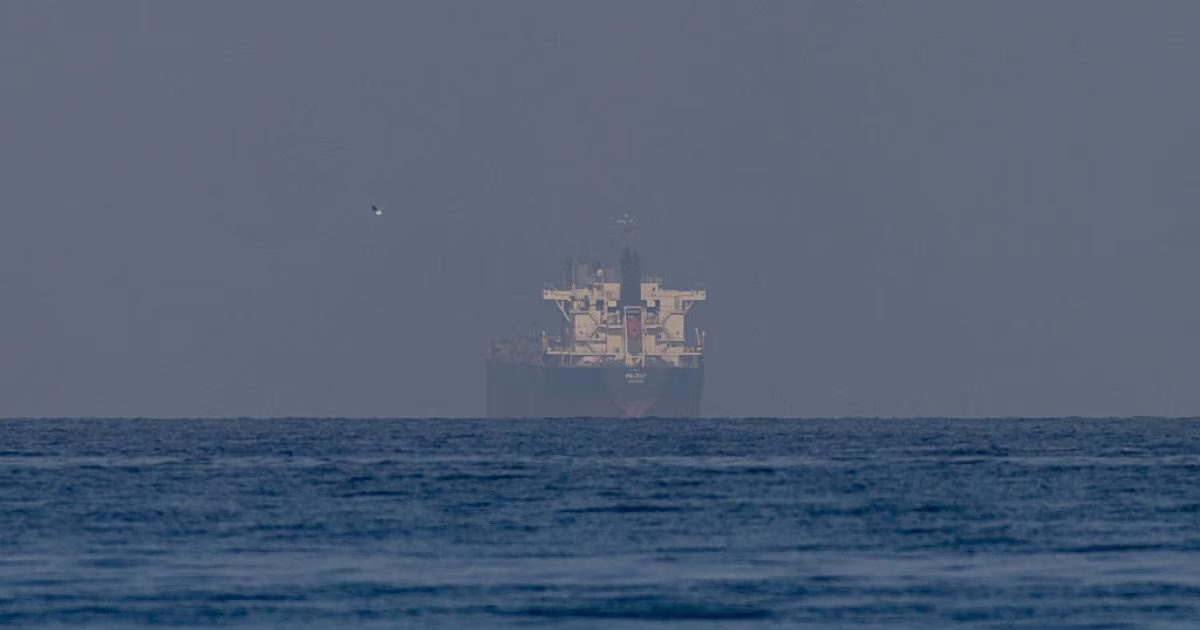







Today, the world enters the first hundred days of one of the most complex geopolitical and economic crises in recent decades, as the Strait of Hormuz continues to operate under the weight of unprecedented disruption in maritime traffic. This situation has directly impacted the stability of global oil markets and international trade flows, as well as directly affecting interest rate forecasts and global inflation rates.
According to estimates issued by international research centers, the crisis, which began on February 28, 2026, took the form of an actual and extended disruption of navigation due to mutual military escalation. This blockage led to a sharp decline in ship traffic through a passage that carries about one-fifth of global oil trade, turning military operations into a prolonged attrition.
The crisis went through five main stages, beginning with the 'blockade shock and military surprise' phase, which caused global astonishment and a sudden halt in shipping traffic. It then quickly moved to the 'peak' phase with the influx of US military forces and the soaring cost of operations to record levels, amidst real fears of an all-out war in the region.
These developments pushed international powers towards the third stage, which involved searching for alternative routes and activating land pipelines to compensate for the shortage. Despite the high costs of these alternatives, figures revealed their inability to compensate for one-fifth of the world's oil that usually passes through the Strait, keeping economic pressures strong and persistent.
Last May, the crisis entered its fourth phase, 'fragile de-escalation and navigational maneuvering,' following a truce reached under Pakistani sponsorship on April 8. This period witnessed a strategic shift led by Britain and France, who spearheaded an international coalition of more than 40 countries to coordinate navigation protection tasks and secure transit corridors.
On the ground, these movements translated into the deployment of the British destroyer 'Dragon' and an increase in military funding by £115 million, in parallel with the arrival of the French aircraft carrier 'Charles de Gaulle' in Djibouti. These reinforcements aim to establish a sustainable ceasefire and protect oil tankers from any potential threats in the region.
In contrast, this Western buildup was met with Iranian deterrence and a complex war of nerves, as Tehran announced the readiness of its light 'Ghadir' submarines and fast attack boats. The Revolutionary Guard also conducted ground maneuvers and a show of force, making actual passage through the Strait limited to tankers moving in 'stealth mode' to avoid detection.
With the completion of 100 days, the crisis entered the stage of 'forced coexistence,' where the disruption of the Strait transformed from an emergency event into a semi-permanent variable in international calculations. Central banks, insurance companies, and policymakers began to integrate these risks into their long-term economic forecasts, awaiting a comprehensive political settlement to end the paralysis.
Despite the temporary ceasefire agreement coming into effect, satellite ship tracking data indicates a gap between political promises and reality. Transit traffic still shows a significant decline, while operational risks continue to rise, reflecting shipping companies' lack of confidence in the sustainability of the current de-escalation.
Economically, the repercussions extended to energy, currency, and metal markets, with gold recording high investment demand as a safe haven. At the same time, the dollar moved in a volatile range, affected by inflationary pressures resulting from rising oil prices and the cost of global transportation and shipping, which doubled during the crisis months.
Politically, negotiations are hitting a complex wall of reciprocal conditions, with the Trump administration insisting on the complete dismantling of Iranian nuclear facilities as a condition for any solution. In contrast, Tehran adheres to its nuclear program and links any progress in the navigation file to the release of $24 billion of its frozen funds abroad.
The United States is currently intensifying its economic pressure by imposing new sanctions on 15 entities and 8 vessels involved in transporting Iranian oil. This escalating diplomatic stalemate keeps the Strait of Hormuz a global flashpoint, pressuring the international economy, awaiting a political solution to end the partial paralysis in the global trading system.
The actual disruption of the Strait has transformed from an emergency event into a semi-permanent variable that central banks and insurance companies integrate into inflation and interest rate calculations.
שתף את דעתך
100 Days into the Strait of Hormuz Crisis: How Has the 'Chokepoint' Reshaped Global Energy and Political Calculations?