






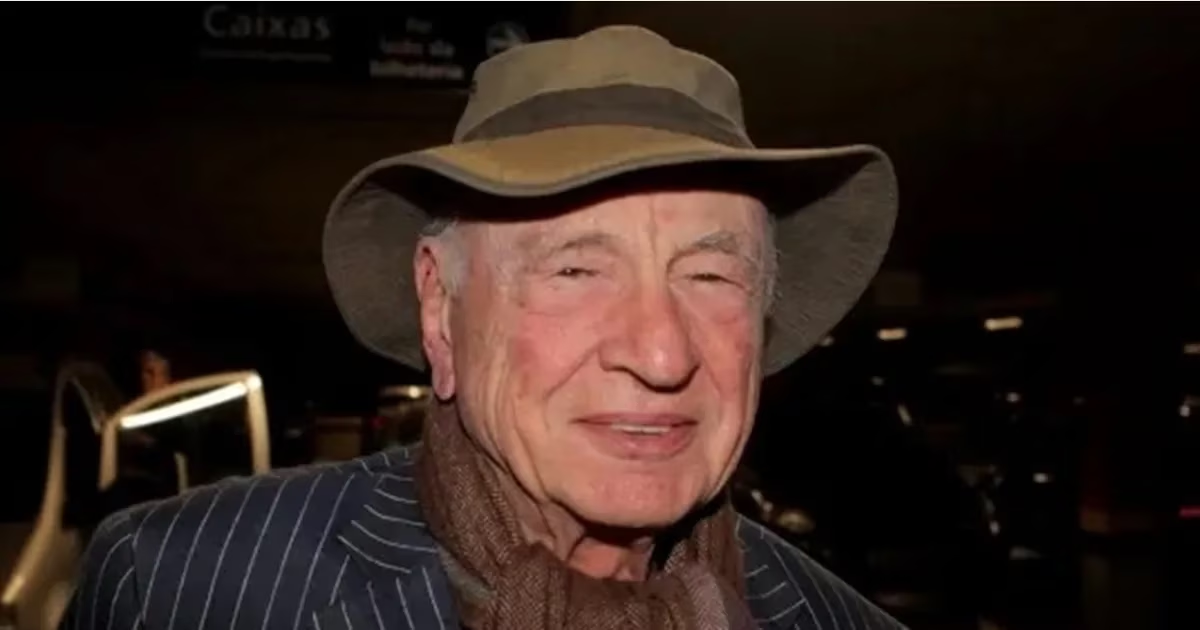
The global intellectual scene has lost the prominent French philosopher Edgar Morin, who passed away on May 29, 2026, at the venerable age of 104. His departure was not merely a fleeting piece of news in cultural circles, but rather a moment of profound reflection on the journey of a man who embodied intellectual conscience and a moral compass for many decades.
Morin is considered one of the most present and influential Western thinkers in contemporary Arab intellectual discussions, where Arab intellectuals found in his theses an escape from the dilemmas of simplification and reduction. The deceased provided cognitive tools that helped the Arab mind understand itself and its surroundings, away from sharp dichotomies and deeply rooted intellectual conflicts.
The 'Complex Thought' project emerged as Morin's most significant contribution, resonating widely in the Arab region. It is an explicit call to connect things rather than separate them. Morin believed that truth is not a straight line but a complex network that requires a holistic understanding that transcends fragmentation in politics, religion, education, and identity.
Morin was distinguished by a rare intellectual fairness towards the Arab world, refusing to reduce it to stereotypes or preconceived orientalist judgments. He viewed Arab crises as part of a global modernity crisis, while at the same time criticizing Western policies that fueled conflicts in the Middle East.
The late philosopher defended the right of Arab peoples to self-determination, calling for a genuine convergence between cultures based on mutual understanding, not domination. He saw in the Arab world great energies and potentials that could flourish if they shed the obstacles of traditional and insular thinking.
In the field of education, Morin's works, such as 'The Seven Necessary Knowledges for the Education of the Future,' left a clear mark on curricula and educational discussions. He advocated moving beyond rote memorization towards critical thinking that connects knowledge with human life in its broad, holistic context.
Morin diagnosed the crisis of educational systems as suffering from excessive fragmentation, lacking a comprehensive view of reality, which makes an increase in information of no real value. He believed that the solution lies in an approach that helps future generations understand complexity and face future challenges with a clear human vision.
In his later years, Morin warned against the rise of populism and the decline of rational discourse amidst the noise of accelerating technology and its complex algorithms. He always reiterated that technological progress without an intellectual vision leads to information without knowledge, and a speed that swallows the meaning and purpose of human existence.
Morin was not merely a 'friend' to Arabs in an emotional sense, but a friend to truth, which he saw above all considerations and interests. He directed his criticisms at Arabs when they became insular, just as he criticized the West when it fell into the trap of arrogance and oversimplification of historical facts.
The late philosopher believed that Arabs are experiencing a complex crisis in which identity intertwines with the state, education with thought, and the relationship with the outside world. He did not offer ready-made solutions to these crises, but rather presented an approach that calls for self-confrontation and acknowledging complexities as a first step towards real change.
Morin was explicit in his writings when he pointed out that Arabs face a highly complex world with simple and outdated thinking tools. He emphasized that the desire for democracy and change cannot be achieved without accepting pluralism and changing the mindset that fears confronting major existential questions.
Morin left a profound lesson summarized in the necessity of self-vigilance and not lying to oneself, a piece of advice that observers see as an urgent need for Arab societies today. For courageous confrontation of mistakes and the ability to acknowledge global changes are the only way to rise again.
With the passing of this sage, the world loses an exceptional thinker who taught us that knowledge is the art of connecting things to each other, not merely collecting separate facts. His impact on the Arab mind will continue as long as there remains a need for an approach that unravels crises and opens new horizons for understanding.
The best tribute to Edgar Morin's legacy is not through eulogies, but by continuing his project of deep thinking and self-questioning before questioning the world. For the death of a thinker does not mean the end of his thought, but rather the transition of that wisdom to become a collective property that illuminates the paths of those seeking truth.
Technology advances, but thought recedes; the world can only be understood through connection, not separation.
שתף את דעתך
The Departure of Edgar Morin.. The Absence of the Philosopher of 'Complex Thought' and the Contemporary Conscience of Humanity