






From the first moments of the Israeli occupation's response to the Al-Aqsa Flood operation, Benjamin Netanyahu's government began formulating war objectives and setting timelines for their achievement. This determination was necessary to absorb the anger of the internal opposition, which held the government responsible for the security failure, while the Biden administration pressed for a shorter war duration, fearing erosion of international support.
The recent statement by former Israeli Defense Minister Yoav Gallant shocked political circles when he announced that Israel would need years to achieve its goals in Gaza. This time estimate revealed a significant gap between Israeli military ambitions and the reality on the ground imposed by the Palestinian resistance and its ability to endure for a long time.
Despite more than two years since the outbreak of the confrontation, Israel has not succeeded in achieving its fundamental goals of forced displacement or the complete elimination of Hamas's structure. Observers attribute this setback to the growing defensive power within Gaza, in addition to the active regional support element that has exerted continuous pressure on various fronts.
The United States has been directly involved in the battlefields, whether through engagement with the Houthis in Yemen or providing intelligence and logistical support in Gaza and Lebanon. Despite the previous attempts by the Biden administration to prevent a comprehensive regional war, absolute military and political support for Israel remained the only constant in American policy.
With Donald Trump's arrival at the White House, the intensity of American involvement in direct confrontation with Iran escalated to support its strategic ally. This was evident in the 'Midnight Hammer' operation, which targeted Iran's fortified Fordow facility, in an attempt to undermine the Iranian nuclear program that Israel views as an existential threat.
Current Israeli ambitions extend beyond the Gaza Strip, as the right-wing government seeks to reshape the Middle East under the name of 'Greater Israel.' This project includes geographical expansion and security influence that extends to cover large parts of neighboring countries, with the aim of ending any regional power centers outside the sphere of dependency.
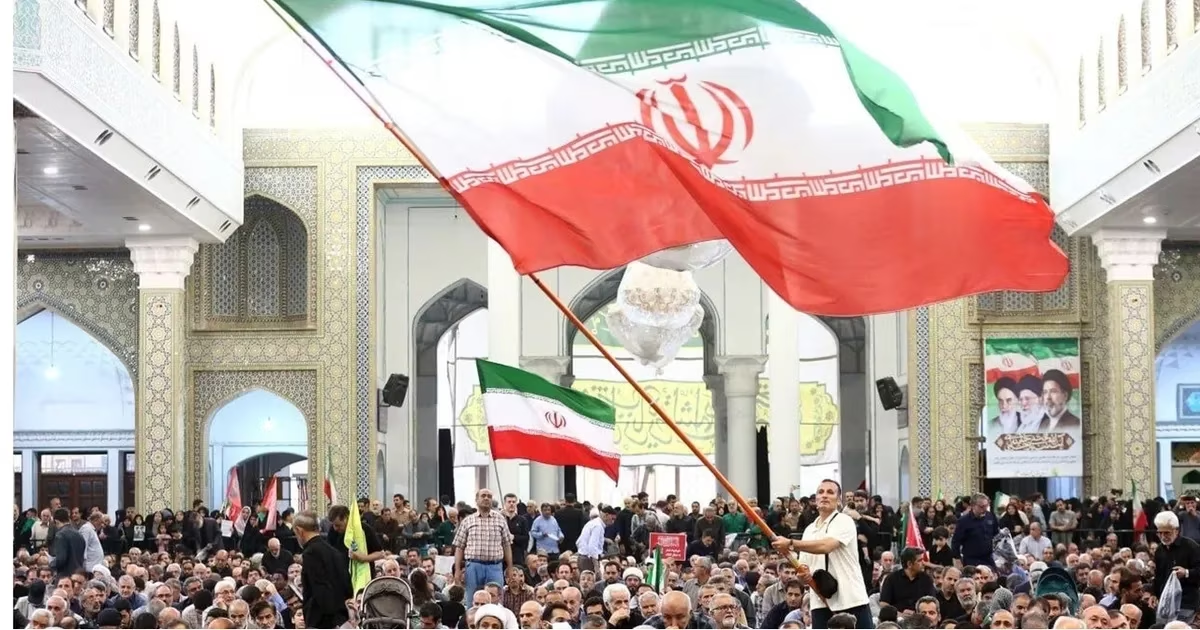
In contrast, Iran is undergoing a deep internal transformation with the emergence of a new generation of technocrats who manage political and military files with a nationalist doctrine. This transformation has made the Iranian regime more focused on the art of governance and national interest, transcending the traditional revolutionary ideological frameworks that prevailed in past decades.
The United States believes that maintaining its global order requires absolute control over waterways and maritime choke points such as the Strait of Hormuz and Bab al-Mandab. This control is the primary guarantee for the continued dominance of the dollar and securing global trade routes that connect East and West.
Iran is a vital component of China's 'Belt and Road' initiative, which seeks to provide an economic alternative to the Washington-led global order. This fierce struggle in the waterways reflects Beijing's desire to restore its position as the world's largest economy through the new 'Eurasia' economic system.
Recent developments have shown that the American military bases deployed in the region are no longer sufficient to fully secure navigation in the Strait of Hormuz. This field challenge has put the American administration in a real dilemma, as it has become clear that igniting wars without a clear exit strategy leads to the depletion of power and international prestige.
Israel's vision of dispensing with American support within a decade, as Netanyahu stated, seems fraught with risks in light of geopolitical shifts. From an American strategic perspective, Israel remains an advanced military base, not an entity completely independent of Washington's vital interests in the region.
Ultimately, the region stands at a crossroads between a decaying American global order and a Chinese system quietly making its way through economy and alliances. Iran, with its geographical positioning and new doctrine, remains the cornerstone of this conflict that will redraw the map of international powers for many years to come.
Israel, first and foremost, is nothing more than an American military base in the Middle East, just like the aircraft carriers that roam the oceans.
שתף את דעתך
Iran and Maritime Straits: The Struggle for Influence Between the American Global Order and the Chinese Alternative