






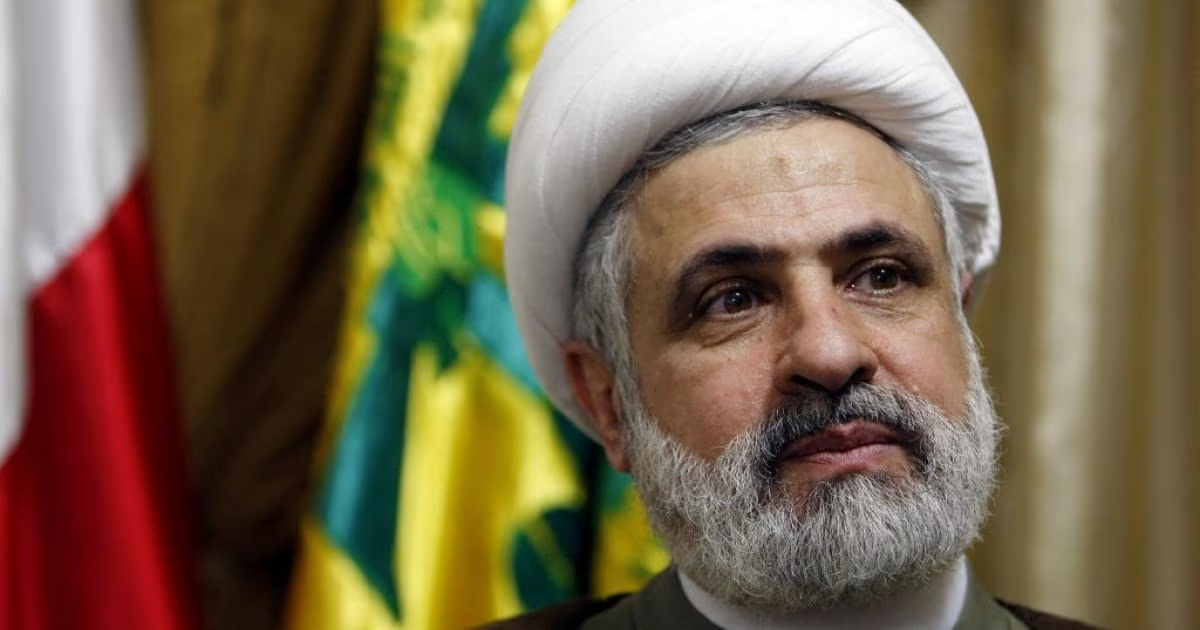
Hezbollah Secretary-General, Naeem Qassem, launched a scathing attack on the results of the direct negotiations held between Lebanon and Israel under American auspices, describing them as 'rejected in their entirety'. Qassem affirmed in an official statement that these results do not represent the aspirations of broad segments of the Lebanese people who refuse to relinquish their sovereign rights.
These statements came after a joint announcement issued on Thursday by Lebanon, Israel, and the United States, indicating that an agreement had been reached to implement a ceasefire. The proposed agreement relies on the complete cessation of Hezbollah's military operations, in addition to the evacuation of all its elements from the area south of the Litani River in southern Lebanon.
Qassem stressed in his statement that the resistance will continue its missions as long as the Israeli occupation of any part of Lebanese territory persists, considering that any ceasefire must be comprehensive and coupled with a complete withdrawal. He also warned that northern Israel will not enjoy security as long as Lebanese villages and their inhabitants remain under the weight of continuous bombing and targeting.
The Secretary-General described the direct negotiation process as 'shameful and a farce', calling for a halt to what he considered an insult to the Lebanese state and the sacrifices of its people. He clarified that the party categorically rejects any attempt to link the survival of the resistance's weapons to the issue of a ceasefire or Israeli withdrawal from the occupied territories.
Qassem held the Lebanese authority fully responsible for addressing internal division and fulfilling its national duties in protecting sovereignty. He believed that the proposed roadmap for a ceasefire aims essentially to 'exterminate a part of the people and enslave the rest', emphasizing that the current outcome is absurd and humiliating.
For his part, the commander of Iran's Quds Force, Esmail Qaani, entered the crisis by demanding Israel withdraw to the lines that existed before the 'Forty-Day War'. Qaani indicated that the Lebanese people will reap the fruits of their steadfastness and jihad in the near future, emphasizing the deep ties between the resistance fronts.
Informed sources in Tehran reported that the Iranian vision closely links what is happening on the Lebanese front with the major regional balances in the region. The sources clarified that the tools of pressure are no longer limited to the Lebanese field, but have extended to include threats to American interests in Gulf countries.
Estimates indicate that targeting American military bases in Kuwait, Bahrain, and the UAE has become part of the indirect engagement equation between Iran on the one hand, and Israel and Washington on the other. This escalation aims to pressure the American administration to force Tel Aviv to accept fair de-escalation terms.
Despite the escalation, Tehran realizes that expanding the scope of confrontation in the Gulf arenas carries a heavy political and security cost in the long run. Nevertheless, the primary goal currently remains to reach a ceasefire formula that meets the minimum demands of the resistance axis and ensures the stability of the fronts.
The past three days witnessed unprecedented tension, as Iran threatened to permanently halt diplomatic exchanges with the American side. This coincided with warnings issued by Hezbollah to residents of northern settlements about the need for immediate evacuation in the event of targeting the southern suburbs of Beirut.
In a related context, reports speak of intensive international efforts to bring the parties back to the negotiating table and avoid sliding into a comprehensive regional war. Signals from within Iran indicate the existence of continuous communication channels aimed at reaching understandings that end the current state of escalation.
Iranian circles believe that the current Lebanese situation calls for more effective action from Tehran, and perhaps tactical concessions to strengthen 'unity of the fronts'. This coordination includes the fronts of Yemen, Iraq, and other axes within what is known as the resistance front to ensure tangible political gains.
Data indicates that Washington is striving to impose a long-term de-escalation exceeding sixty days, in order to secure relative stability preceding major international events. Among these events are the preparations for the World Cup, which prompts the American administration to focus on closing hot files.
The coming days remain crucial in determining the fate of the agreement, amidst anticipation of what the mutual field and political pressures will yield. While Hezbollah insists on its sovereign conditions, international powers continue their attempts to impose a new reality in southern Lebanon that guarantees the security of Israel's northern borders.
The results of the direct negotiations are absurd and humiliating, and they are rejected in their entirety by broad segments of the Lebanese people.
שתף את דעתך
Naeem Qassem attacks ceasefire agreement and describes negotiations as 'shameful': Resistance continues