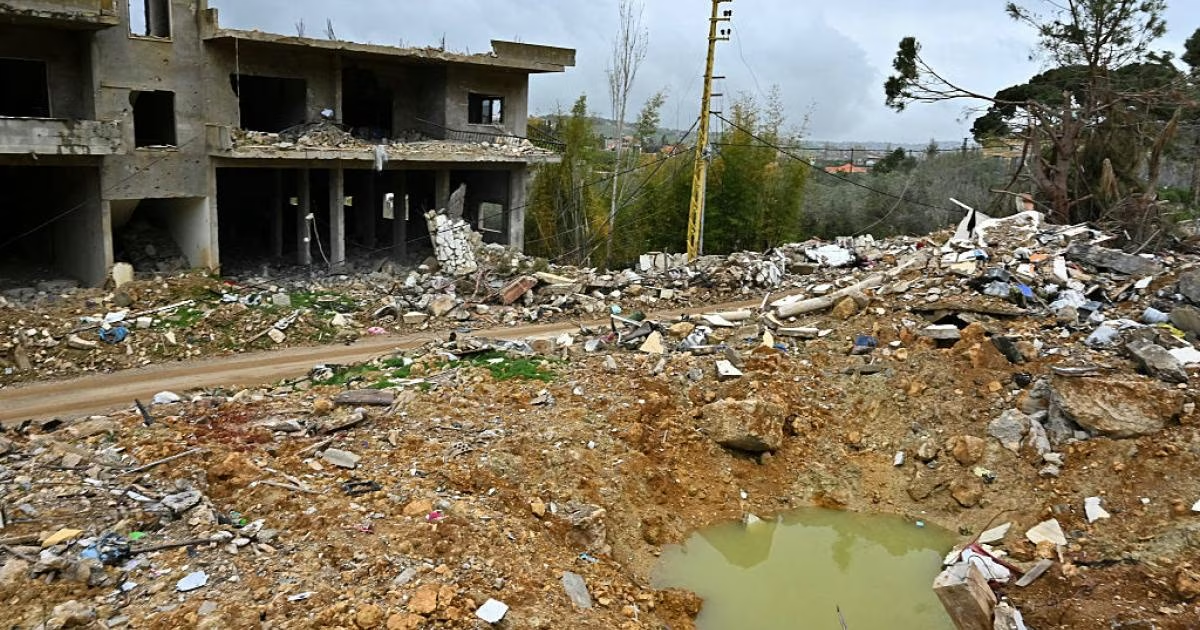







Lebanese medical sources reported that six citizens sustained various injuries as a result of an airstrike carried out by Israeli occupation aircraft today, Monday, targeting the town of Qa'qa'iyat al-Jisr in the Nabatieh district of southern Lebanon. This raid comes amidst a temporary truce that began last Thursday, but the field is witnessing repeated violations that threaten the stability of the fragile agreement.
Local sources stated that an Israeli drone directly targeted the vicinity of the Litani River basin in the same town, causing a state of panic among residents who are trying to check on their properties. Concurrently with the aerial bombardment, the occupation army carried out extensive demolition operations in the town of Shemaa in Nabatieh, and another in the area between the towns of Al-Qusayr and Al-Qantara in the Marjayoun district.
In a related context, the Disaster Risk Management Unit in the Lebanese government serail revealed shocking figures related to the displacement crisis, where the number of displaced people in shelters exceeded 117,000. The periodic report clarified that the officially registered displaced families amounted to more than 30,000 families, suffering from difficult humanitarian conditions amidst ongoing military threats.
The total death toll from the Israeli aggression, ongoing since early March, has risen to 2,387 martyrs, in addition to approximately 7,602 people injured with various wounds. These figures reflect the extent of human and material destruction caused by the intensive military operations on Lebanese villages and towns, especially in border areas.
For its part, the Israeli occupation army renewed its strict warnings to Lebanese citizens against returning to their homes in about 80 villages and areas in the south, considering them closed military zones. This measure aims to prevent civilians from accessing areas that still have an Israeli military presence or field sweeping operations.
In a field response to these movements, Hezbollah announced the destruction of four Israeli tanks in various areas of southern Lebanon using explosive devices it had planted earlier. The party affirmed that these operations come within the framework of a natural response to repeated Israeli violations of the ceasefire agreement and the incursion of occupation forces into Lebanese territory.
The occupation army claimed in an official statement to have carried out attacks targeting those it described as 'saboteurs' in the Bint Jbeil area, alleging that they violated the truce understandings and approached the front defensive line. The statement indicated that the air force intervened to eliminate these elements after they were monitored by the Paratroopers Brigade, claiming to remove a direct threat to the forces stationed there.
Israeli media discussed the so-called 'Yellow Line,' which is an imaginary security strip drawn by the occupation army inside Lebanese territory with a depth of up to 10 kilometers along the Blue Line. Through this line, the occupation aims to define the areas of deployment of its forces and prevent any Lebanese movements within this range, which Lebanon considers a violation of national sovereignty.
On the political front, Lebanese President Joseph Aoun affirmed that the Lebanese state seeks, through the anticipated direct negotiations, to permanently establish a cessation of hostilities. Aoun clarified that the top priority is to end the Israeli occupation of the southern regions and ensure a complete withdrawal of forces, noting continued coordination with the American mediator in this regard.
In contrast, opposing stances emerged regarding the direct negotiation path, with MP Hassan Fadlallah considering that Lebanon's interest lies in moving away from this path, which might impose unacceptable concessions. Fadlallah stressed the refusal to offer any political or security prices to the occupation, affirming that the resistance will remain vigilant against any Israeli attempts to impose a new reality under the guise of the truce.
Field reports indicate that the occupation army exploited the truce days to carry out demolition operations of homes and facilities in border villages, which further complicates the future return of displaced people. These operations are part of the 'scorched earth' strategy pursued by the occupation to secure its northern borders at the expense of inhabited Lebanese villages and towns.
The temporary ceasefire agreement, which came into effect for ten days, remains threatened with a complete collapse amidst mutual escalation and accusations of violating the agreed-upon terms. International and local circles are awaiting what the coming days will bring in terms of diplomatic efforts to try to transform this fragile truce into a permanent and comprehensive ceasefire.
The goal of the anticipated direct negotiations with Israel is to cease hostilities and end the occupation of its forces in areas in the south of the country.
שתף את דעתך
Israeli Escalation Violates Truce in Lebanon: Injuries in Nabatieh Raid and Tanks Destroyed in the South