






Today, the Middle East is no longer a space where balances are settled through rigid alliances or clear ideological alignments. Instead, it has transformed into an open arena where states move with extreme caution. In this landscape, international relations are characterized by proximity without adhesion and distance without complete rupture, reflecting a new geopolitical reality forming away from traditional patterns.
Israel stands at the heart of this transformation, not just as a party to a traditional conflict, but as an actor seeking to redefine the entire regional game. This strategy aims to make its presence a functional center around which regional networks revolve, using seemingly neutral tools such as energy, technology, and cross-border economic corridors.
Current Israeli policy seeks to shift the center of gravity away from the Palestinian issue, attempting to strip it of its character as a national political liberation cause. The ultimate goal is to transform it into merely a humanitarian and security file devoid of strategic impact, thereby facilitating the gradual construction of dominance networks that make adapting to them a less costly option than opposing them.
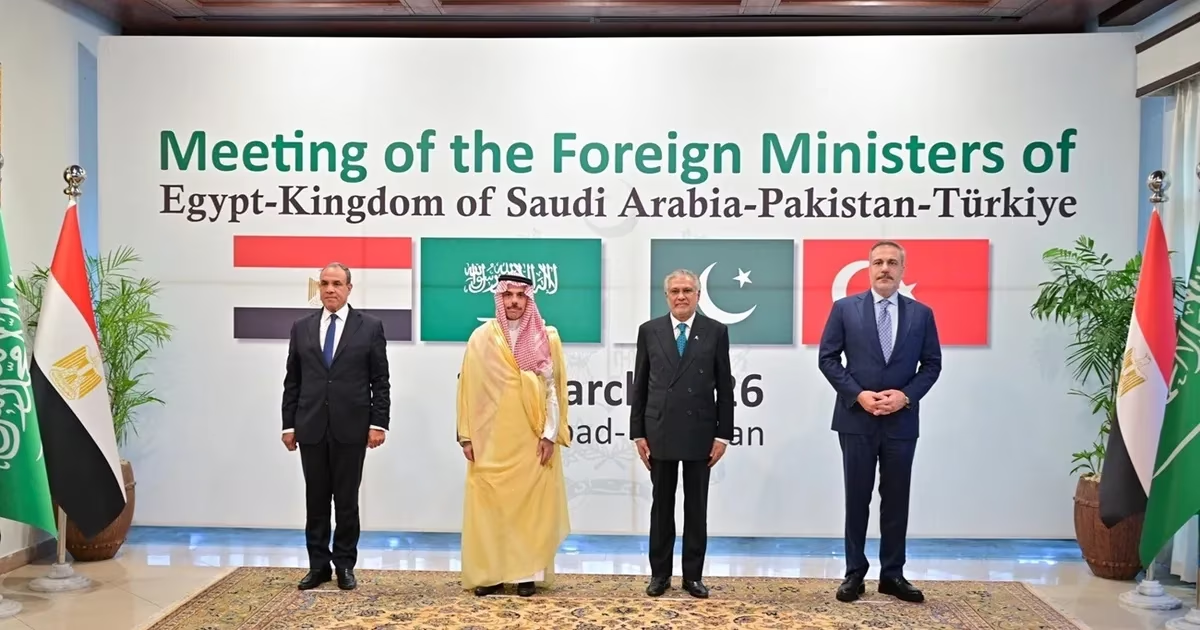
In this complex context, the behavior of major regional powers such as Turkey, Saudi Arabia, Egypt, and Pakistan cannot be understood as an attempt to form an opposing axis in the classical sense. Rather, these movements appear as simultaneous attempts to position themselves within the new reality and ensure that the region's future is not shaped without considering the vital interests of these states.
Turkey, which aspires to a role beyond its geographical borders, today balances its political discourse supporting the Palestinian cause with its strategic necessities. Ankara realizes that isolating itself from Eastern Mediterranean arrangements or international energy equations will not serve its ambitions as a rising regional power, making its maneuvers characterized by high political realism.
As for Saudi Arabia, it is undergoing a profound transformation aimed at redefining its position as a regional stability maker, not just a financial power. Its cautious openness reflects a conscious attempt to control the pace of rapid changes and prevent Israel from becoming an economic and security monopoly center in the region, while maintaining its own conditions for entering any new equation.
For its part, Egypt moves according to a conservative logic closely linked to protecting its national security and strategic position in the Eastern Mediterranean. Cairo views the ongoing transformations as a test of its ability to prevent an imbalance of power, and therefore maintains an organized relationship with Israel, opening doors for cooperation when necessary and closing them when an imbalance is perceived.
Away from the geographical heart of the stage, Pakistan emerges as a cautious observer carrying significant symbolic weight in the Islamic world. Despite maintaining a clear political distance from Israel, its internal priorities make it focus on monitoring the scene and ensuring that its interests are not harmed by the ongoing reshaping of the regional map.
What unites these countries is not a unified political project or a common ideology, but a collective realization that the region is fundamentally changing, and it is impossible to remain outside this change. However, this realization does not necessarily translate into a military or political alliance, given the differing calculations of each state and its definition of threat sources.
The illusion of grand alliances has dissipated, replaced by a more complex pattern of flexible network relationships built and dismantled according to need and interest. These networks are managed by the logic of short-term gain, not long-term commitment, making the ability to maneuver politically far more important than the strength of aligning behind a single axis.
The four regional powers do not appear to be moving towards forming a unified front for direct confrontation with Israel, but rather seeking to forge a complex balance that constrains Israeli hegemonic ambitions. This balance, despite its fragility, represents the most realistic option in a region that can no longer tolerate major military adventures or comprehensive clashes that could destabilize everyone.
The nature of the system currently forming points to a Middle East without a single center and without fixed axes, where each power tries to maintain its position within the game. The real conflict today is not about traditional military victory, but about the ability to endure and not allow others to redefine the roles of states within a system they did not participate in creating.
Despite attempts at marginalization, the Palestinian issue remains the cornerstone of any real stability, as economic corridors alone cannot replace political rights. Regional powers realize that completely bypassing this issue could lead to unexpected explosions that threaten all the networks of interests currently being built.
Ultimately, we are facing a region reinventing itself away from grand slogans, where the language of numbers and geopolitical interests governs the paths of states. This new reality compels everyone to adopt flexible strategies capable of dealing with successive changes in a highly fluid and complex security and political environment.
The ability to maneuver in the region today has become more important than the strength of alignment, where balance itself becomes a goal, not just a result of conflict.
שתף את דעתך
Middle East Transformations: Network Conflict Replaces Traditional Alliances