







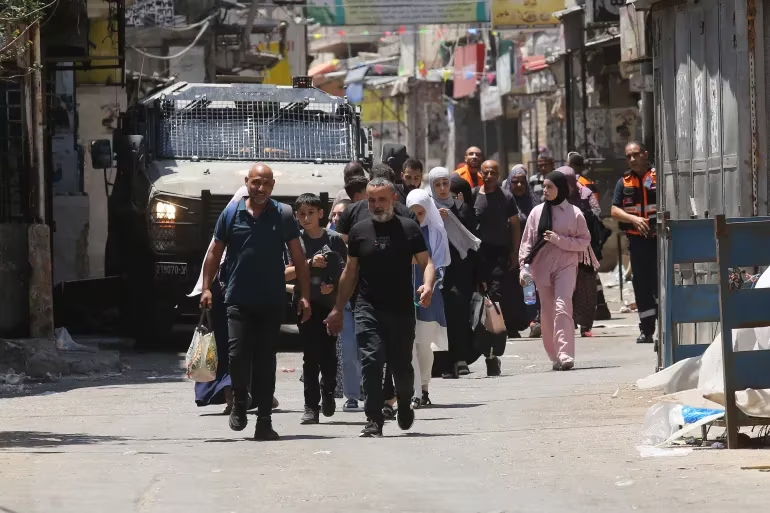
The West Bank is currently witnessing a gradual process of pressure and erosion, which cannot be understood as merely a series of isolated security measures, nor as the implementation of a single, clearly defined political plan. What is taking shape on the ground is a more complex reality: an overlap of field policies, political rhetoric, and low international engagement, all of which collectively lead to the weakening of the existing structure without resolving the question of an alternative.
At the heart of this scene stands the Palestinian Authority, not just as an administrative or security apparatus, but as a political entity facing an open existential test. Since its inception, the relationship between it and Israel has been based on a delicate equation: the survival of the Authority serves a minimum level of stability, but it is not supposed to become an entry point for full political sovereignty. This equation, inherently fragile, is now under unprecedented pressure.
Repeated incursions into cities, the expansion of arrests, escalating settler violence, along with suffocating economic pressures, not only affect the reality on the ground but also gradually erode the Authority's ability to perform its functions and weaken its position in the eyes of its society. With each round of tension, its ability to present itself as an actor capable of protection or influence diminishes, creating a growing gap between it and the Palestinian street.
However, what gives this path its deeper significance is not just what is happening on the ground, but the political discourse that accompanies it. Within the current Israeli government, the issue is not limited to a difference in tactics but extends to a divergence in vision regarding the very existence of the Authority. Figures like Bezalel Smotrich have clearly expressed their rejection of the idea of the Authority continuing in its current form and have put forward positions that push towards undermining or bypassing it, within a broader conception that fundamentally rejects the idea of a Palestinian state.
This discourse is not detailed or marginal; rather, it emanates from an influential position within the decision-making structure, reflecting the existence of a real political current that sees the weakening of the Authority as an end in itself. However, this stance does not reflect a complete consensus within Israel. Within the security establishment, there is still an understanding that the collapse of the Authority could open the door to uncontrollable chaos, and that its existence, even if weak, remains less costly than its complete absence. This contradiction partially explains the dual nature of current policies: continuous pressure on one hand, without going to the decisive step on the other.
In parallel, the American position plays an equally important role, but from a different angle. Unlike previous stages where Washington was more involved in balancing acts, its role today appears more limited in the West Bank. American attention is focused on managing major crises in the region, while the West Bank is treated as a relatively secondary file, where the crisis is managed rather than sought to be resolved.
This relative retreat does not mean complete absence, but rather a conditional and limited presence. The United States continues to talk about the necessity of "reforming" the Authority and links its support to its ability to improve its internal performance, which puts it in a constant defensive position. Instead of being a party that needs political protection amid increasing pressures, it finds itself required to prove its eligibility to survive.
In the same context, political pressures intersect with more sensitive issues related to international legal paths and accusations of war crimes. Although the nature of these pressures varies from case to case, the general trend seems clear: the international environment does not encourage legal escalation as much as it pushes for political containment of the conflict, even if that comes at the expense of pressure tools possessed by the Palestinian side.
When these elements are combined—field pressure, political discourse within Israel, and low American engagement—a broader picture emerges: there is not necessarily an announced decision to end the Authority, but there is an entire environment that gradually pushes towards its weakening. It is a slow process of erosion, which may not be centrally programmed, but it is moving in a clear direction.
In this context, a hypothesis emerges that what is happening is not direct dismantling, but rather a push towards "self-disintegration." That is, leaving the Authority under continuous financial, security, and political pressure until it reaches a point where it loses its ability to continue, without the need for an official decision to dissolve it. This approach, if correct, provides a less costly political exit for the party that prefers to end its role without publicly bearing the consequences.
However, this approach carries a dangerous paradox. The absence of the Authority does not mean a vacuum that can be easily controlled; rather, it could open the door to an uncontrolled multiplicity of local actors and turn the West Bank into an open arena for a low-intensity but permanent conflict, more complex in terms of control. Here lies the contradiction within the Israeli position itself: between those who see the weakening of the Authority as a goal, and those who fear the results of achieving this goal.
On the ground, the danger of this path is manifested in the very nature of the West Bank, which differs fundamentally from Gaza. The conflict in Gaza takes the form of clear rounds: escalation, then war, then calm. In the West Bank, however, the conflict is open and continuous, permeating daily life, and embodied in constant friction between the army and the population, and between settlers and the local community. This pattern does not allow for a quick resolution but rather entrenches a state of chronic tension, where force is used not to end the conflict, but to manage it and control its pace.
But managing the conflict in this way carries an internal contradiction: the longer the pressure continues, the more the tools that help control it erode, foremost among them the Authority itself. With the decline of its capabilities and legitimacy, the risk of sliding into a less controllable situation increases.
Ultimately, the region does not seem to be heading towards a quick resolution, but rather towards the continuation of this open path. The most likely scenario is the Authority remaining in a state of chronic weakness, performing limited functions under constant pressure, without a clear political horizon. But this "fragile stability" does not contain a guarantee of continuity, but rather a permanent susceptibility to erosion and explosion.
Here lies the fundamental dilemma: not in the existence of a clear plan, but in its absence. History shows that the most dangerous transformations do not always come from decisive decisions, but from paths left to develop without direction, until they reach a point where they can no longer be controlled. In the case of the West Bank, it seems that everyone is managing the present, without a real agreement on the shape of the future.
שתף את דעתך
Is Israel Pushing the Palestinian Authority Towards Self-Disintegration?