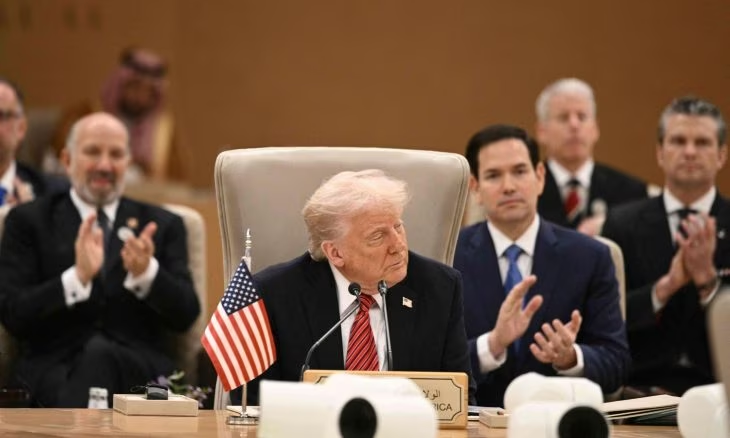







The British newspaper The Independent launched a sharp attack on US President Donald Trump's policies towards Iran, considering that his declaration of victory in the recent confrontation is not based on tangible reality. The editorial explained that the military and diplomatic campaign led by the White House ended in failure on all fronts, leading to an exacerbation of crises in the Middle East.
The newspaper pointed out that the American approach to dealing with Tehran, whether through military pressure or diplomatic attempts to secure a new nuclear agreement, led the region to a real catastrophe. It considered that expectations of resolving a conflict that has lasted for nearly half a century during a single negotiating session in the Pakistani capital, Islamabad, were a figment of imagination and completely unrealistic.
The report strongly criticized Trump's decision to send individuals lacking the necessary diplomatic experience to manage such a complex file, as real estate mogul Steve Witkoff and Jared Kushner were assigned the task. The newspaper believed that these negotiators entered the talks without real leverage, which made the United States' position appear weak in front of the seasoned Iranian negotiator.
The editorial also drew attention to the deliberate marginalization of the US State Department and its Secretary, Marco Rubio, as they were excluded from their essential role in formulating and managing foreign policy. This marginalization did not serve American interests, but rather led to confusion in strategic vision and a loss of coordination between sovereign institutions in Washington.
In a related context, the newspaper considered that assigning Vice President J.D. Vance to head the delegation in Islamabad was a grave mistake, despite his political weight. Vance, who had previously warned against falling into this predicament, found himself facing inevitable failure, which sparked speculation that Trump wanted to blame him for the expected diplomatic failure.
Analytical sources warned that the fragile ceasefire might not last more than two weeks, especially in light of continuous attempts to undermine peace efforts by regional parties. This situation places civilians in the region and the global economy under direct threat, amid a deadlock in prospects for sustainable political solutions.
The newspaper believes that the weak American negotiating position stems from the inability to make mutual concessions, as Trump and his team refuse to acknowledge strategic defeat. In contrast, Tehran appears to be controlling most of the cards in the game currently, benefiting from the tactical errors made by the American administration in choosing the timing and tools of the conflict.
Before the outbreak of this confrontation, the Strait of Hormuz was open to international navigation, and the Gulf states were experiencing a state of relative stability away from the drums of war. However, current policies have led to the closure of vital waterways and placed the entire region on the brink of a volcano, with increasing probabilities of uncalculated military escalation.
On the nuclear front, the newspaper confirmed that the Islamic Republic survived the fierce war and still retains its enriched uranium stockpile in fortified sites. This reality gives Tehran the ability to develop a nuclear weapon at any time, which the newspaper considers a strategic victory for Iran against an American failure to achieve the goal of disarmament.
Despite Trump's statements in which he insists on describing America as victorious regardless of the results, the reality on the ground indicates the exact opposite. The war, which caused global economic disruption and intimidated neighbors, did not achieve any of the goals announced by Washington at the beginning of the escalation.
The editorial predicted that the United States would eventually be forced to accept conditions imposed by Tehran, or a complete withdrawal and leave the region to other international powers such as China and Europe. This scenario would represent a historical humiliation for the American administration, reminiscent of the Saigon withdrawal in 1975 or the chaotic exit from Kabul in 2021.
The real tragedy lies in Trump's abandonment of diplomatic agreements that could have achieved American interests without bloodshed, most notably the 2015 nuclear deal. According to the newspaper, tearing up that agreement was driven by Trump's desire to erase the legacy of his predecessor Barack Obama, and not based on a sound strategic assessment.
The newspaper also pointed to a more recent Omani-brokered agreement that was ready for signing before Trump decided to resort to the option of military force last February. This shift towards escalation proved its futility, as force did not succeed in imposing a new reality, but rather increased the complexity of the political and military scene.
The newspaper concluded its analysis by recalling Winston Churchill's saying that 'jaw-jaw is better than war-war,' calling on Trump to review his calculations before it is too late. The internal political repercussions could devastate the Republican Party in the upcoming elections, which could pave the way for impeachment proceedings against the president if control of Congress is lost.
Whatever happens now, America has lost this war, whether it ends with an agreement or Trump decides to escalate the military effort.
שתף את דעתך
Independent: Trump faces strategic failure in his war against Iran, and his negotiators lack leverage