






Washington – Said Arikat – 12/4/2026
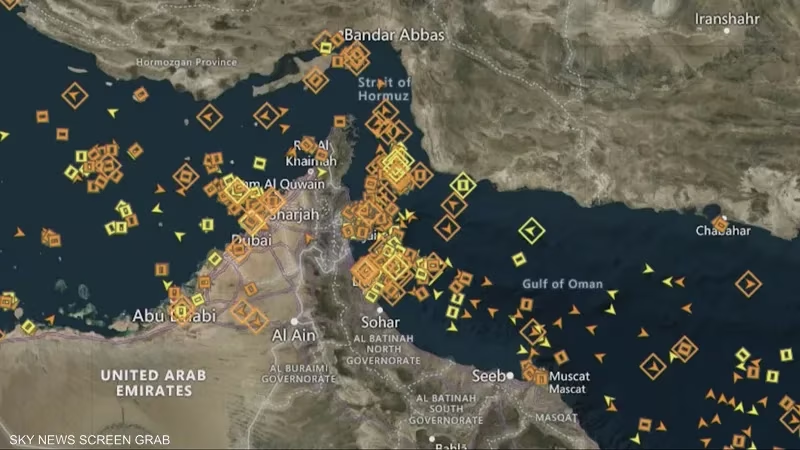
In a striking escalation that portends wide-ranging regional and international repercussions, US President Donald Trump on Sunday announced a US naval blockade of the Strait of Hormuz, threatening to destroy “what remains of Iran,” following the collapse of talks hosted by the Pakistani capital, Islamabad, over the weekend without achieving any significant breakthrough.
In a series of posts on the "Truth Social" platform, Trump stated that the US military would soon begin operations to blockade ships entering or exiting the Strait, asserting that any vessel paying fees to Iran for safe passage would be intercepted. He also vowed that any targeting of US forces or civilian ships would be met with a "crushing" response, at a time when the US Navy continues mine-clearing operations in the vital waterway.
Trump considered Iran's actions to be "global blackmail," adding that world leaders, "especially the United States," would not succumb to such pressure. This escalation comes after the failure of a round of negotiations described as the highest level since 1979, which aimed to reopen the Strait of Hormuz and resume the flow of about one-fifth of global oil supplies through it.
For his part, US Vice President J.D. Vance, before leaving Islamabad, said that Tehran had rejected US conditions, emphasizing that Washington needed an "unequivocal commitment" not to seek nuclear weapons or develop capabilities that would allow for their rapid acquisition. A US official confirmed that the entire negotiating team had departed, including two close associates of the Israeli Prime Minister, Steve Witkoff, and President Trump's son-in-law, Jared Kushner, along with the technical teams.
The blockade announcement came one day after "US Central Command CENTCOM" confirmed the passage of two US destroyers through the Strait as part of a mine-clearing mission, the first operation of its kind since clashes erupted six weeks ago. Tehran considered the move a violation of the ceasefire and proceeded with a plan to impose fees on ships for safe passage.
Despite the harsh rhetoric, Vance did not clarify whether the United States and Israel would resume military strikes or expand their scope to include civilian infrastructure. In contrast, Trump tried to portray the talks as “productive,” considering that the points agreed upon were still better than the option of full-scale military escalation.
Trump's decision to impose a blockade on the Strait of Hormuz reflects a dangerous shift in the American approach, from attempting to manage a crisis to creating an open confrontation with incalculable risks. A naval blockade, even if presented as a tool for negotiating pressure, is considered an act of aggression under international law and could push Iran into unconventional responses in multiple theaters. This option also reveals confusion in US strategy, which appears torn between the desire for deterrence and avoiding a full-scale war that could have exorbitant political and economic costs domestically and internationally.
Notably, Washington is setting extreme conditions that are difficult for Tehran to accept without compensation, raising questions about the seriousness of the negotiating path from the outset. Insisting on an “unequivocal commitment” without offering guarantees or parallel incentives reflects a dictatorial rather than a negotiating approach. This behavior reinforces the conviction among US adversaries that the goal is not to reach an agreement, but to impose political surrender. In this climate, the chances of returning to the negotiating table in the coming days seem slim, unless there is a tangible adjustment in the ceiling of American demands.
The region is likely to witness a calculated escalation in the form of mutual "fiery messages" without an immediate slide into full-scale war in the next few days. Iran may resort to indirect targeting through regional allies or cyber operations, while Washington will intensify its military presence in the Gulf to establish a new deterrence equation. However, any miscalculation, or an accidental incident in the Strait, could ignite a wider confrontation that would be difficult to contain, especially in the absence of effective communication channels between the two parties.
Economically, the Strait of Hormuz will remain the primary focus of concern, as any actual disruption of oil traffic would sharply raise prices, putting the Trump administration under increasing domestic pressure. This factor may push Washington to balance military escalation with tactical de-escalation steps, such as opening back channels through regional mediators. Nevertheless, the continuation of the current approach based on maximum pressure without a clear political horizon may prolong the crisis and turn it into an open attrition for all parties.
שתף את דעתך
Trump declares Strait of Hormuz blockade after Islamabad talks with Iran collapse