






Washington – Said Arikat - 10/4/2026
News Analysis
At a time of escalating field sensitivity, the call announced by the US State Department to host a meeting next week on prospects for a ceasefire between Israel and Lebanon reflects a renewed attempt to reactivate the diplomatic track, even if from a position of containing repercussions rather than imposing a decisive settlement path. According to a US official, in an email statement received by Al-Quds newspaper's Washington office, the upcoming meeting comes amid a growing realization within Washington that continued escalation could open the door to a wider regional slide that would be difficult to control later.
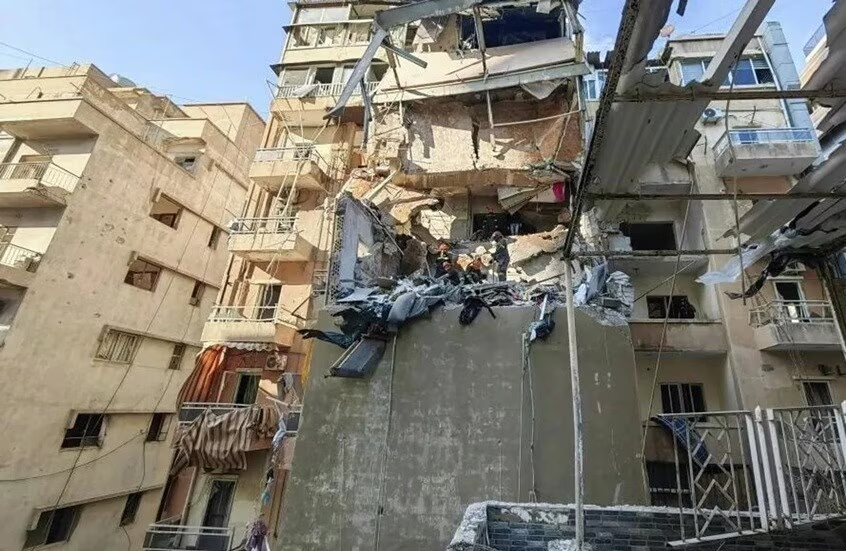
However, this diplomatic movement coincides with a very harsh reality on the ground in Lebanon, where the death toll has exceeded 300 people, and the injured 1100, most of them civilians, amid widespread destruction that affected the southern suburbs of Beirut and areas in the south, and in which the Israeli occupation forces are carrying out ethnic cleansing in southern Lebanon after destroying bridges. This escalation reflects a qualitative shift in the nature of brutal Israeli military operations, both in terms of their intensity and their geographical scope, which doubles humanitarian pressures and puts any negotiation path to an early test.
In this context, indications of a divergence in the American-Israeli approach regarding the limits of de-escalation are emerging in Washington. While Israeli Prime Minister Benjamin Netanyahu adheres to his position rejecting linking the Lebanese arena to any ceasefire agreement reached with Iran, justifying this by saying that Lebanon is outside the scope of understanding, recent data revealed an American attempt to control this escalation. US President Donald Trump published a tweet on the "Truth Social" platform in which he confirmed that he had contacted Netanyahu, asking him to "de-escalate attacks on Lebanon," a reference that reflects growing concern within the US administration about the widening scope of the confrontation.
This public stance by Trump highlights a striking paradox: on the one hand, there were previous indications that Washington had given Israel something akin to a "limited green light" to continue its operations, but on the other hand, it seems that the accelerating pace of escalation and the scale of human losses pushed the White House to try to curb Tel Aviv's impulsiveness, even through direct political messages. This raises questions about Washington's ability to translate these calls into effective pressure that changes Israel's behavior on the ground.
In contrast, Netanyahu continues to pursue a dual path that combines military escalation and cautious openness to negotiation, as he announced that he had issued directives to begin direct negotiations with Lebanon "as soon as possible." This approach reflects a strategy based on using field pressure to improve negotiation conditions, at a time when he praised Lebanese Prime Minister Najib Mikati's call for disarmament in Beirut, considering that it could be an entry point for any future settlement, despite the internal political complexities surrounding this issue.
In parallel, this path is not separate from a wider regional movement, as attention turns to the upcoming talks between the United States and Iran in Islamabad, chaired by US Vice President JD Vance. These talks are seen as a test of the two sides' ability to contain tension, and perhaps pave the way for broader understandings that will be reflected in other arenas, including Lebanon.
Nevertheless, the main challenge facing the American move remains the gap between diplomatic rhetoric and the reality on the ground. The call to host negotiations, despite its importance, does not seem sufficient in the absence of decisive indications of Washington's readiness to use effective pressure tools on Israel. This weakens the image of the United States as an impartial mediator, and reinforces the impression that its move aims primarily to prevent the expansion of the crisis, not to address it fundamentally.
In contrast, the Israeli strategy based on imposing new facts on the ground entails increasing risks, as it may lead to a hardening of Lebanese positions, and perhaps to expanding the scope of the confrontation instead of containing it. Escalation, even if used as a negotiating tool, can quickly turn into a factor undermining any political path if it exceeds the limits of control.
Internally in Lebanon, the inclusion of the disarmament issue in a negotiating context under military pressure opens the door to additional complications, given the delicate political balances and thorny sovereign questions associated with this issue, which may hinder the achievement of national consensus on it in the short term.
In conclusion, the chances of success of any negotiation path seem dependent on the availability of three interrelated elements: a genuine political will on the part of the parties, effective international pressure led by Washington, and a broader framework that addresses the roots of the crisis, not just its symptoms. In the absence of that, diplomatic moves, including the upcoming meeting in Washington, may remain mere attempts to manage the crisis, not solve it.
שתף את דעתך
Trump asks Netanyahu to de-escalate attacks on Lebanon amid military escalation and new American diplomatic move