






Washington – Saeed Erikat – 9/4/2026
News Analysis
On Wednesday, the White House announced that US Vice President J.D. Vance would lead the American negotiating team in the upcoming talks in Islamabad over the weekend. This move, according to initial indications, reflects an attempt to inject political momentum into a fragile negotiating path linked to a limited-duration ceasefire. This comes after the announcement, on Tuesday-Wednesday night, of a two-week agreement to cease hostilities between the United States, Israel, and Iran, amidst an atmosphere dominated by caution and skepticism about its sustainability.
According to White House Press Secretary Karoline Leavitt, Vance, who opposed the war from its beginning and even before, will head the delegation, which also includes President Donald Trump's envoys, Steve Witkoff and Jared Kushner. The level of American representation in these talks is seen as an indicator of the seriousness of engagement, especially after previous reports suggested Vance's potential absence for security reasons, or that the meetings would take place at a different time. The administration has affirmed its confidence in the security protection arrangements for the Vice President during his visit to Pakistan.
In contrast, diplomatic leaks indicate that Tehran prefers Vance to lead the negotiation process, given its reservations about Witkoff and Kushner's performance during previous rounds, and their accusation of misrepresenting some Iranian positions. Vance is also among the few voices within the administration who have expressed reservations, according to reports, about the option of military escalation with Iran, which may explain the Iranian bet on him as a more amenable negotiating partner.
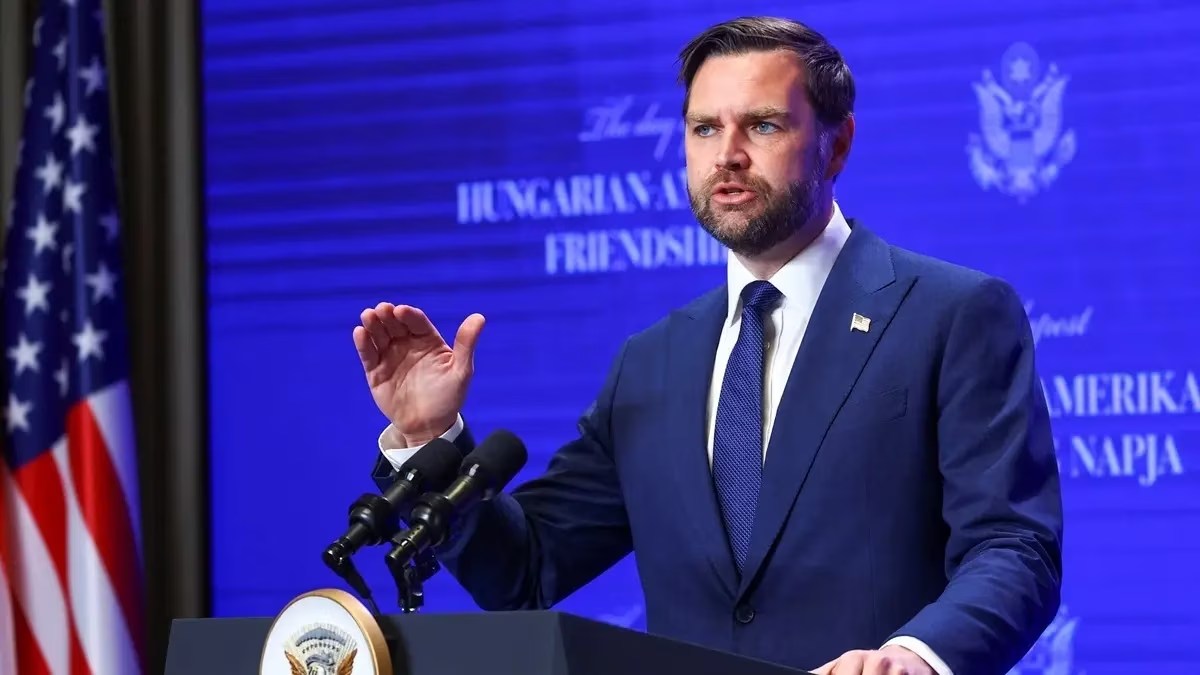
During a speech in Budapest, Vance indicated that Trump is showing impatience with the slow progress towards ending the war, emphasizing that the President has directed his team to negotiate “in good faith.” However, these positive signals coincided with adverse developments on the ground, as the ceasefire was quickly subjected to serious tests, amidst mutual accusations and violations.
Iran accused Israel of targeting oil facilities, while Gulf countries reported being subjected to drone and missile attacks by Iran on Wednesday, after a night that saw missile strikes on Israel. This mutual escalation reflects the fragility of the announced understandings and raises questions about the mediators' ability to contain the deterioration.
The issue of including Lebanon in the ceasefire agreement stands out as one of the most prominent points of contention. While Pakistani mediators indicated that the agreement extends to include the Lebanese arena, the United States and Israel categorically denied this. Vance affirmed that what he described as a “legitimate misunderstanding” led Iran to believe that Lebanon was included, stressing that the agreement focuses exclusively on Iran and Washington's allies, specifically Israel and the Gulf states.
Despite Vance's talk of Israeli readiness to show some restraint in Lebanon in support of the negotiations, no clear field indications of this have emerged, as southern Lebanon witnessed a significant escalation in Israeli strikes. Vance considered that Iran's linking the fate of the negotiations to the situation in Lebanon remains an “option” taken by Tehran, in a reference to Washington's rejection of expanding the negotiation framework.
On another note, Iranian Parliament Speaker Mohammad Bagher Ghalibaf escalated his rhetoric, accusing the United States of violating three provisions of a ten-point Iranian proposal, presented as a basis for a long-term agreement. These provisions, according to the Iranian narrative, included the ceasefire covering Lebanon, preventing the penetration of Iranian airspace, and recognizing Tehran's right to enrich uranium.
While Trump had previously announced his acceptance of the Iranian proposal as a basis for negotiation, Washington later confirmed that the version published in Iranian media did not reflect the actual submitted formula, without revealing its details. This discrepancy reflects a persistent trust gap, explicitly pointed out by Ghalibaf, who considered the United States' record of “violating commitments” justifies Iranian suspicions.
For his part, Vance tried to downplay the importance of the differences, considering that focusing on three points of contention might mean a broader common ground. However, he stirred controversy by questioning the accuracy of Ghalibaf's understanding of some elements of the proposal, a comment that could be seen as further complicating the negotiating atmosphere.
In the same context, Leavitt described the ceasefire as a “victory” for the United States, pointing to the achievement of key military objectives, including weakening Iranian naval and missile capabilities and reducing its support for regional allies. However, she implicitly admitted that these capabilities were not completely destroyed, but rather set back years, which opens the door to varying assessments of the confrontation's outcomes.
The nature of current American moves reflects an attempt to manage the balance between escalation and containment, as Washington seeks to leverage military pressure to improve negotiation terms, without sliding into an open confrontation. However, the multiplicity of conflict paths, from the Gulf to Lebanon, makes it difficult to confine understandings to a narrow geographical framework. Moreover, the discrepancy between political rhetoric and ground realities may gradually erode trust, unless declared intentions are translated into verifiable commitments.
The selection of Vance to lead the negotiating delegation highlights an awareness within the administration of the importance of the personal dimension in managing international crises. Negotiations in such contexts do not rely solely on texts, but also on the level of trust between the parties. If it is true that Tehran sees Vance as a less hardline interlocutor, this could open a limited window for understanding, even if surrounded by internal political constraints on both sides.
The assignment of the negotiation task to Vance raises questions about the diminished roles of figures like Steve Witkoff and Jared Kushner, whose names were previously associated with Middle East files. This marginalization may reflect an assessment within the administration of their weak technical and diplomatic expertise in managing a complex conflict of this magnitude, or considerations related to the need to reset the negotiation path away from channels that proved to have limited effectiveness in previous crises.
Furthermore, the close association between some American negotiators and Israeli Prime Minister Benjamin Netanyahu raises doubts about the neutrality of American seriousness in negotiation, weakens Tehran's trust in Washington's seriousness, and reinforces the conviction that negotiations are taking place within a biased framework, especially since the United States launched a war on Iran twice while negotiating with the Witkoff-Kushner team. Therefore, the success of the diplomatic path requires demonstrating greater American independence, either by changing faces or modifying negotiation mechanisms to ensure a relative balance in the approach.
The disagreements over the provisions of the Iranian proposal reveal a deeper dilemma related to conflicting narratives, where each party adheres to a different interpretation of the same document. In the absence of full transparency, it becomes difficult to verify the validity of mutual claims, which reinforces an atmosphere of suspicion. Moreover, the introduction of sensitive sovereign issues, such as enrichment or airspace, into the core of negotiations, further complicates reaching a quick settlement, and makes any agreement vulnerable to instability at the first field test.
שתף את דעתך
Vance Leads US Delegation to Negotiate with Iran in Islamabad Amid Fragile Ceasefire Test