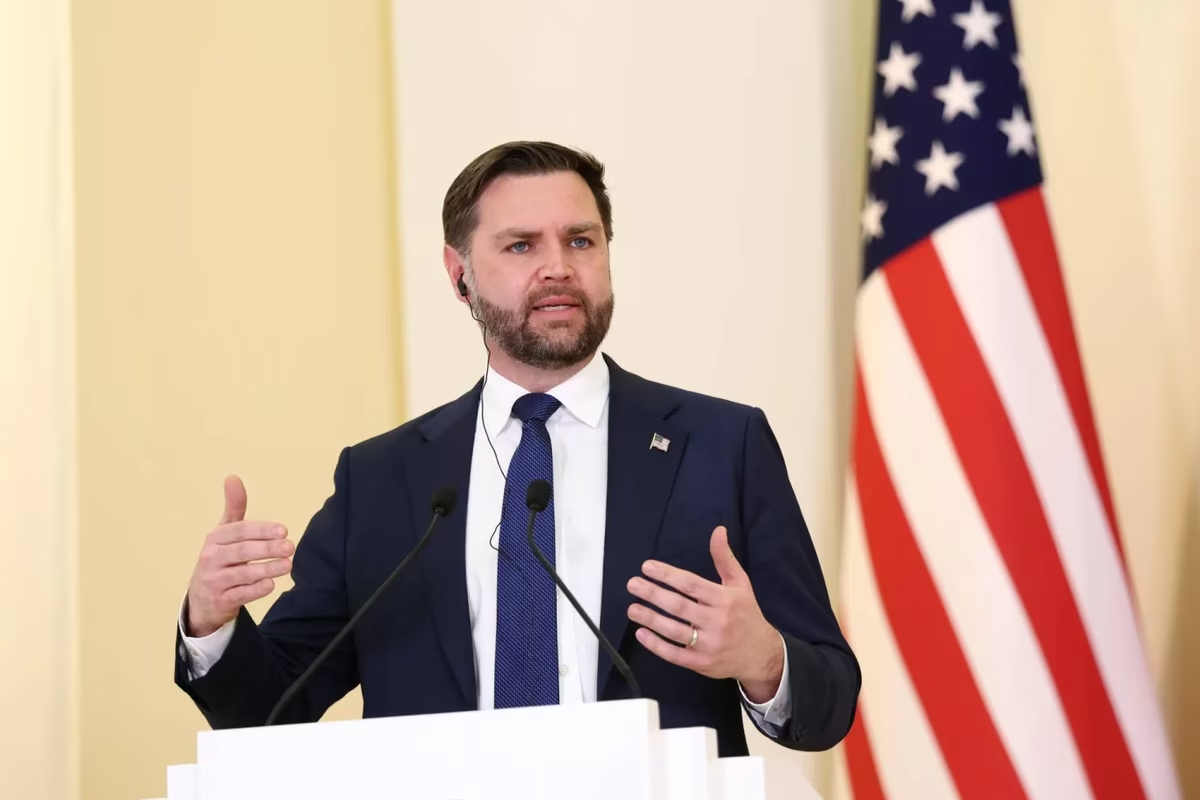







Washington – Saeed Erikat – 7/4/2026
US Vice President J.D. Vance is poised to engage in sensitive negotiations with Iran, should indirect communications pave the way for direct meetings. These back channels are currently being managed by President's Special Envoy Steve Whitkoff, with the participation of Jared Kushner, amidst predictions that Vance could be pushed to the forefront if tangible progress is made, according to Politico magazine, citing informed sources.
This arrangement reflects an attempt by the Donald Trump administration to reallocate roles within the national security team, giving Vance a prominent position in managing one of the most complex files. Despite the ambiguity of the specific demands from the Iranian side, indications suggest that Washington is seeking to test opportunities for de-escalation in parallel with continued military pressure.
White House spokeswoman Anna Kelly affirmed that the administration has an “exceptional team” including Vance and Secretary of State Marco Rubio, noting that ongoing efforts are focused on exploring the possibility of reaching an agreement. However, she simultaneously stressed that the US military would continue its operations, amid explicit threats issued by Trump to inflict widespread destruction on Iran if it did not respond to American demands within a specified timeframe.
This diplomatic movement comes at a highly sensitive moment, where signals of de-escalation intersect with potential military escalation. Secretary of Defense Pete Hegseth announced preparations to carry out “unprecedented” strikes, while Trump himself admitted the lack of clarity regarding the final path of the crisis, between containment or explosion.
Although Vance has remained relatively out of the media spotlight, he has played an active role behind the scenes, including communicating with international mediators. In this context, he contacted Pakistani Army Chief Asim Munir, coinciding with Islamabad's move to propose a 45-day ceasefire initiative, in an attempt to find a diplomatic solution to the crisis.
In parallel, Trump continued to exert public pressure, setting a deadline for Iran to reopen the Strait of Hormuz, and affirming the continuation of negotiations. He also did not hesitate to employ his usual style, publicly joking with Vance, holding him responsible for the success or failure of any potential agreement, a gesture reflecting the magnitude of the stake in his role.
Vance's involvement in this file is seen as an extension of his previous stances against what are known as "forever wars," despite his current support for military actions. The White House was keen to deny any impression of his marginalization during the early stages of the conflict, affirming his participation in intensive national security team meetings, as part of a media strategy aimed at unifying messages in a highly volatile situation.
The potential push of Vice President J.D. Vance to the forefront of negotiations reflects a striking shift in the White House's crisis management style, combining quiet back channels with escalatory public rhetoric. This apparent contradiction is not new in American politics, but it reaches its peak here with the coupling of military threat and the opening of a negotiation window. On one hand, this approach gives Washington additional leverage, but on the other hand, it creates a state of strategic ambiguity that may lead Tehran to question the seriousness of the diplomatic path, complicating the chances of reaching a quick settlement.
The Pakistani role as a potential mediator highlights the expanding circle of international actors seeking to contain the crisis, a development that reflects a growing awareness of the danger of the situation sliding towards a wider regional confrontation. However, the success of this path remains contingent on the willingness of both parties to make tangible concessions. Previous experiences indicate that mediating initiatives often clash with maximum demands, especially when coinciding with military escalation. Therefore, the Pakistani initiative may constitute an opportunity, but it is not a guarantee to stop the escalation.
Donald Trump's contradictory statements—between threatening to “send Iran back to the Stone Age” and admitting the unclear direction of the crisis—reveal a state of uncertainty within American decision-making circles. This oscillation may be a negotiating tactic, but it also carries risks of miscalculation, especially in a militarily charged environment. In this context, the role of figures like Vance becomes crucial in attempting to strike a balance between the escalatory tendency and the need for a diplomatic exit, a delicate balance that may determine the course of the crisis in the coming days.
שתף את דעתך
Vance on the Negotiation Line with Tehran: Between Diplomacy and Military Threat