






Washington – Said Arikat – 5/4/2026
News Analysis
In a striking military development that reflects the nature and complexities of modern warfare, US special forces, in close coordination with the Central Intelligence Agency (CIA), successfully carried out a high-risk rescue operation for an American pilot whose plane crashed inside Iranian territory, as reported by "The Washington Post." However, this success, presented as an exceptional achievement, opens the door to a deeper critical reading, extending beyond the operational dimension to what it reflects in terms of strategic and ethical dilemmas in conflict management.
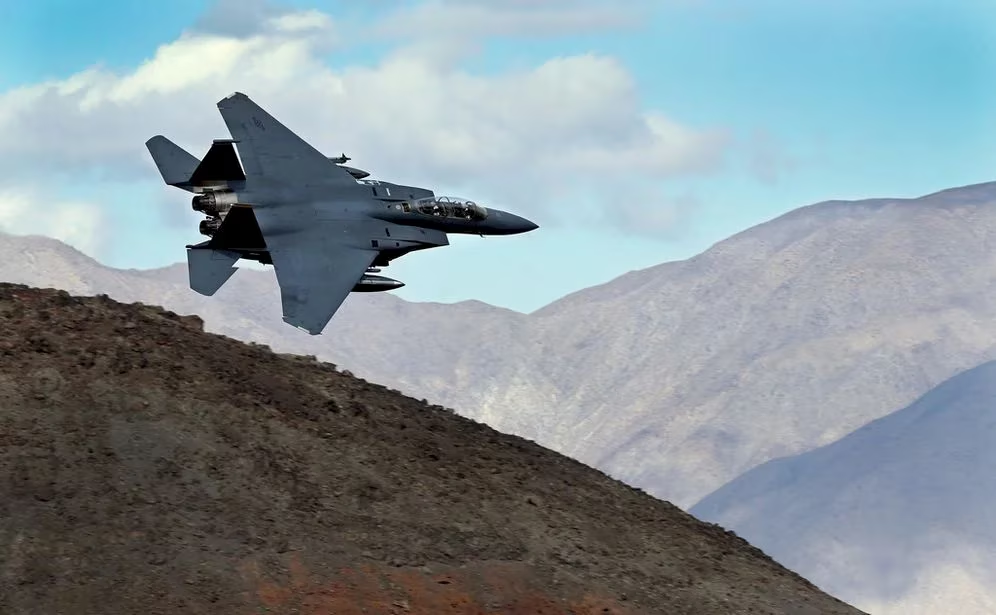
The incident began with the downing of a US F-15E fighter jet in a rugged mountainous area while it was carrying out blatant aggression in Iran, leading to the ejection of its crew. While the first pilot was quickly rescued, the weapon systems officer found himself alone, injured, and surrounded by a hostile environment, at a time when Iranian forces and local groups were combing the area in search of him. At that moment, according to experts, the issue became a race against time, not only to save an individual's life but to avoid serious political and intelligence repercussions if he were captured.
In this context, the coordination between the US military and the CIA emerged as a crucial element in managing the operation. However, this coordination was not limited to intelligence gathering but also included the use of strategic deception tools, by spreading misleading narratives within Iran claiming that the pilot had already been evacuated. This tactic contributed to diverting search efforts and gave US forces a time window to act. Yet, this approach raises questions about the limits of using deception in conflicts, especially when it becomes a central tool in managing operations, reflecting an increasing shift towards "narrative warfare" where truth itself becomes part of the battle.
In parallel, the operation relied on advanced intelligence capabilities, including surveillance, sensing technologies, and data analysis, which enabled the pilot's location to be pinpointed in a narrow mountain gorge. One official described this mission as akin to finding a "needle in a haystack," a description that summarizes the magnitude of the challenge. However, this technical superiority highlights a striking paradox: while Washington can locate an individual in complex terrain in record time, it still lacks a clear strategy to end a conflict whose scope is expanding and whose cost is escalating.
According to the newspaper, President Donald Trump issued orders to execute the "extraction" operation after confirmation, initiating the most dangerous phase. Rescue helicopters entered Iranian airspace at low altitudes, attempting to evade detection, but came under ground fire, injuring several soldiers. Despite this, forces managed to reach and secure the pilot before executing a rapid evacuation, in a scene reflecting a high level of operational efficiency and field daring.
However, this tactical success cannot be separated from its broader context. On the one hand, it provided the US administration with a moral victory amidst an ongoing war, and on the other hand, it highlighted the fragility of the strategic situation. The recovery of a single soldier, no matter how important, does not address the roots of the conflict but may be used to reinforce a narrative of military superiority, thereby justifying continued involvement in an open conflict without a clear horizon for resolution.
The operation also reveals a qualitative shift in the nature of warfare, where confrontation is no longer confined to the traditional battlefield but has extended into the information space. The disinformation campaign led by the CIA played a pivotal role in the mission's success, reflecting the growing importance of psychological operations in contemporary conflicts. However, this shift opens the door to an escalating intelligence race, which may push adversaries to develop more complex counter-methods, increasing the likelihood of escalation and making crisis containment more difficult.
Furthermore, the downing of an American aircraft inside Iranian territory, and the subsequent deep rescue operation, indicates an unprecedented level of direct confrontation between the two sides. Although the operation ended without serious losses, it raises questions about the limits of escalation and the possibilities of retaliation in a highly tense regional environment. Every such penetration could be viewed as a precedent, opening the door to reciprocal reactions that are difficult to control.
The rescue operation of the American pilot reflects a complex mix of military success and strategic confusion. It demonstrates the United States' ability to conduct precise operations in hostile environments, but at the same time reveals the limits of this capability when it comes to managing long-term conflicts. While the operation is celebrated as a heroic achievement, a critical reading places it in a broader context, where tactical successes proliferate without translating into sustainable political solutions.
Thus, the operation, with all its daring and complexity, appears to be an example of the paradox of American power in modern warfare: a superior ability to decide in the moment, versus a continuous inability to decide the course. Between these two extremes, the big questions remain unanswered, while the war continues to produce more facts that are difficult to contain or predict their outcomes.
In conclusion, President Donald Trump's discourse emerges as an additional factor complicating the picture, as it is still largely characterized by confusion and disarray, as reflected in his contradictory statements regarding the war and its objectives. While he celebrates and exaggerates military successes, he returns to affirm his desire to avoid wars or reduce foreign involvement, creating a clear gap between rhetoric and practice. This discrepancy not only weakens the clarity of US strategy but also confuses allies and gives adversaries conflicting signals, which may exacerbate miscalculation and increase the likelihood of uncalculated escalation in a highly fragile environment.
שתף את דעתך
Military Daring and Strategic Ambiguity: The Rescue of an American Pilot in Iran Reveals the Limits of Power