





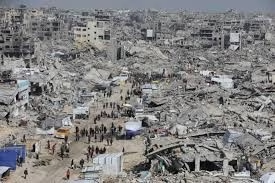
Washington – Said Arikat – 5/4/2026\n\nNews Analysis\n\nThe Middle East has witnessed profound transformations in the patterns and methods of warfare, with the emergence of a new military doctrine led by the United States and Israel, based on transferring the Gaza war model to other arenas such as Iran and Lebanon. This shift is not limited to military tools but extends to redefining the boundaries of what is morally and legally acceptable in armed conflicts, threatening to undermine the system of international humanitarian law established after World War II.\n\nThe war on Gaza represented a pivotal moment, not only because of the scale of destruction and human losses but also because it revealed a deliberate trend to normalize combat patterns based on widespread targeting of civilian areas, destruction of vital infrastructure, and the use of excessive force without adequate consideration for the principles of proportionality and distinction. With this model transferring to Iran and Lebanon, what was previously seen as a shocking exception now appears to be presented as a repeatable rule.\n\nIn Iran, data indicates an intense and unprecedented bombing campaign, targeting residential neighborhoods and service facilities, including health and educational facilities, and energy and water infrastructure. This pattern reflects an increasing reliance on heavy firepower and the use of modern technologies such as artificial intelligence in targeting, raising serious questions about the accuracy of these strikes and the limits of accountability. Moreover, targeting vital facilities, including nuclear sites, carries catastrophic risks that extend beyond the direct conflict.\n\nIn Lebanon, the same scenario is repeated, through widespread displacement of populations, systematic destruction of homes and infrastructure, in addition to targeting health workers and media personnel. These practices, which were considered grave violations of international law, are now being carried out within a political and military discourse that justifies them on security grounds, sometimes relying on controversial historical comparisons, such as the bombing of cities during World War II.\n\nThis transformation reflects, in essence, a redefinition of the concept of war itself, where the gap between military and civilian targets is narrowed, and the scope of “legitimate targets” is expanded to include essential elements of community life. The discourse accompanying these operations also indicates a noticeable decline in public commitment to ethical rules, replaced by harsher language that legitimizes violence and gives it an existential character.\n\nHowever, the most dangerous aspect of this path is its long-term repercussions. Weakening the rules of international law not only affects the victims of current wars but also opens the door for other parties to adopt the same approach, leading to a spiral of mutual escalation, where violations become justifications for counter-violations. In this context, retaliatory strikes targeting civilian structures appear to be an indicator of a rapid slide towards this scenario.\n\nWhat is happening today cannot be separated from broader transformations in the international system, where the effectiveness of multilateral institutions is declining, and unilateral tendencies are increasing, weakening mechanisms of control and accountability. In light of this reality, the danger of “generalizing the Gaza model” is not just a possibility but an existing path that is reshaping the rules of engagement in contemporary wars.\n\nIn this context, there is a clear erosion of the traditional concept of deterrence, where military force is no longer used merely to contain adversaries but to reshape demographic and political environments through widespread destruction. This shift reflects a conviction among some decision-makers that rapid decisive action requires a high human cost, which contradicts the principles humanity has sought to establish since the mid-20th century. The continuation of this approach could lead to the normalization of excessive violence as a political tool, threatening international stability in the long term.\n\nAlso noteworthy is the growing role of technology, especially artificial intelligence, in managing military operations. Despite claims of accuracy and efficiency, excessive reliance on these tools may contribute to expanding the scope of errors or reducing sensitivity to human losses, due to the distance from direct human judgment. This raises complex ethical and legal issues related to responsibility and accountability and calls for a serious international discussion about the controls on the use of these technologies in armed conflicts.\n\nGeneralizing this model of warfare not only threatens the targeted countries but also impacts global security as a whole, including the countries leading it. Undermining international rules creates a more chaotic environment where all parties become vulnerable to similar violations. Hence, restoring respect for international humanitarian law and strengthening accountability mechanisms is no longer just an ethical issue but a strategic necessity to maintain a degree of stability in an increasingly fragile international system.

א 05 אפר 2026 8:58 am - שעון ירושלים
Generalizing the Gaza Model: Towards Reshaping the Rules of War in the Middle East
שתף את דעתך
Generalizing the Gaza Model: Towards Reshaping the Rules of War in the Middle East