






Washington – Said Arikat - 4/4/2026
News Analysis
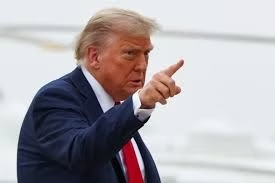
US President Donald Trump reminded Iran on Saturday that it had only 48 hours to reach a deal or open the strategic Strait of Hormuz, warning that it would face “hell” if it did not comply, in a new escalation of the crisis that has lasted over a month. Trump confirmed via the Truth Social platform that the previous deadline he announced — ten days ending on April 6 — had not resulted in any agreement, warning of striking Iranian energy infrastructure if the closure continued. This comes amid escalating military actions between the United States and Iran, where American planes were shot down over Iranian airspace, resulting in the loss of one pilot, with urgent search and rescue operations underway, indicating a serious escalation on the ground.
In a speech to the nation on April 1, 2026, Trump tried to reassure Americans that military operations were “close to completion” and that his country would continue strikes “severely in the coming weeks,” but he did not provide any timeline for ending the conflict or a clear diplomatic plan. This speech, which adopted a language of force and threat, faced a real field test after the downing of American planes, revealing a gap between Trump's statements of complete control and the reality on the ground, and confirming the limited American ability to impose quick results without direct tactical confrontation with Iran.
Trump's previous threats began on April 27, when he announced an initial five-day deadline to force Iran to open the Strait of Hormuz, as part of a maximum pressure strategy on Tehran to prevent disruption of global oil supplies. During these days, Trump reiterated his threats to strike energy infrastructure, but sometimes backed down or extended deadlines, giving a contradictory impression of the stability of American policy. The extended deadline until April 6 did not lead to any tangible results, while Trump's statements and fluctuations affected global markets, with oil prices rising sharply due to a lack of confidence in the continued stability of supplies, reflecting the economic dimensions of the US administration's actions.
The critical analysis of Trump's behavior reveals three main dimensions: First, the contradiction of political messages. While he escalates his rhetoric publicly, he sometimes tries to show diplomatic flexibility, which weakens credibility among allies and gives Iran an opportunity to exploit political vacillation. Second, clear economic repercussions on global markets, where volatile statements lead to sharp jumps in oil prices and economic fluctuations that extend beyond American borders, reflecting the absence of strategic planning beyond media rhetoric. Third, the reflection of the field reality on political discourse, as the downing of American planes and the loss of the pilot revealed a gap between the rhetoric of power and the control of American forces on the ground, raising serious questions about the feasibility of continuous escalation without a real strategy to end the war.
The analysis shows that Trump relies in managing the crisis on a mixture of military threat and media display of control, while the field results remain complex and undecided. Repeated statements about “complete control” and “the success of military operations soon” contradict the real events that witnessed direct American losses, which highlights the weak coordination between political discourse and field operations. This gap between reality and rhetoric increases international tension and places allies before the choice of carefully evaluating American credibility.
Strategically, Trump's escalation shows that the US administration faces difficulty in combining military and diplomatic pressure to achieve clear goals on the ground. The policy of deadlines and repeated threats has shown limited direct impact on Iran, as these tactics have not led to any tangible response from Tehran, which weakens the American vision for resolving the crisis. At the same time, the economic repercussions on energy markets reflect that the war is not just a military confrontation, but has global strategic dimensions that affect the economy and international politics.
In short, Trump's management of the crisis reveals a mixture of political confusion, media threats, and direct field challenges. While he seeks to show strength and control over Iran, real events prove that escalation without a clear plan to end the war leads to unexpected results and increases international risks. The analysis indicates that continuing such an approach could lead to greater escalation and increase political and economic uncertainty, placing the United States and its allies before complex strategic dilemmas, while Iran remains able to exploit any fluctuation in Trump's positions to achieve field and diplomatic gains.
שתף את דעתך
Trump's Threats and the Escalating Crisis with Iran