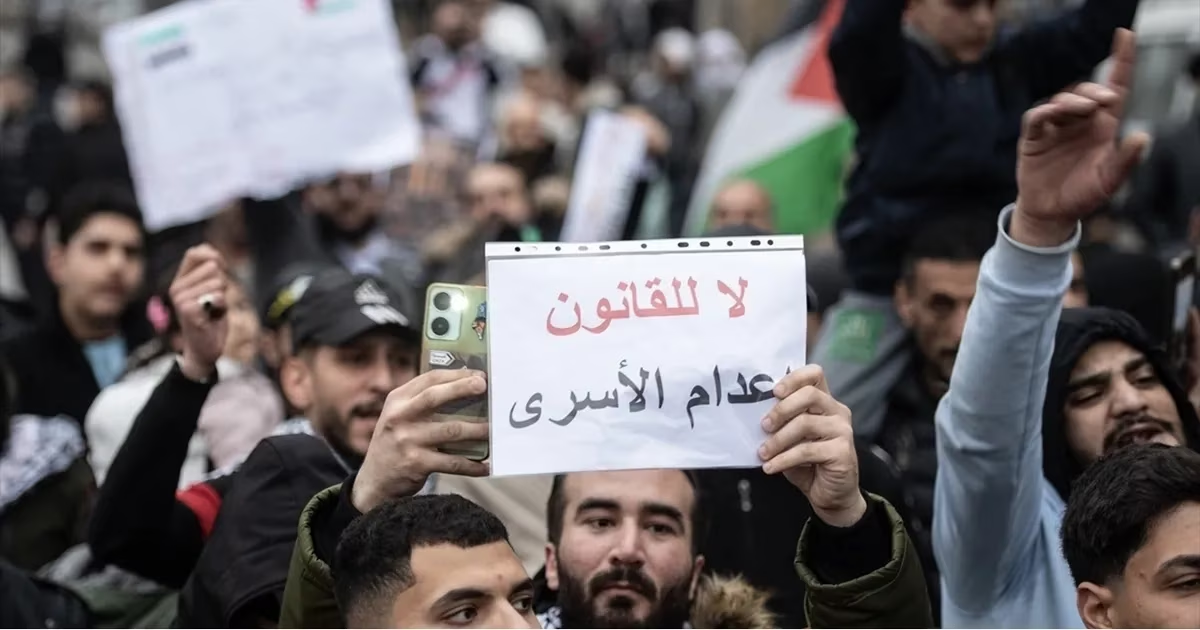







The Israeli Knesset recently approved the Palestinian prisoner execution law, a step that reflects the true face of the occupation's policies based on racial discrimination. This legislation is not merely a criminal procedure; rather, it is a political tool aimed at eliminating the Palestinian presence under flimsy legal pretexts claiming democracy.
Many countries around the world have the death penalty in their constitutions, but the Israeli case fundamentally differs from any other system. The new law is characterized by absolute selectivity, as it was specifically designed to apply to Palestinians only, even in cases where settlers commit more heinous crimes.
Israeli society lives in an unnatural state, where settlers carry out systematic daily attacks against Palestinians and their property without any legal accountability. These crimes often occur under the direct protection of the occupation army, confirming that the judicial system operates solely to serve the settlement project.
The assassination of journalist Shireen Abu Akleh stands as a living testament to the policy of impunity enjoyed by occupation soldiers. Despite overwhelming evidence, investigations were shelved and forgotten, paving the way for more legislation that legitimizes premeditated murder and abolishes the right to life.
The American stance on this law was, as usual, disappointing, with Washington considering its approval an internal sovereign matter. This support not only provides political protection for the occupation but also constitutes implicit legitimization of the grave violations committed against the Palestinian people under the guise of sovereign independence.
Internationally, condemnations poured in, describing the law as a blatant violation of international humanitarian law and human rights conventions. However, these condemnations remain mere verbal statements lacking real enforcement mechanisms capable of deterring the occupation or imposing economic and political sanctions on it.
The European Union suffers from a state of paralysis regarding decisive decisions due to the consensus mechanism that grants any member state veto power. This hesitation gives the occupation additional space to continue its repressive policies, crossing all red lines set by the international system after World War II.
The ongoing genocide in the Gaza Strip and the escalating violations in the West Bank prove that the occupation does not recognize any international legitimacy. The field practices of starvation, killing, and destruction are perfectly consistent with the racist laws enacted by the Knesset to strengthen the grip of the new fascism.
The current political identity of the occupation is based on an absolute hostile view towards everything non-Jewish, as confirmed by former Knesset officials. This vision transforms the conflict from a political struggle over land into an existential confrontation in which laws are used as tools for moral and physical extermination.
Far-right leaders, led by Itamar Ben-Gvir, celebrate this law as a victory for the approach of force and defiance of the international community. They believe that international laws do not pose an obstacle to the implementation of their plans as long as the field is under their direct military control.
The new law lacks clear definitions of what constitutes a 'terrorist act,' which opens the door wide to vague interpretations targeting all forms of resistance. Under this ambiguity, the occupation can turn any Palestinian national activity into an accusation warranting immediate execution.
Through these legislations, the occupation authorities are trying to test the will of the Palestinian people and break their spirit of resistance through extreme intimidation. However, history proves that policies of oppression and killing have never succeeded in forcing peoples under occupation to surrender.
It is clear to observers of the Israeli political scene that there is no longer a real difference between what was called right and left in dealing with Palestinians. The current competition within Israeli political society is confined to an extreme right and an even more extreme one, closing off prospects for political solutions.
Ultimately, the prisoner execution law remains one link in a long chain of Israeli attempts to end the Palestinian issue through brute force. But the bet always remains on the steadfastness of the Palestinian people and their ability to confront these unjust laws by adhering to their legitimate rights on their land.
Israeli law is not a general law, but rather exclusive legislation directed against Palestinians alone, which strips it of any normal judicial character.
שתף את דעתך
Prisoner Execution Law: Legislating Racism and Entrenching the Fascist Identity of the Occupation