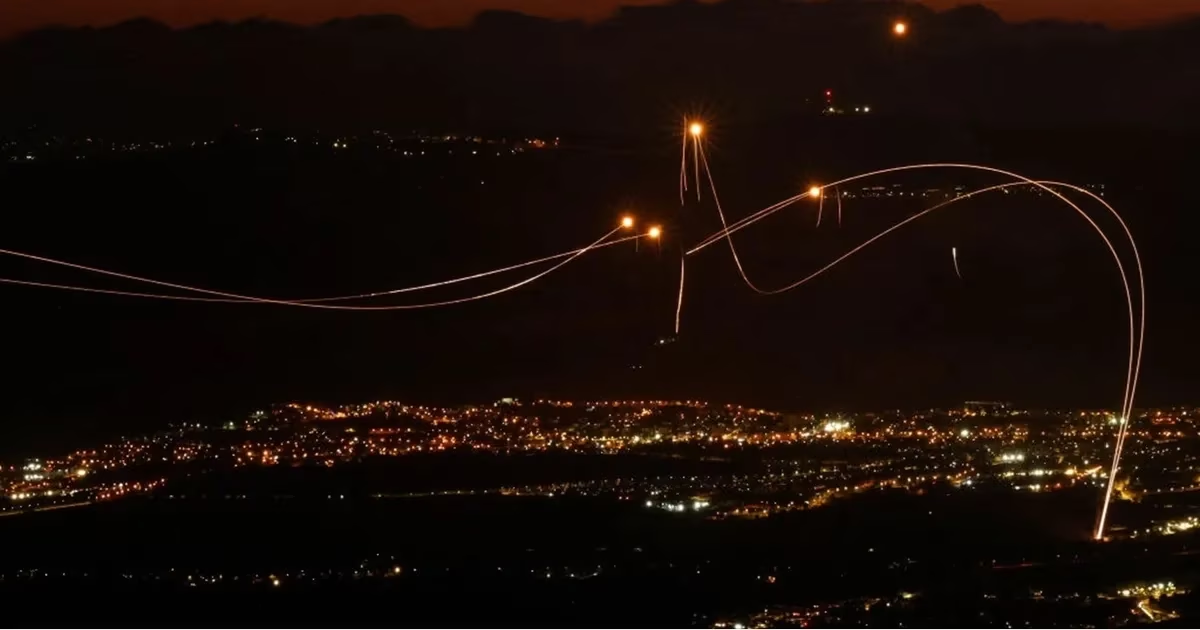







Israel faces a escalating field dilemma on the northern front, where Hezbollah rockets continue to rain down on settlements despite ongoing ground operations. Military reports indicate that the Israeli army has so far failed to neutralize Hezbollah's missile capabilities, leaving the leadership with difficult and complex strategic choices.
Yisrael Ziv, former head of the Operations Directorate in the Israeli army, believes that the Hebrew state currently stands at a fateful crossroads in its ongoing war. He affirmed that the key to resolving this multi-front confrontation lies in Washington, especially with increasing international pressure to end the protracted military operations.
Ziv warned that Iran still possesses cards of power that threaten the fate of the war, most notably the continued flow of rockets that put Israel in a long war of attrition. He also pointed to the danger of enriched uranium, which represents a long-term strategic threat that cannot be overlooked in current Israeli security calculations.
Regarding the Lebanese arena, the former military official explained that Hezbollah, despite the severe blows it has received, is still capable of disrupting the daily lives of Israelis. He considered that the party has returned to a 'guerrilla warfare' pattern after losing the characteristics of an organized army, which makes it more dangerous in direct confrontations.
Military sources warned that deep penetration into Lebanese territory could be a trap set by the party to lure Israeli forces and target them easily. Deploying large numbers of soldiers in rugged areas serves the party's cells that hide and await opportune moments to launch surprise attacks against supply lines.
Ziv touched upon the statements of the Israeli Chief of Staff regarding the heavy burden on the forces, pointing to a clear erosion in the capabilities of the fighting units. This erosion is a result of continuous fighting for long periods without achieving a decisive military resolution that ends the threat of shells and rockets from the north.
The new vision proposes the necessity of exploiting the current situation to pressure the Lebanese government and various sects to effectively disarm Hezbollah. Observers believe that any deeper penetration will not solve the problem of rockets coming from north of the Litani River, but may increase the human losses among the army.
The proposed plan includes establishing a tight defensive line on the border areas to ensure the protection of settlements from infiltration and direct threats. It also includes declaring the area extending from the Litani River southwards as a closed military zone, where any aerial or ground target will be dealt with with absolute military firmness.
In parallel, the plan calls for demanding the Lebanese government to extend its army's control over the areas north of the river to ensure that militants do not return to them. Ziv suggests training a specialized Lebanese commando brigade to dismantle Hezbollah's infrastructure, instead of relying on the current army forces, which he described as ineffective.
The proposed strategy emphasizes the importance of launching a firm international and local campaign to dry up Hezbollah's funding sources and stop its arms smuggling operations across the borders. Weakening financial and logistical resources is considered a fundamental pillar in any effort aimed at eliminating the organization's military capabilities in the foreseeable future.
The vision also indicates the necessity of opening an intensive negotiation track to achieve a political agreement with the Lebanese state, considering that the current time is optimal for achieving this goal. Such an agreement would strike a strong blow to Iran's influence in the region, which is striving to prevent Lebanon's stability away from its hegemony.
Ziv believes that the new American administration led by Donald Trump may tend to end ground operations quickly to avoid a long-term war of attrition. However, caution remains paramount regarding political fluctuations in Washington that may affect the course of military and political support for Tel Aviv.
Israel's continued state of attrition war on two or more fronts represents a major obstacle to restoring normal life and economic growth. Israeli society needs a clear time horizon for the end of military operations and the beginning of a phase of reconstruction and stabilization of security in the displaced northern areas.
In conclusion, this military reading confirms that excessive force alone may not be sufficient to sustainably end the Hezbollah threat. The combination of field military pressure, international political action, and drying up financial sources is the only way to ensure long-term security for the northern borders.
Deeping military penetration will lead to extending supply lines, and will give the party greater opportunities to inflict damage on forces without solving the problem of rocket fire.
שתף את דעתך
Failure to Stop Rockets: A Proposed Israeli Plan to Disarm Hezbollah and Dry Up Its Funding