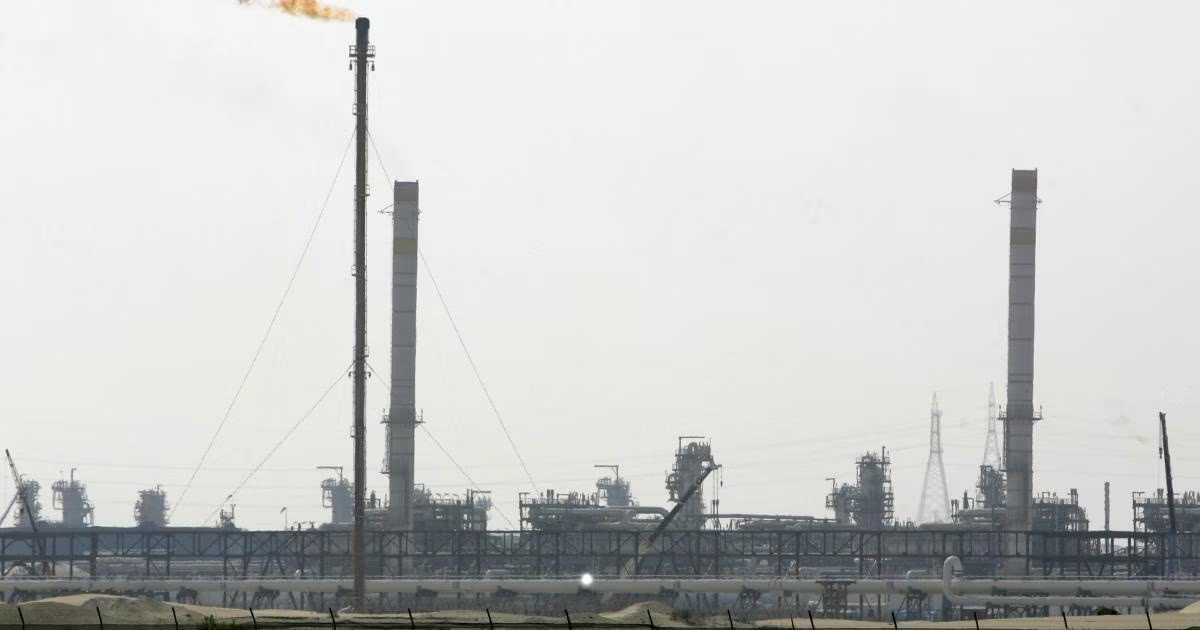







Authorities in the Emirate of Abu Dhabi announced today, Friday, that a fire broke out at the vital Habshan gas facilities, as a result of falling debris following an aerial interception operation described as successful. The Abu Dhabi Media Office confirmed that specialized teams are dealing with the incident on site, noting that precautionary measures included suspending operational activities at the facility to ensure public safety.
Official sources in the Emirate clarified that the incident did not result in any human casualties, despite the material damage to the site due to the fire. In a separate statement, authorities indicated that other debris fell in the Ajban area after air defenses confronted hostile threats, reflecting the extent of security tension witnessed in the region in recent hours.
For its part, the UAE Ministry of Interior confirmed that air defense systems effectively dealt with a missile threat targeting areas in the state. The ministry did not provide additional details about the source of the threat or the type of missiles used, merely confirming the readiness of the armed forces to protect civilian assets and economic facilities from any external attacks.
In a related context, other Gulf countries witnessed similar attacks, with Kuwait, Saudi Arabia, and Bahrain announcing that they had been subjected to barrages of missiles and drones. Sources reported that Saudi defenses managed to shoot down a drone in its airspace, while other attacks caused a limited fire in operational units belonging to the Al-Ahmadi oil refinery in Kuwait.
On the diplomatic front, the Arab Republic of Egypt reiterated its firm and supportive stance for the security of the Arab Gulf states against any external threats. The Egyptian Foreign Minister, Badr Abdel Aty, stated during his presence in Moscow that Cairo condemns in the strongest terms all attacks targeting the stability of the region, describing the attacks as unjustified and affecting Arab national security.
In an international military move, the office of British Prime Minister, Keir Starmer, announced London's decision to deploy the advanced air defense system (Rapid Centry) in Kuwait. This measure aims to enhance protection for joint British and Kuwaiti interests in the Gulf region, especially after the recent attacks that targeted oil infrastructure overnight.
The British announcement came after a phone call between Starmer and the Crown Prince of Kuwait, Sheikh Sabah Khalid Al-Hamad Al-Sabah, in which he expressed his country's full solidarity. The British Prime Minister condemned what he described as a 'reckless attack' carried out by drones, stressing that the deployment of the defense system aims to deter low-altitude aerial threats.
During the discussions, the British and Kuwaiti sides touched upon the crisis of disrupted navigation and global shipping in the strategic Strait of Hormuz. Both parties welcomed the diplomatic efforts led by British Foreign Secretary, Yvette Cooper, to develop an international plan to ensure the reopening of the vital maritime passage and secure the flow of global energy supplies away from military conflicts.
These rapid field developments come amidst a state of open warfare involving international and regional parties since late last February. The warring parties exchange missile strikes and drone attacks, resulting in civilian casualties and severe damage to economic facilities in several Arab countries that Tehran says include American interests.
Reports indicate that the current escalation represents the peak of tension in the region, as oil and gas facilities have become a direct target for military operations. International circles are concerned about the possibility of the region sliding into a wider conflict that could lead to a complete paralysis of maritime trade through the main waterways in the Middle East.
In light of this complex scene, technical teams in Abu Dhabi and Kuwait continue to work on assessing the damage and restarting the affected facilities as quickly as possible. The targeted countries affirm that they will retain the right to respond and defend their sovereignty, while global capitals await the results of diplomatic efforts aimed at de-escalating the situation and preventing a comprehensive military explosion.
All attacks against Gulf countries are reprehensible and cannot be justified under any pretext, and Egypt reiterates its condemnation of any infringement on the security and stability of the region.
שתף את דעתך
Escalation in the Gulf: Fires at gas and oil facilities in Abu Dhabi and Kuwait, Britain deploys air defenses