






International press reports have revealed the escalating scale of losses incurred by the United States as a result of its military confrontation with Iran, with damages affecting 13 American bases spread across the Middle East. Sources indicated that Washington finds itself, for the first time in decades, facing a regular army with advanced technological capabilities, rather than the irregular armed groups it is accustomed to fighting.
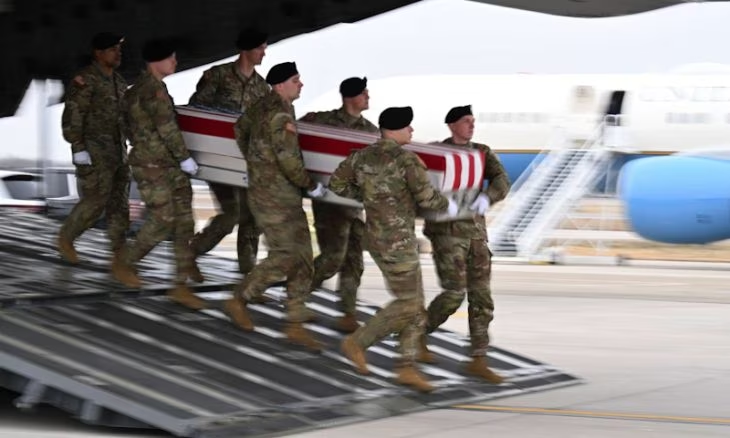
According to recorded data, the cost of material destruction after the first month of the conflict amounted to approximately $1.5 billion, while 13 American soldiers were killed and over 300 others sustained injuries of varying degrees. The US Department of Defense (Pentagon) is facing sharp criticism for what has been described as a failure to adapt to drone warfare, despite the clear lessons provided by the war in Ukraine in recent years.
Defense sources confirmed that Iranian drone swarms, especially the 'Shahed-136' suicide drone model, posed an exceptional challenge to advanced American air defense systems. Despite the deployment of the most expensive defensive systems capable of intercepting ballistic missiles, the drones repeatedly managed to penetrate these defensive layers and hit their targets with high accuracy.
Among the most prominent qualitative losses noted in the report was the destruction of an 'AWACS E-3 Sentry' early warning and control aircraft at Prince Sultan Air Base in Saudi Arabia, a rare aircraft costing $300 million. A long-range radar system in the 'Umm al-Dahl' area near Al Udeid Air Base in Qatar was also completely destroyed, a system estimated to be worth over $1 billion.
In Bahrain, attacks targeted the headquarters of the US Navy's Fifth Fleet in Manama, causing severe damage to vital radar and communication equipment. Reports submitted to Congress estimated the value of damaged equipment at this location alone to be around $200 million, reflecting the rapid financial and military attrition.
US bases in Kuwait witnessed deadly attacks, with six soldiers killed in a raid targeting a logistics center in Shuwaikh Port near Camp Arifjan. Ali Al Salem and Camp Buehring bases also suffered successive strikes that led to the disruption of communication systems and widespread destruction of administrative and military buildings.
In the UAE, Al Dhafra Air Base was a frequent target for drones, a base that houses 'F-22 Raptor' stealth aircraft. Information indicates the destruction of nine 'MQ-9 Reaper' drones belonging to the US Army in separate incidents, with each aircraft of this type costing approximately $30 million.
The bases in Jordan and Iraq were not spared from these targeting efforts, with a air defense radar system at Muwaffaq Salti Air Base in Jordan, valued at $500 million, being damaged. In northern Iraq, Erbil base, which houses special forces, is subject to continuous attacks, while US authorities are imposing a blackout on the extent of damage at Ain al-Asad base in Anbar.
Reports indicate that Russian-Iranian cooperation has further complicated the field situation for US forces, as Moscow is believed to be providing Tehran with precise coordinates of base locations. This cooperation includes monitoring the daily movements of exposed aircraft on runways, making it easier to target them before they are moved to fortified shelters or take off.
Iranian forces are using upgraded versions of drones carrying 90-kilogram warheads, capable of flying at low altitudes to avoid radars. This technology has proven effective in bypassing defensive systems installed on warships and at ground bases, putting American air superiority to a real test.
In the context of military attrition, the United States has consumed a significant portion of its strategic inventory of 'Tomahawk' interceptor and offensive missiles to counter aerial threats. Observers believe that this attrition may be a motive behind American political statements calling for a swift end to the war to avoid entering a costly, comprehensive ground operation.
Military experts believe that the US military is designed to withstand significant pressures, but the scale of the current confrontation is heavily pressing on the American defense industrial base. The need to rebuild operational capabilities and replace destroyed equipment requires time and huge budgets that may not be readily available given the current political division.
For his part, US Secretary of War, Pete Hegseth, admitted that some Iranian missiles and drones had indeed succeeded in penetrating the air defenses deployed in the region. Officials acknowledged that the numerical intensity of the attacks was greater than expected, making it difficult to intercept all hostile targets simultaneously.
In conclusion, defense advisors believe that fighting a state with a regular army like Iran requires a political strategy parallel to military performance to achieve any tangible success. Iran is conducting both symmetrical and asymmetrical battles simultaneously, utilizing multiple levels of military power and regional influence to exhaust its American adversary.
The US Department of War's failure to learn the lessons of Ukraine, particularly regarding drone warfare, is a bipartisan failure across two presidential administrations.
שתף את דעתך
Billions of Dollars in Losses and Strikes on 13 Bases.. Washington Faces a Hefty Price Tag in its Conflict with Iran