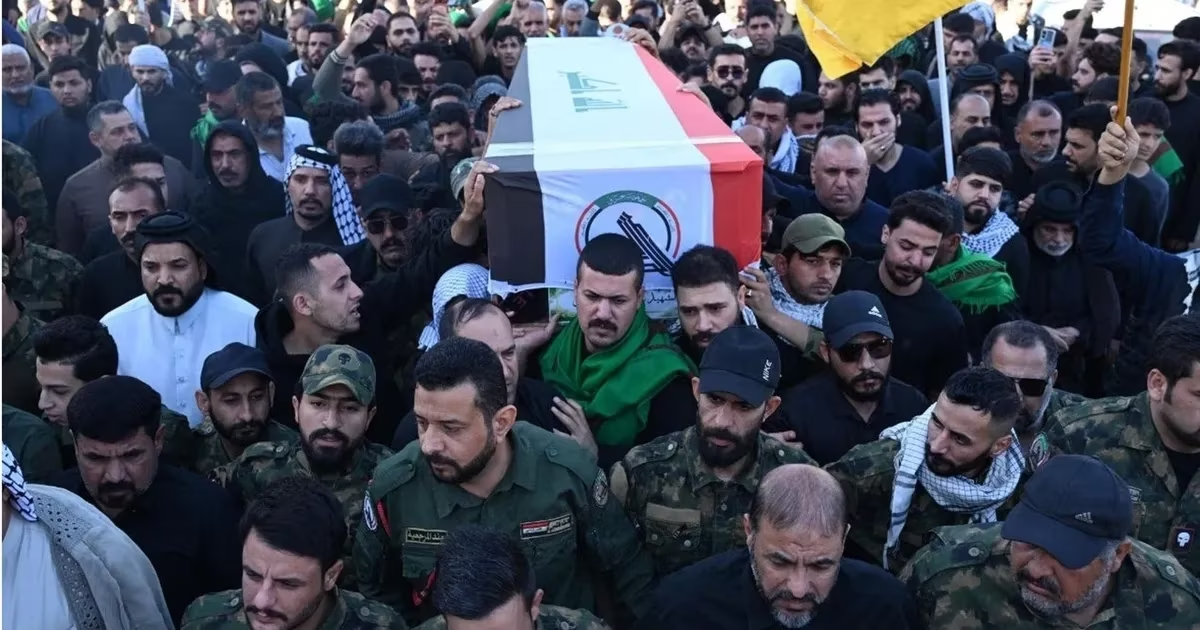







The Iraqi arena is witnessing a remarkable field escalation through almost daily airstrikes targeting sites belonging to the Popular Mobilization Forces (PMF), with these attacks notably concentrated in predominantly Sunni areas. These operations have raised questions about the strategic objectives of confining the targeting to this geography, and whether they aim to undermine the influence of factions in border cities and sensitive security areas.
In the latest field developments, the Popular Mobilization Forces mourned three of its fighters who fell in a raid it described as 'Zionist-American' targeting the 17th Brigade in the city of Rutbah in Anbar province. This attack was preceded by similar strikes that hit the 45th Brigade in the Jurf al-Sakhar area of Babil province, and the 31st Brigade in the Karma sector, reflecting the expanding scope of targeting deep in western Iraq.
Observers believe that the strategic importance of the PMF's presence in these areas lies in controlling the border crossings that connect Iraq with Syria and Jordan. These corridors are vital for transporting supplies, with sources indicating that the bombing may target qualitative weapons shipments en route to regional parties, exploiting the Syrian state's weak control over its eastern borders.
Jurf al-Sakhar in Babil province represents a special case in this conflict, described as a fortified stronghold for armed factions that regular forces find difficult to enter. Reports speak of the area containing advanced weapons factories and warehouses, and detention centers, making it a constant target for air operations aimed at dismantling the military infrastructure of pro-Iranian factions.
For its part, the 'Kata'ib Sayyid al-Shuhada' faction warned that repeated attacks in Mosul, Kirkuk, Salah al-Din, and Anbar aim to create a suspicious security vacuum. The faction called on the Iraqi government to provide security forces with advanced air defense systems to counter these violations, considering that silence on these strikes could bring back harsh security scenarios Iraq witnessed previously.
In the context of political analysis, the hypothesis of replicating the Syrian 'Idlib experience' in Sunni areas of Iraq emerges, where analysts believe Washington may seek to create new spheres of influence. This scenario assumes weakening the grip of armed factions in favor of local or international powers, within a broader vision of reshaping the political and security map in the Middle East.
The Iraqi government faces increasing pressure to identify factions it describes as 'outlaws,' a US demand that Baghdad has rejected to avoid internal conflict. This rejection comes at a time when fears are growing that the security gap resulting from the weakening of the PMF could provide a suitable environment for the return of extremist organizations that previously exploited the state of political division.
Despite continuous demands from some political forces to remove the PMF from cities, the field reality indicates significant complexities that prevent this in the short term. This issue is closely linked to the outcomes of regional conflicts and the Iraqi state's ability to impose its full sovereignty over border areas away from the influence of armed factions.
Political sources indicate that the next phase may witness shifts in the identity of components and their geographical extensions, especially in the western provinces, which are considered a strategic depth for Iraq. It is believed that there is a trend to prepare these areas to be away from conflicting regional axes, ensuring relative stability that prevents them from turning into an open war zone.
Regarding the American position, the Washington administration appears to be adopting a 'surgical pressure' strategy by targeting leaders and warehouses without entering into a comprehensive confrontation. This policy aims to reduce the factions' ability to threaten American bases in the region and compel the Iraqi government to take more serious steps in the matter of integrating weapons under state authority.
Experts believe that ruling out a complete return of ISIS may be optimistic, but the harsh experience endured by the residents of those areas makes it difficult to accept any extremist organization again. Nevertheless, the vacuum that the withdrawal of the PMF might leave without a strong security alternative remains a concern for decision-makers in Baghdad and the international community alike.
The overlap between local and regional agendas in the PMF issue makes it difficult to predict an early end to these airstrikes. While factions see them as an assault on national sovereignty, other parties view them as a necessity to reduce cross-border influence and secure vital international corridors passing through Iraqi territory.
Ultimately, the Sunni component in Iraq remains the most affected by these military tug-of-wars, as their cities turn into an arena for settling scores between major powers. The residents of these areas look forward to solutions that guarantee them security and stability away from the dominance of uncontrolled weapons or continuous aerial threats targeting their vital centers.
The question remains about the Iraqi government's ability to balance its international obligations and the pressures of internal factions, in a complex security landscape open to all possibilities. The coming days will reveal whether these strikes are merely tactical operations or part of a comprehensive strategic plan to change the rules of the game in Iraq.
The repeated targeting of the Popular Mobilization Forces in these cities may aim to create a safe zone for opposing Iraqi parties, in the context of what is called the New Middle East.
שתף את דעתך
Implications of Concentrating Airstrikes on the Popular Mobilization Forces in Sunni Areas of Iraq