







Washington – Said Arikat – 2/4/2026
News Analysis
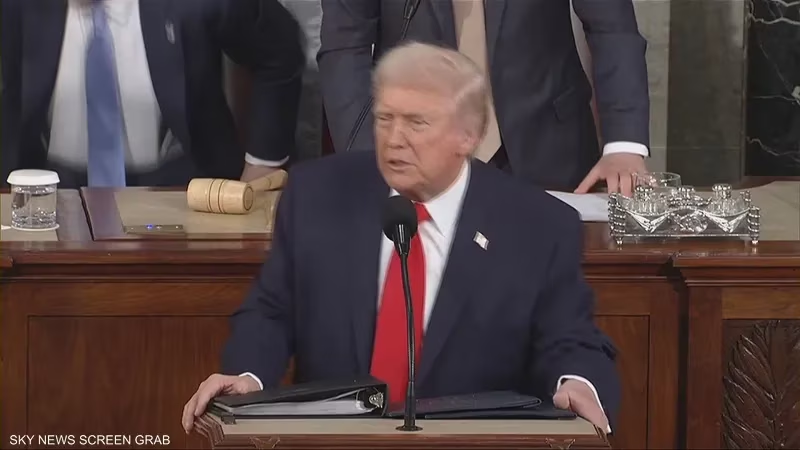
In his first address to the American nation since the outbreak of war over a month ago, President Donald Trump announced that US forces were on the verge of "completing the mission" in Iran, affirming that core strategic objectives were nearing completion. Trump offered a strong defense of the war, considering it a decisive moment to put an end to Tehran's ambitions, especially regarding its nuclear program, which Washington has long considered a direct threat.
This speech came in a context characterized in recent weeks by conflicting American messages, oscillating between talk of reducing military operations at one moment and preparing for escalation at another. Amidst continued Iranian attacks on Israel and Gulf states, and intensified airstrikes on Tehran, the speech appeared aimed at resetting the official narrative and presenting a clearer picture of the war's trajectory and its ultimate goals.
Despite this attempt, Trump reiterated many points he had previously raised in his speech, indicating that the United States was close to achieving its military objectives, and setting a timeframe for ending operations within two to three weeks. He also stressed that US forces would continue to deliver "very powerful" strikes, confirming that military decisive action remains his preferred option.
In justifying the war, Trump stated that preventing Iran from acquiring nuclear weapons was no longer just a slogan, but required actual action. He considered that US forces had achieved "swift and decisive victories" in recent weeks, criticizing the policies of previous administrations which, according to him, failed to deal with the Iranian file, and asserting that he was now working to "correct those errors" that had accumulated over decades.
On the military front, Trump painted an optimistic picture of the operations' progress, announcing the destruction of a large part of Iran's capabilities, including its navy and air force, and indicating that what remained was "easy." He also warned that any Iranian attempt to target or rebuild nuclear sites would be met with devastating strikes, under precise American satellite surveillance.
Economically, Trump acknowledged the rise in oil and gasoline prices within the United States, but described these repercussions as temporary. He affirmed that his country does not depend on oil from the Strait of Hormuz, calling on other countries to take responsibility for protecting this vital passage, with Washington ready to provide support when needed.
Regarding the nuclear file, Trump accused Tehran of continuously seeking to rebuild its nuclear program in secret locations, considering the cancellation of the previous nuclear agreement a correct decision. He also leveled sharp accusations against the Iranian regime, affirming that the United States is systematically working to dismantle its capabilities that threaten its security and the security of its allies.
In a related context, Trump's statements during a public event sparked widespread controversy when he hinted at the possibility of "seizing Iranian oil," before partially retracting, indicating that American public opinion prefers ending the war and returning home. This discrepancy in statements increased the ambiguity surrounding the true goals and limits of the war.
On the ground, the speech coincided with mutual escalation, as Iranian missiles targeted sites in Israel and Gulf states, while American strikes continued. Tehran, through its foreign minister Abbas Araghchi, also denied any request for a ceasefire, affirming that the war would continue until "the aggressor is punished."
Domestically in the US, opinion polls reflect a decline in Trump's popularity, with increasing opposition to the war and its economic repercussions. Data also showed a decrease in support for the military operation, especially among independent voters, raising questions about the speech's ability to change public mood or gain broader support.
As for global markets, Brent crude remained under pressure from volatility, with prices rising due to continued tension in the Strait of Hormuz, through which about 20% of global energy supplies pass, reflecting ongoing concern about the widening scope of the crisis and its impact on the international economy.
Trump's speech reflects a clear attempt to re-produce the narrative of "imminent decisive action," a recurring feature in American war rhetoric, where a short timeframe is used to convince the public of the utility of operations. However, this pattern often ignores the complexities of the situation on the ground, and transforms war into a technical matter capable of rapid completion, rather than an open political and strategic conflict with multiple possibilities, which may lead to a growing gap between official discourse and actual reality.
The speech is also characterized by a simplistic tendency in describing the adversary, as the Iranian regime is presented as a monolithic entity that can be easily dismantled militarily. This simplification ignores the complex structure of the state and society in Iran, and also overlooks the regional repercussions of any sudden collapse. Thus, the speech becomes more of a mobilization tool than a realistic analysis, which may weaken the ability to formulate long-term policies.
Also noteworthy is the selective use of the economic dimension in the speech; while Trump acknowledges rising prices, he quickly downplays their importance, in an attempt to contain domestic anxiety. However, this approach ignores the deep interconnectedness between geopolitical stability and energy markets, making the speech seem detached from citizens' real concerns, especially amidst continued volatility.
The discrepancy between Trump's statements about "seizing oil" and the call to end the war reveals a lack of clear strategic consistency. This contradiction not only weakens the credibility of the discourse but also raises questions about the nature of the war's true objectives: are they security-related, economic, or domestic political? Amidst this ambiguity, the speech becomes closer to a mixture of conflicting messages that are difficult to translate into a coherent policy.
It is also observed that Trump, in his address to the American nation, adopted a tone close to the Israeli approach consistently put forward by Prime Minister Benjamin Netanyahu, known as the "mowing the grass" principle, i.e., delivering periodic and intensive strikes to weaken the adversary without seeking a final resolution. This approach reflects a shift in American discourse from the logic of long-term deterrence to managing a continuous low-intensity conflict, raising questions about the horizon and limits of American strategy, and the possibility of it sliding into a permanent pattern of open confrontation.
שתף את דעתך
Trump declares war on Iran "nearing its end" and vows devastating strikes on Tehran