






Arab-Iranian relations are no longer merely a political file subject to interpretation; rather, they have transformed into a complex arena for the struggle of wills and an imbalance of trust. This comes as a result of policies that have chosen an approach of expansion and intervention at the expense of the principles of good neighborliness and respect for the sovereignty of national states in the region.
The current reality reveals a prioritization of the logic of influence over the logic of partnership, where disputes are managed through pressure and escalation tools instead of dialogue. It was hoped that Iran's civilizational weight would contribute to enhancing stability, but practical actions have led to deepening divisions in several Arab arenas.
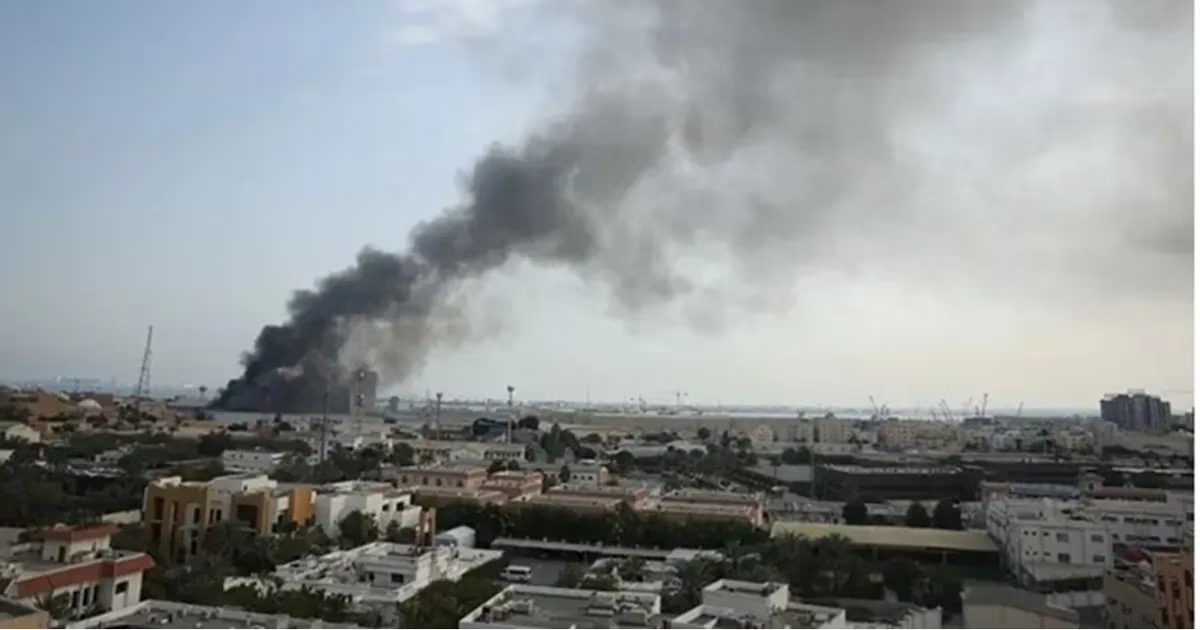
Iran's targeting of the Arab Gulf states, under the pretext of responding to American-Israeli aggression, represents a grave error from both strategic and ethical perspectives. This step reflects a flaw in assessing situations by directing weapons towards neighbors who did not participate in the ongoing conflict.
The Arab Gulf states are a space for stability in a turbulent environment, not an arena for open military conflicts. They also play a pivotal role in supporting Arab causes, foremost among them the Palestinian cause, through continuous humanitarian and developmental aid to affected populations.
Targeting these states opens the doors to discord and deepens divisions within the Islamic nation, transforming the conflict from confronting external aggression into an internal dispute. This path squanders the potential of peoples and drains their energies in battles that serve only the powers lurking in the region.
Observers recall the heavy record of Iranian interventions in countries such as Syria, Lebanon, Iraq, and Yemen, where these policies contributed to weakening national institutions. These interventions have led to major humanitarian tragedies from which the peoples of those countries still suffer the catastrophic effects to this day.
Repeating this approach at a highly sensitive regional moment reinforces the state of distrust among neighbors. Historical experiences confirm that expansionist policies cannot form the basis for a secure future or healthy relations between states.
Divine laws, foremost among them Islam, emphasize the sanctity of human life and make its preservation paramount over narrow political interests. Dialogue based on understanding and common interests remains the only way to ensure international peace and security, away from the language of violence.
The decision by the United States and Israel to wage war against Iran comes at a surprising time, coinciding with the holy month of Ramadan. This choice represents a blatant disregard for Muslim sentiments and an unjustified provocation at a time when the world was looking forward to diplomatic de-escalation.
This war lacks legal and moral legitimacy, as it came outside the frameworks of international law and United Nations institutions. The return to the logic of force and hegemony brings to mind the dark eras that preceded World War II.
Although international law guarantees the right to self-defense, this right should not be turned into a pretext for striking innocent countries. Expanding the circle of confrontation undermines opportunities for a political solution and makes the region hostage to an open escalation whose end cannot be predicted.
Amidst this escalation, Benjamin Netanyahu is exploiting regional preoccupation to continue violations against the Palestinian people in Gaza and Jerusalem. These violations have reached the point of preventing worshippers from entering Al-Aqsa Mosque, a dangerous precedent not witnessed in the city since 1967.
The double standards of international treatment of the Palestinian issue contribute to exacerbating instability. True peace cannot be achieved without respecting human rights and adhering to international laws that protect peoples under occupation.
In conclusion, security and stability in Arab countries require a comprehensive deterrent force that includes military, political, and faith aspects. Peace will only be achieved by holding aggressors accountable and preserving human dignity, for justice is the only pillar that creates sustainable security.
Directing weapons at peaceful neighbors who had no role in the conflict represents a deep flaw in assessing strategic situations.
שתף את דעתך
Regional Escalation and Targeting the Gulf: A Reading of the Repercussions of the Iranian Conflict with International Powers