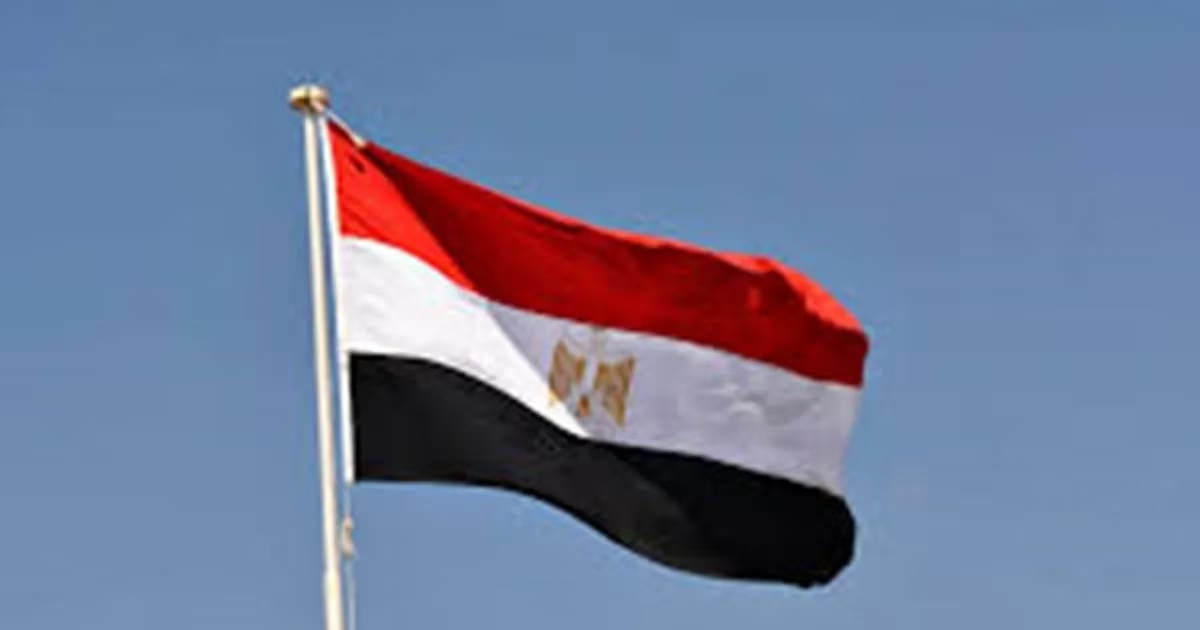







Reserve Colonel Amir Noi, former commander of the Operational Coordination Cell in the US Army, painted a bleak picture of the future challenges facing the Egyptian state in the wake of the military confrontation between Iran on one hand, and the United States and the occupation state on the other. Noi explained in an analysis published by media sources that Cairo finds itself today facing three simultaneous crises affecting the economic, political, and media sectors, which places its foreign policy under the scrutiny of regional criticism.
The economic crisis topped the list of challenges, as the war led to widespread disruptions in international trade routes passing through the Red Sea and the Bab al-Mandab Strait. This tension prompted major global shipping companies to change their routes towards the Cape of Good Hope around Africa, causing a sharp and direct decline in the revenues of the Suez Canal, which represents the main lifeline for hard currency in the country.
The analysis indicated that the Egyptian tourism sector, which is highly sensitive to any security tensions in the region, was not spared from the negative repercussions. These circumstances created a harsh paradox for the Egyptian state, which, despite its commitment to a policy of caution and non-direct involvement in military operations, is bearing the largest economic cost of the escalating regional conflict.
In a related context, the American colonel raised questions about Cairo's continued allocation of huge budgets for arms deals and military capability development despite the suffocating financial crisis. He considered that these systems, ostensibly directed towards the occupation, raise the astonishment of observers in light of an existing peace treaty, attributing this to the regime's desire to maintain the army as a fundamental pillar of state stability and its Arab standing.
On the internal political front, the report noted that President Abdel Fattah el-Sisi's regime faces increasing pressure to maintain a balance between security control and providing a minimum level of living stability. Noi warned that widening social disparities and exacerbating economic crises could turn any sudden regional shock into a fuse for internal unrest, especially with the threat of some opposition forces remaining dormant.
The analysis touched upon Egyptian-Gulf relations, indicating that Cairo relies heavily on remittances from hundreds of thousands of its workers in Gulf countries. With these countries facing direct threats from Iran and its proxies during the military campaign, Egypt's cautious stance raised questions among Gulf elites about the absence of a clear defensive position, which could in the future turn into a political pressure tool on Cairo.
Strategic experts in Cairo believe that the danger lies not only in the continued existence of the Iranian regime but also in the possibilities of its sudden collapse, which could lead to widespread chaos. Egypt fears the rise of new regional leaders who may seek to seize legitimacy by instigating additional conflicts, making the preservation of the status quo, despite its drawbacks, an Egyptian option to avoid unforeseen geopolitical shifts.
This official approach was reflected in the local media discourse, where editorials in national newspapers such as Al-Ahram focused on the need for self-restraint and preventing the region from sliding into a comprehensive war. Media messages held major powers responsible for curbing 'military adventures,' while sharply criticizing Israeli policies that contribute to expanding the scope of the conflict and threatening Arab national security.
While the world is preoccupied with the conflict between major powers and Iran, Gaza continues to suffer from the effects of widespread destruction and the spread of torn tents amidst the legendary steadfastness of Palestinian women. These analyses come at a time when Washington insists on harsh conditions towards Tehran, including the surrender of enriched uranium stockpiles and the opening of the Strait of Hormuz for international navigation under strict supervision.
The report also indicated that the Egyptian position will undergo a historical evaluation in the post-war phase, where the policy of 'caution' will be judged either as responsible diplomacy that spared the country the ravages of war, or as evidence of the decline of Cairo's regional leadership role. The balance of cost and benefit remains the primary driver for decision-makers in facing accumulated economic losses.
On the other hand, the contradiction in international positions stands out, where Trump's 'Peace Council' demands that resistance factions surrender their weapons in exchange for reconstruction, while Benjamin Netanyahu adopts an extremist discourse that sanctifies power. This complex atmosphere increases the difficulty of Egypt's task in maintaining its strategic balance between American pressures and Arab popular demands.
In conclusion, Colonel Noi affirmed that Egypt will continue to face a real test of its mental image in the Arab world, where arms deals intertwine with economic setbacks and political risks. Cairo's ability to overcome these three crises will determine its position in the new regional order currently forming amidst the explosions in the region.
Egypt did not participate directly in the war but bears its heavy economic cost as a result of the disruption of global trade routes.
שתף את דעתך
Former American Colonel: Egypt Faces Complex Crises and a Test of Its Regional Role After the War on Iran