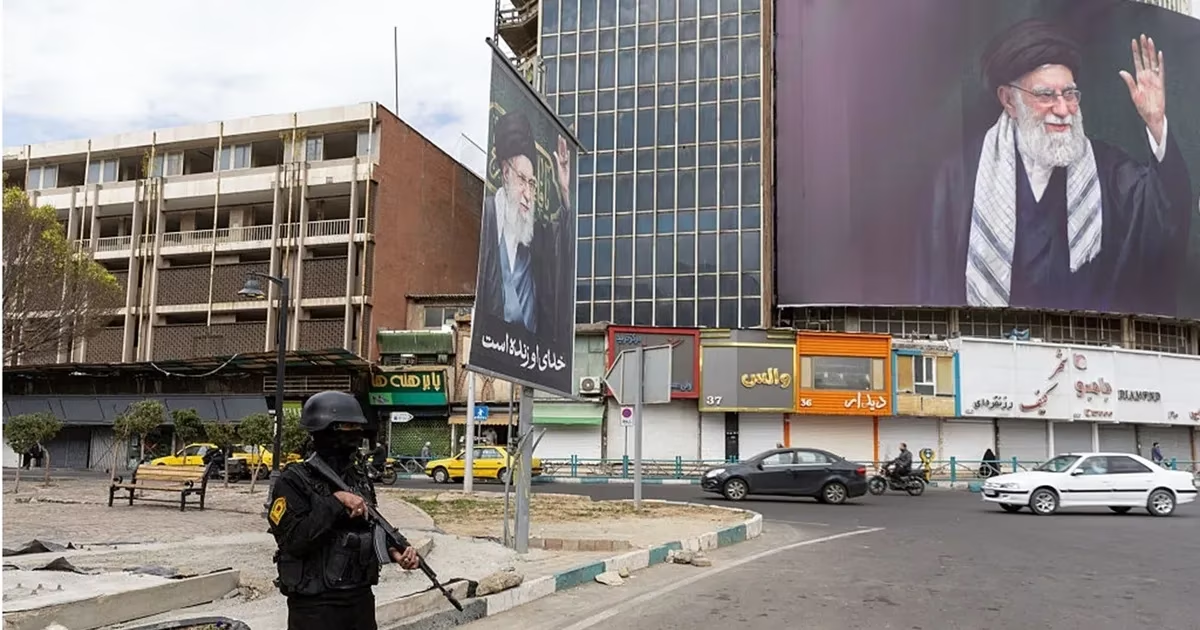







Field readings, weeks after the direct military confrontation, indicate that the bet on isolating the Iranian regime by targeting its leaders did not achieve the desired results. Tehran's organizational structure proved to possess an alternative command chain, pre-prepared to deal with emergencies and assassinations, drawing inspiration from Hezbollah's experience in rapid recovery.
The United States and Israel have so far failed to extract fundamental concessions regarding the nuclear program or to halt the production of long-range ballistic missiles. Despite intense bombardment, Tehran remains steadfast in its political and military stances, putting war planners in Washington in a predicament of a continuing war with no clear prospect of victory.
On the Lebanese front, resistance sources succeeded in drawing the occupation into significant land and air attrition to relieve military pressure on the Iranian interior. This was evident in the qualitative ambushes that targeted Merkava vehicles in the south, in addition to continuous rocket barrages that paralyzed movement in the Galilee settlements.
Iranian missiles demonstrated their superior ability to penetrate the most advanced defense systems in the world, including Iron Domes and modern American systems. These missiles reached sensitive strategic points near the Dimona reactor, prompting the Israeli leadership to admit the difficulty of the situation and describe the past nights as 'arduous'.
Official Israeli and American narratives starkly contradict the reality on the ground, as Netanyahu and Trump had previously announced the destruction of Iran's nuclear capabilities in previous rounds. However, the recurrence of war and the return to targeting the same facilities reveal the falsity of those claims and clarify that the true goal goes beyond the nuclear file to an attempt to break political will.
The issue of defending the existence of the Zionist entity emerged as a primary driver for the current American administration in this war, with Trump considering Iran an existential threat that cannot be overlooked. Nevertheless, the justifications put forward by the White House spokeswoman remained vague and undefined, reflecting confusion in determining the ultimate goals of the military operation.
For Benjamin Netanyahu, this confrontation is a fateful and personal battle, through which he seeks to escape his legal prosecutions and consolidate his political legitimacy. Netanyahu used the rhetoric of 'existential war' to justify the massive destruction and strikes that hit the Iranian interior, despite the significant risks of adverse reactions.
In contrast, Iran was able to inflict painful blows on American bases in the region, and its missiles reached the heart of Tel Aviv and vital oil facilities. The confrontation also saw a remarkable development with the withdrawal of the aircraft carrier 'Gerald Ford' from service after sustaining damage, which weakened the naval offensive capability of the coalition.
The closure of the Strait of Hormuz remains Tehran's most potent weapon, as it caused a suffocating global energy crisis that led to a crazy rise in fuel prices. Despite Washington's attempts to use its strategic reserves, the halt in the flow of Gulf oil paralyzed the major industrial countries allied with America economically.
The Strait became a political fulcrum that prompted countries such as Japan, South Korea, and Pakistan to review their positions on joining the American military alliance. These countries preferred to distance themselves from the conflict to avoid further collateral damage to their economies as a result of the cessation of navigation in this vital passage.
American rhetoric gradually began to retreat from the 'regime change' square to seeking diplomatic exits through international mediators. Trump appeared in his recent statements more inclined to talk about agreements that guarantee Iran does not possess nuclear weapons, which represents a retreat from the high demands set at the beginning of the war.
Sultanate of Oman played a pivotal role in revealing the scenes of secret negotiations, as its Foreign Minister Badr Al Busaidi confirmed that Tehran had already agreed to technical terms before the outbreak of the war. This statement embarrassed Western propaganda and showed that the military escalation was a purely Israeli desire to disrupt any potential rapprochement.
Reports indicate the involvement of Mossad in attempts to sabotage any potential de-escalation between Washington and Tehran, including the mysterious explosions that targeted oil facilities inside America. This behavior aims to keep the United States engaged in the war and prevent Trump from reaching an agreement that ends military operations before Netanyahu's goals are achieved.
The question remains about the fate of the region's countries that found themselves caught in a conflict in which they have no stake, without being part of the agreement formulation. While the major powers negotiate, these countries remain vulnerable to the economic and security consequences of the war, awaiting the outcome of the 'war of words' in upcoming diplomatic rounds.
An Iranian regime armed with long-range missiles and nuclear weapons would pose an intolerable threat to the Middle East and also to the American people.
שתף את דעתך
Tehran's Resilience and the Dilemma of Attrition: Why Did Bets on the Collapse of the Iranian Leadership Fail?