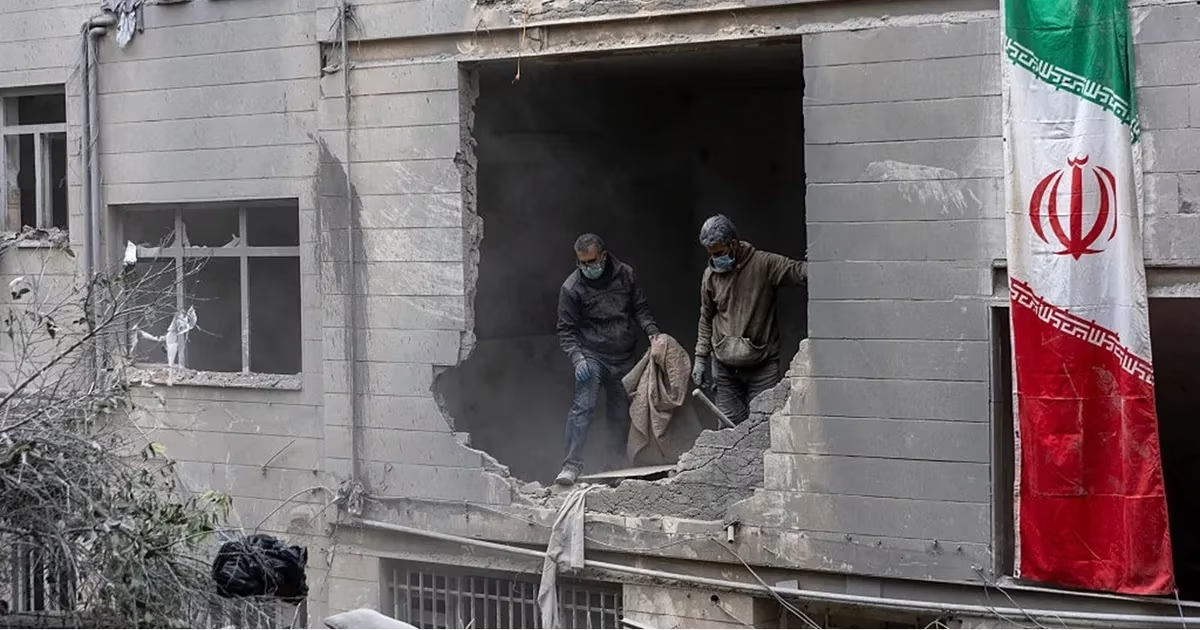







Russian press reports shed light on the underlying motives behind the Iranian leadership's rejection of all proposals put forward by the US administration under Donald Trump to reach a ceasefire. Sources indicated that Trump is trying to expand the conflict by drawing in multiple international parties, including Washington's NATO allies and countries of the Global South, to strengthen his negotiating position.
Sources stated that the US President, after his diplomatic efforts faltered, adopted a more escalatory path that included targeting high-ranking officials and launching airstrikes on various facilities. However, most international powers preferred to distance themselves from this military adventure, with the exception of some countries that had completely lost their political balance in dealing with the crisis.
Observers believe that the fundamental reason for the steadfastness of the Iranian position is Tehran's retention of its primary power cards in fortified, hard-to-reach locations. While some promote the idea of a collapse in Iranian capabilities due to a decrease in the intensity of strikes, realists believe that this calm precedes storms and unpleasant surprises for Washington and Tel Aviv.
In this context, Major General Sergei Lipovoy, Hero of the Russian Federation, confirmed that Tehran has practically announced a transition to a new phase of war characterized by long-term endurance. This strategy relies on innovative tactics and the deliberate deployment of its missile arsenal, far from the blitzkrieg approach that adversaries were betting on.
Moving towards long-term military operations imposes on the Iranian leadership a policy of rationalizing the use of specialized weapons, with a focus on accuracy. The arsenals stored deep underground are considered the trump card that ensures the continuity of Iranian military resistance for extended periods without being affected by surface strikes.
Estimates indicate that Iran possesses a huge fleet of offensive drones, numbering between ten and fifteen thousand aircraft. This unconventional air power represents a continuous threat to military bases and vital interests in the region, and acts as a long arm in Iran's deterrence strategy.
Regarding missile power, sources quoted Revolutionary Guard officials as saying that recently produced missiles have not yet entered the battlefield. Officials clarified that what has been consumed so far does not exceed 7% of the total missile stockpile, which is estimated at about one hundred thousand missiles of various ranges and destructive capabilities.
Since the first decade of the twenty-first century, Iran has begun building integrated missile cities under towering mountain ranges, reaching depths of hundreds of meters. These facilities include production lines, command and control centers, and launch platforms, making their destruction by conventional airstrikes almost impossible.
Although US intelligence is aware of the existence of these sites, the precise coordinates of their entrances and exits remain top state secrets. This operational ambiguity forms a fundamental pillar in the ability of Iranian military infrastructure to operate under the harshest conditions of intense aerial bombardment.
Western air defense systems face a significant technical challenge from Iranian missiles that reach speeds of between 4 and 5 Mach. Sources confirm that systems such as the American 'Patriot' have shown clear inability to intercept these projectiles, which sometimes carry warheads weighing more than one ton.
Military sources reported that US bases in the Middle East have undergone severe tests that proved the failure of interceptor missiles to counter precise attacks. In some cases, five interceptor missiles were launched for every attacking missile without being able to prevent it from reaching its designated target.
On the Israeli side, the 'Iron Dome' was not in a better position in confronting high-speed missiles, despite propaganda campaigns promoting its effectiveness. Israeli Prime Minister Benjamin Netanyahu acknowledged the difficulty of overthrowing the regime in Tehran by betting on popular protests, hinting at other surprises.
In contrast to Israeli claims of destroying hundreds of Iranian launch platforms, negative data emerged regarding the shrinking US aerial refueling fleet. The US Air Force lost seven Boeing KC-135 aircraft due to technical and field reasons, which weakens the air force's ability to carry out long-range missions.
In conclusion, it appears that the attack planned by the United States and Israel to be swift and decisive has turned into a mutual attrition that does not serve their interests. With Tehran continuing to conceal its true capabilities, expectations are growing that the region is heading for a confrontation that will require Washington to prepare for scenarios worse than expected.
We have not consumed more than 7 percent of our missile stockpile, while our total stockpile is estimated at about one hundred thousand missiles, and most of our modern arsenals have not been touched yet.
שתף את דעתך
Secrets of Iran's Rejection of Trump's Proposals: Underground Arsenal and Long War of Attrition