







Washington - Said Arikat - 22/3/2026
News Analysis
In a dangerous development reflecting an unprecedented escalation of tension, Iran has threatened to completely close the Strait of Hormuz, should the United States proceed with its threats to target Iranian energy facilities. This comes in response to a clear ultimatum from US President Donald Trump, who gave Tehran 48 hours to reopen the vital shipping lane for global trade.
According to Reuters, the Iranian Revolutionary Guard Corps (IRGC) confirmed in an official statement that closing the Strait would be a strong option if the energy infrastructure were subjected to any American attack, emphasizing that the response would not be limited to defense but could extend to targeting widespread economic interests. The statement clarified that companies linked to the United States could become direct targets, while energy facilities in countries hosting American bases could be considered “legitimate” targets.
The IRGC affirmed that Iran “did not start the war and will not start it,” but stressed that any aggression against its vital facilities would be met with a comprehensive response, reflecting what it described as the country’s right to defend its sovereignty and the interests of its people. These statements come in an escalating context characterized by harsh rhetoric and mutual deterrent messages, reflecting the crisis sliding into a more dangerous phase.
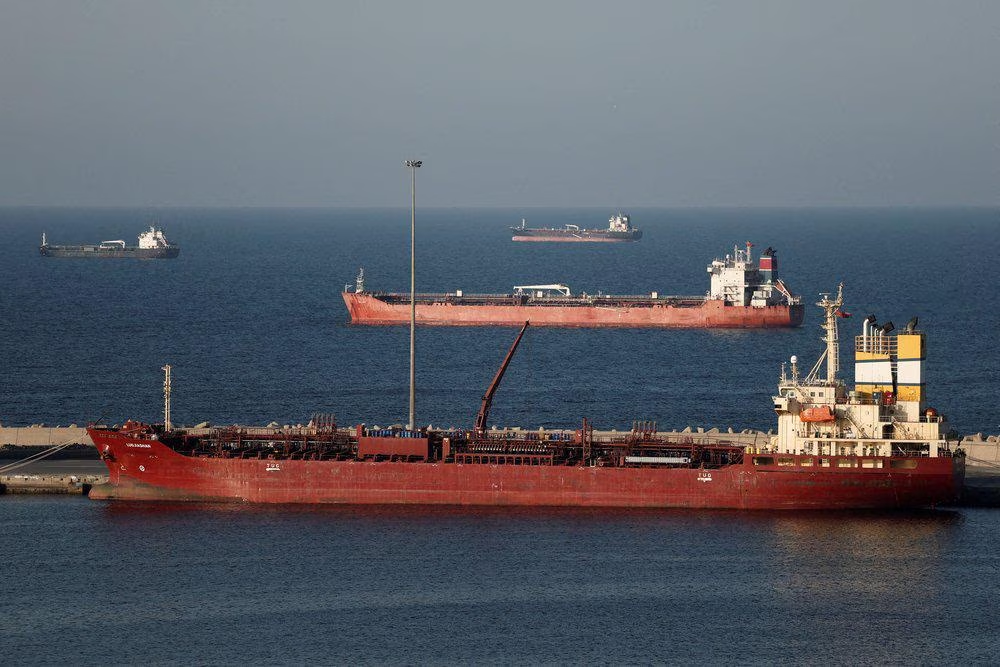
In contrast, the US President significantly escalated his tone, threatening to destroy Iranian energy facilities, starting with the largest among them, if Tehran did not commit to reopening the Strait of Hormuz. This strait is considered one of the most vital arteries in the world, as about one-fifth of global oil exports pass through it, along with large quantities of liquefied natural gas.
Field reports indicate that navigation in the Strait has already been significantly affected due to increasing security threats, leading to a decrease in the number of passing ships and a sharp rise in global energy prices. This has directly impacted American markets, where consumers have begun to feel the consequences of the crisis through rising fuel prices.
On the ground, the escalation expanded to include inside Israel, where Iran launched missiles targeting the cities of Dimona and Arad in the south of the country, in areas near the Israeli nuclear research center. According to (Israeli) reports, some missiles managed to penetrate air defense systems, leading to a large number of casualties and significant material damage.
Israeli authorities announced that about 180 people were injured as a result of the attacks, some in serious condition, while Prime Minister Benjamin Netanyahu described the situation as “very difficult,” indicating the severity and scope of the strikes. Scenes from the bombing sites showed widespread destruction, reflecting the precision of the attacks and their ability to have a tangible impact.
In the same context, Iranian officials escalated their rhetoric, with the Parliament Speaker announcing that any targeting of Iranian energy facilities would be met with an expansion of the response to include vital infrastructure in the Gulf region, threatening to turn the conflict into an open regional confrontation.
On another front, “Hezbollah” announced the execution of a series of missile attacks targeting Israeli military sites near the Lebanese border, indicating the targeting of troop concentrations in several areas. Although these claims have not been independently verified, they reflect the possibility of the confrontation widening to include more than one arena.
This multi-front escalation reflects a state of strategic fragility, where military threats intersect with complex political calculations. It also highlights the contradiction in the American position, as statements range between talk of potential de-escalation and readiness for widespread military escalation, adding an element of ambiguity to the scene.
Given these facts, the region appears to be on the brink of a comprehensive confrontation, especially with the entry of new elements into the conflict equation, such as targeting the vicinity of nuclear facilities, and expanding the scope of the threat to include regional infrastructure. It is feared that any miscalculation could lead to consequences that are difficult to contain.
The Strait of Hormuz is one of the most dangerous choke points in the global economy, and any complete disruption of its movement would lead to immediate disturbances in energy markets. The Iranian threat is not limited to being a political leverage, but represents a tool of global economic influence. Given the reliance of major countries on this passage, any closure could trigger a sharp wave of inflation and reshape international policy priorities, including alliances and alternative energy plans.
The discrepancy in American rhetoric reflects a deeper problem related to crisis management in a complex environment. Combining military threats with talk of de-escalation creates a state of strategic ambiguity, which other parties may interpret in contradictory ways. This pattern of messaging may increase the chances of misunderstanding, a factor that has historically caused the outbreak of unforeseen conflicts, especially in regions saturated with tensions such as the Middle East.
Introducing the nuclear dimension, even indirectly, raises the level of risk to a new qualitative degree. Targeting areas near sensitive facilities creates an unstable mutual deterrence, where calculations become more complex and dangerous. With the involvement of non-state actors, the likelihood of the conflict expanding horizontally increases, which could turn it into a widespread regional conflict, difficult to contain by traditional diplomatic means.
שתף את דעתך
Unprecedented Escalation: Mutual Threats Between Washington and Tehran Warn of Strait of Hormuz Closure and Widening Confrontation