






Washington – Said Arikat – 2026/3/18
News Analysis
Since its inception, Israel has not acted as a state content with defense, as it claims. Instead, its behavior has been characterized by a recurring offensive tendency, often based on interpretable pretexts to justify launching wars, with a firm understanding that the United States would provide extensive political, military, and diplomatic support. This understanding was not a minor detail; rather, it constituted a structural element in shaping its security doctrine, where the cost of military initiative decreases with guaranteed American cover, which reinforced the preference for offensive action over defensive reactions.
In this context, the insights of Professor Nathan Brown, a political science professor at George Washington University, gain particular importance, as he points to a profound shift in Israeli strategy. According to his analysis, Israel no longer operates within the mix of deterrence and diplomacy that characterized its policies for decades, but has shifted to a more rigid logic based on dominance, weakening adversaries, and preventing their recovery, instead of seeking viable settlements.
Brown believes that Israel no longer aims to end wars or produce stable political arrangements, but acts as if it has entered a phase of "permanent war," where the goal becomes managing the conflict within controllable terms, not resolving it. This reflects a transition from attempting to modify the adversary's behavior to working on dismantling its structural capabilities, militarily and politically, thereby preventing it from reconstituting itself as a threatening force.
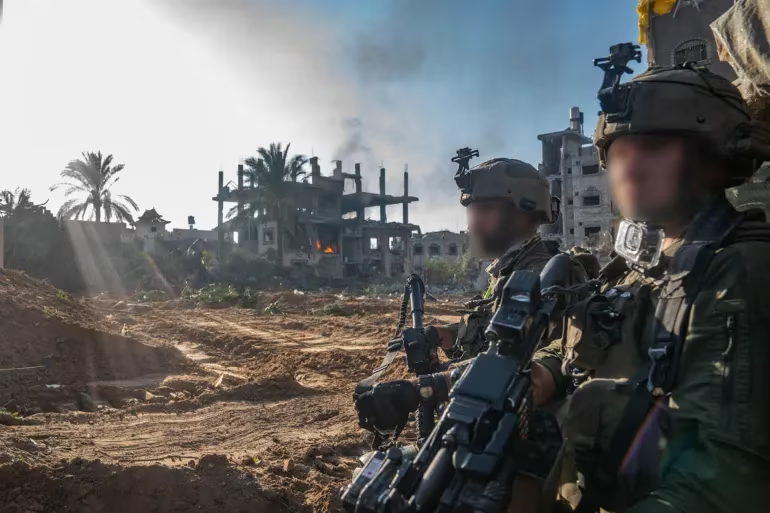
Since the attacks of October 7, 2023, the Israeli response was not merely a restoration of the logic of deterrence, but represented a departure from it. Operations have targeted civilian infrastructure, health facilities, educational institutions, places of worship, farms, water wells, and more, as part of an approach based on continuous subjugation. In this sense, war is no longer a means to impose a settlement, but a tool to manage a permanent reality of superiority and control.
Historically, Israel relied on a mix of military force and deterrence to compel its adversaries to avoid confrontation, and this approach partially succeeded with countries like Egypt and Jordan, leading to peace agreements. However, this success remained geographically limited and did not extend to the Palestinian arena, which remained the central challenge.
In the Palestinian case, the threat was not existential as much as it was political and symbolic, given the Palestinian national movement's ability to mobilize regional and international support. Therefore, Israel tried to combine deterrence and containment, benefiting from Western diplomatic cover, but this approach did not end the conflict; rather, it contributed to its transfer to more fragile arenas, such as Lebanon.
Attempts to "produce a deterrable entity" culminated in the 1982 invasion of Lebanon, but ended with counterproductive results, most notably the rise of new forces and continued instability. Even the Oslo Accords were merely a framework for managing the conflict, through a Palestinian Authority with limited powers, without addressing the roots of the issue.
In Gaza, the 2023 attacks constituted a strategic turning point, as Israel shifted from a policy of "controlled containment" to an approach seeking the complete elimination of resistance. This was not limited to the military dimension but included an attempt to dismantle the foundations of life and impose realities that push towards displacement, in parallel with accelerating steps to annex the West Bank. This occurred with the conviction that American support would remain, even if it sometimes took a cautious tone in rhetoric.
This shift was not confined to the Palestinian arena but extended to a broader regional pattern. In Syria, Israel moved beyond limited strikes to targeting deeper areas, aiming to prevent the re-formation of hostile forces. In Lebanon, the approach is repeated through an attempt to dismantle the environment supporting resistance. As for Iran, the goal is to undermine long-term strategic capabilities. Across all these arenas, the logic of reshaping the regional environment by force is being solidified, ensuring permanent superiority.
However, this strategy, despite its military successes, lacks a clear political horizon. War is no longer a means to achieve stability; rather, it has become the organizing framework for relations, pushing the region towards a sustained state of instability.
In this context, the United States appears to be a key partner in enabling this approach, as its support contributes to reducing the cost of escalation for Israel, which weakens the chances of reaching political settlements. Here lies a fundamental paradox: while Israel enhances its military superiority, it contributes to producing a more fragile and complex environment.
Brown's analysis highlights a structural shift in Israeli strategic thinking, where settlements are no longer a realistic option but a potential risk. Instead, conflict management is preferred, despite its long-term cost, which is the entrenchment of instability and the perpetuation of violence as a permanent tool.
The "prevention of recovery" approach also raises an additional problem, as dismantling adversaries does not necessarily reduce the threat but may open the door for more extremist actors. Regional experiences indicate that security vacuums are often filled by forces that are difficult to deter, turning military successes into future challenges, according to Brown.
The decline of diplomacy further complicates the scene, as the absence of a political path means that military operations do not translate into stable arrangements but into repeated cycles of violence. This places Israel's allies, especially the United States, before a strategic dilemma between continuing support or attempting to revive weak political paths.
Internally, the continuation of this approach may lead to strengthening the role of the military establishment in decision-making and a decline in political discussions, with the possibility of entrenching a permanent state of emergency. This may also strengthen the influence of hardline right-wing currents, making it more difficult to backtrack from this path in the future.
Ultimately, this strategy reveals a reality moving towards managing open conflicts instead of resolving them, raising serious questions about the future of stability in the Middle East, in the absence of a real political horizon.
שתף את דעתך
Israel's Open Wars: Deep-Rooted Aggression and a Logic of Permanent Subjugation