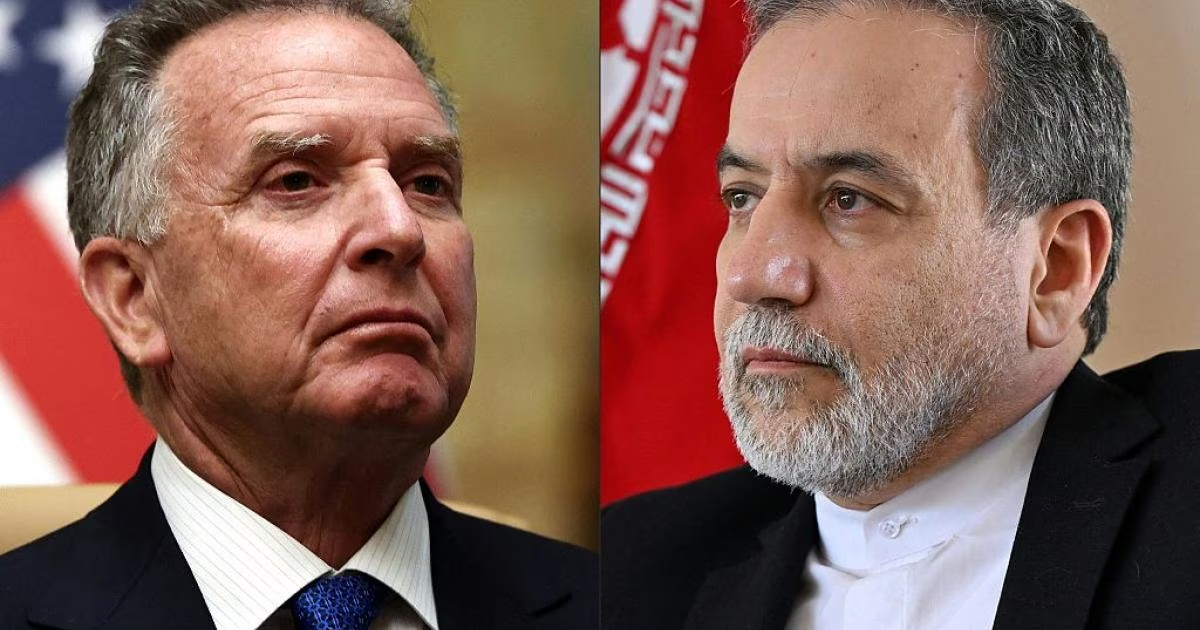







Iranian Foreign Minister Abbas Araghchi categorically denied reports of direct communication channels with the United States since the latest military escalation began on February 28. Araghchi clarified that claims promoted by Western media about an exchange of messages with the American side are unfounded and aim to manipulate global energy markets and mislead international public opinion.
In official statements, the Iranian minister indicated that the last contact with US envoy Steve Witkoff preceded the US administration's decision to launch what he described as illegal military attacks against Iranian territory. Araghchi considered this military attack a death blow to the diplomatic efforts that had been made in previous periods, emphasizing that his country does not negotiate under the weight of ongoing aggression.
In contrast, American media sources, quoting informed officials, revealed that Washington had received text messages from the Iranian side centered on mechanisms to end the ongoing war. These sources claimed that US President Donald Trump is open to reaching a comprehensive deal that would allow Tehran to reintegrate economically into the international community and benefit from its oil revenues in exchange for specific conditions.
Despite these American claims, informed sources in Tehran confirmed that the initiative for messaging came from US envoy Steve Witkoff, but the Iranian leadership made an official decision to ignore those messages and not respond to them. The sources stressed that Tehran also received messages from the White House through international mediators, but the Iranian position remained firm in rejecting any direct dialogue under the current circumstances.
Iranian sources explained that the window for direct negotiations with Washington has been completely closed by a decision from the country's supreme authorities, noting that any talk of a ceasefire is the exclusive prerogative of the Supreme Leader. They affirmed that the foreign minister or any other government official does not have the authority to make strategic decisions of this magnitude without referring to the supreme leadership that manages the confrontation file.
Regarding the field situation, Tehran informed countries that attempted to mediate for de-escalation that it would not accept any agreement that does not guarantee a complete and comprehensive cessation of American and Israeli attacks on its sovereignty. It stressed that any settlement must ensure that aggressions are not repeated, considering that current proposals do not meet the minimum legitimate Iranian demands for self-defense.
Iran is currently adopting a military strategy based on diversifying confrontation fronts and carrying out qualitative operations against American and Israeli interests over a long and unspecified period. This plan, according to sources close to decision-making circles, aims to gradually exhaust the enemy's capabilities and drain its military and economic resources through scattered and effective strikes in various spheres of influence.
The Iranian leadership believes that continuing the approach of armed resistance and directing precise strikes at the vital interests of adversaries is the only way to create suitable conditions for imposing a sustainable and just ceasefire. Tehran affirms that field pressure is the trump card that will force other parties to retreat from the policy of military escalation and recognize Iranian rights in the region.
For his part, US President Donald Trump stated that Iran appears willing to end the conflict and reach an agreement, but he expressed his confusion about who currently represents the actual decision-making authority in Tehran. Trump affirmed that the United States will not negotiate from a position of weakness and will not back down from the strategic goals that led it to enter this direct military conflict.
It is worth noting that the region has witnessed an unprecedented escalation since late February, where mutual military operations have resulted in hundreds of casualties, amid Tehran's continued use of ballistic missiles and drones to target what it describes as hostile sites. Arab countries accuse Tehran of targeting civilian objects and vital installations on their territories, which has further complicated the regional and international scene.
Any claims of communication are only intended to mislead oil traders and deceive public opinion, and the last contact with the US envoy was before the decision to launch the illegal military attack on Iran.
שתף את דעתך
Araghchi Denies Contact with Washington and Reveals Features of Iran's Exhaustion Strategy