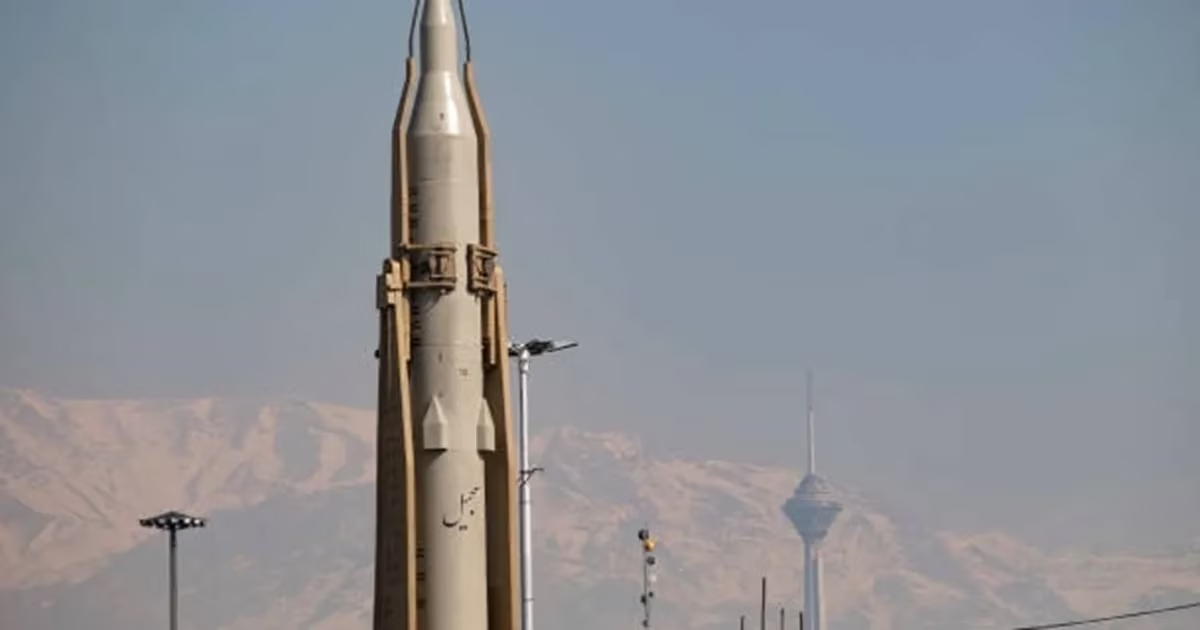







Hebrew press reports issued today, Monday, stated that Iranian forces have recently escalated the use of cluster missiles in their ongoing attacks. Sources clarified that this method relies on striking as many targets as possible indiscriminately to expand the scope of targeting.
The sources mentioned that the security establishment had detected indications of Tehran's intention to use missiles capable of carrying small, multiple munitions since the beginning of the confrontation. These developments come amidst severe warnings issued by the Home Front Command about the need for extreme caution regarding the remnants of these missiles.
Military estimates indicate that Iran has launched more than 300 missiles of various types since the outbreak of the current war. It appears that Iran's focus has significantly shifted towards missiles with split warheads, which multiply the area of surface destruction.
Media sources quoted Israeli researcher Yehoshua Kalisky as saying that the current Iranian strategy aims to cause widespread environmental and human damage. He added that these missiles do not follow the traditional point-targeting pattern but rather seek to spread panic over extended geographical areas.
Security data confirms that about half of the recent missile launches were of the split type, reflecting an Iranian awareness of their psychological and material impact. These launches occur almost daily, targeting vital and populated areas deep within.
Local authorities observed clear signs of destruction in several locations extending from the far north to the southern regions in Eilat. The scattered small bombs caused direct damage in major cities such as Tel Aviv, Lod, Ramat Gan, and Bnei Brak.
Military experts explained the mechanism of these missiles, where the warhead opens at an altitude ranging between seven and ten kilometers above the designated target. Once opened, dozens of small bombs, each weighing between two and a half to five kilograms, scatter.
The final explosion process relies on a precise trigger mechanism that activates upon impact with the ground or any solid object in the fall zone. This scattering covers a wide area, sometimes reaching a diameter of ten kilometers.
Kalisky pointed out that the distribution of these bombs does not follow a symmetrical geometric pattern but is directly affected by weather factors and prevailing winds in the upper atmospheric layers. This fluctuation in falling makes it difficult to accurately predict the exact location of each small bomb's explosion.
Sources warned that a percentage of these munitions do not explode immediately upon impact with the ground, turning them into radioactive debris and ticking time bombs. These unexploded bombs pose a grave danger to civilians, as they can explode upon human contact or movement.
Cities such as Rishon LeZion, Ness Ziona, and Be'er Ya'akov are experiencing a state of constant alert to clear sites that have seen the fall of these fragments. Engineering teams are sweeping open areas and residential buildings to ensure there are no unexploded war remnants.
Observers believe that Iran's recourse to this type of weapon represents an attempt to bypass air defense systems by overwhelming them with a large number of small targets. While the parent missile can be intercepted, the process of tracking all scattered munitions remains a significant and complex technical challenge.
In a related context, the Home Front Command confirmed that the structural damage from these bombs might be less than that of large missiles, but their danger lies in their widespread distribution. Authorities urge residents to remain in fortified areas for longer periods even after missile barrages end to ensure the stability of the field situation.
Hebrew sources concluded their report by indicating that the intensive use of this technology reflects Tehran's desire to deplete defensive resources and keep the home front on high alert. Security assessments continue to address this evolving threat that now affects most major cities.
The purpose of cluster missiles is to cause widespread environmental damage, and indiscriminate damage to a large number of targets and casualties.
שתף את דעתך
Hebrew Reports: Iran Intensifies Cluster Missile Attacks, Expands Scope of Indiscriminate Targeting