






Washington – Said Arikkat – 3/14/2026
News Analysis
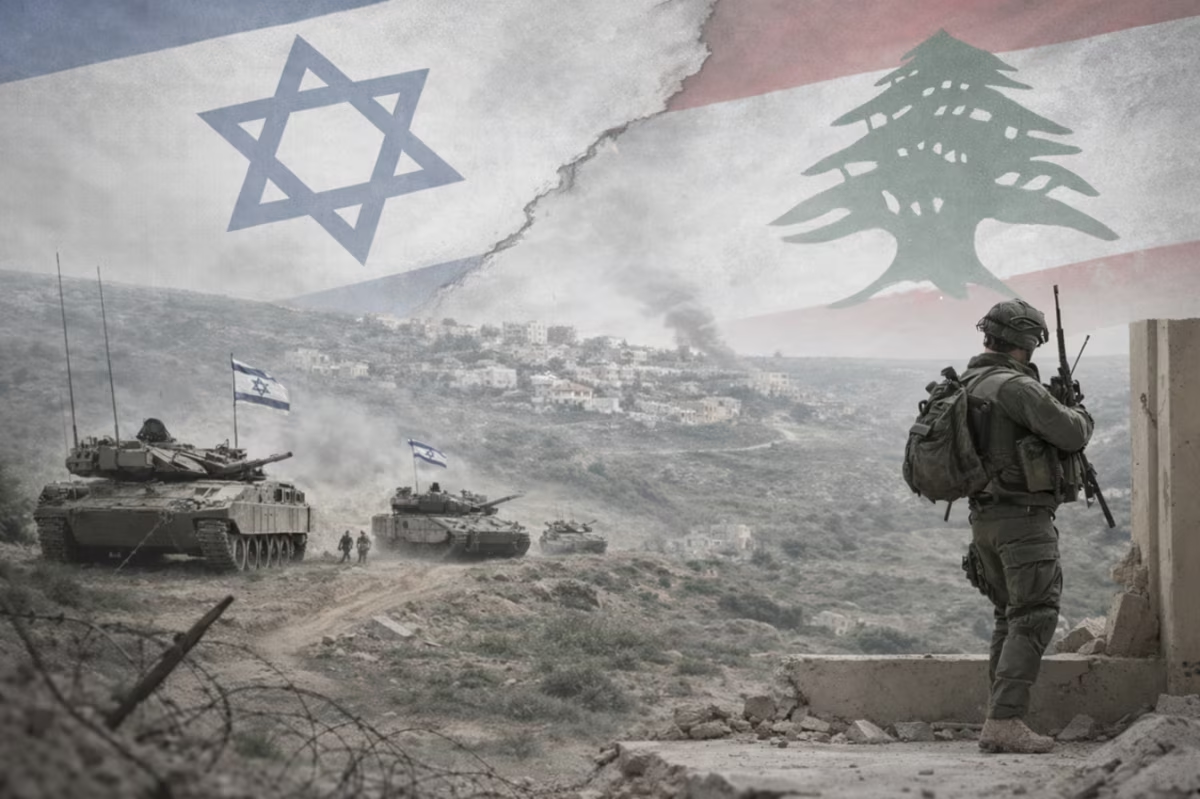
Speculation has been mounting in recent weeks about the possibility of Israel launching a large-scale ground invasion into Lebanese territory, a move that could represent the most dangerous expansion of the ongoing war in the region since the confrontation with Iran erupted in late February. American and Israeli media reports indicate accelerated military preparations on Israel's northern border, while diplomatic warnings are increasing that any major ground operation could push the region into a new phase of escalation that would be difficult to contain politically or militarily, especially given the currently very high tensions between Tehran and Washington and their allies in the Middle East.
According to what the American news website Axios reported on Saturday, citing Israeli and American officials, the plan being discussed by Tel Aviv involves expanding ground operations with the aim of controlling areas south of the Litani River and pushing Hezbollah fighters north away from the Israeli border, in addition to destroying the party's military infrastructure in southern villages. An Israeli official says that the government, led by Benjamin Netanyahu, had been inclined to contain the confrontation to focus on the Iranian front, but the launch of more than two hundred rockets from Lebanon changed calculations and pushed the military leadership to consider the option of a potential large-scale ground invasion.
Field reports indicate that since the war with Iran erupted, the Israeli occupation army has maintained large armored units and infantry forces near the Lebanese border and has carried out limited incursions into some border villages in recent weeks. On Friday, the occupation army announced the dispatch of additional reinforcements and the call-up of reserve forces in preparation for a wider operation. Officials say the immediate goal is to control the land and dismantle Hezbollah's positions and weapons depots, but observers warn that such an operation could quickly turn into a long war of attrition within the densely populated southern villages and towns.
In contrast, Hezbollah affirms its readiness to confront any potential ground invasion. Leader Naim Qassem said that Israeli threats do not intimidate the party but could turn into a military trap for the attacking forces. This stance is based on the experience of the long conflict with Israel, where the party previously managed to force the Israeli army to withdraw from southern Lebanon after years of fighting, and also engaged in a fierce confrontation in the 2006 war, which leads its leaders to believe that any new ground incursion will face violent and prolonged resistance within the party's local environment there.
Humanitarianly, the cost appears set to rise rapidly. The Israeli occupation army has issued widespread evacuation orders in southern Lebanon, which for the first time included towns north of the Litani River, in addition to areas in the southern suburbs of Beirut. Lebanese estimates indicate that about eight hundred thousand people have been forced to flee their homes, while the death toll has exceeded seven hundred people, many of whom are civilians. Humanitarian organizations have warned that the expansion of ground operations could exacerbate the humanitarian crisis in a country already suffering from a severe economic collapse and weakness in health infrastructure and basic services for many, many years.
Politically, American sources confirm that the Trump administration has asked Israel to avoid targeting Beirut airport or major government facilities, but these controls do not significantly change the reality of broad American support for the military operation. Axios quoted an Israeli official as saying that Tel Aviv feels it has full American support. Washington, at the same time, is betting that military pressure will lead to broader negotiations that may ultimately result in an agreement that officially ends the state of war that has existed between Israel and Lebanon since 1948, at least theoretically, until today.
However, developments in the regional war make these calculations extremely complex. The confrontation escalated after the assassination of Iranian Supreme Leader Ayatollah Ali Khamenei in a joint American-Israeli attack, an event that pushed Tehran and its allies to expand their military response across multiple fronts, including Lebanon, Iraq, and the Gulf. UN experts also warned that American and Israeli strikes against Iran and Lebanon could constitute a violation of international law and threaten to expand the conflict to include the entire region, especially with the threat to energy routes in the Gulf and the Strait of Hormuz, through which a large part of the world's oil passes today.
The increasing talk of a potential Israeli ground invasion of Lebanon reveals an old strategic dilemma facing Tel Aviv whenever it considers an incursion into Lebanese territory. Historical experience from the 1982 invasion to the 2006 war shows that military control does not necessarily mean achieving political or security stability; rather, occupied territories often turn into a long-term war of attrition, which Israeli military planners are well aware of. But internal political calculations and regional deterrence calculations sometimes push the Israeli leadership to risk large-scale operations despite the expected human and military cost in such a scenario.
Observers believe that the Trump administration's stance reflects a traditional pattern in American policy based on granting Israel a wide margin of military freedom of action while contenting itself with some formal controls related to infrastructure or civilians. However, this political and military support places Washington practically in the position of a partner in any potential escalation, especially if the ground invasion turns into a broader regional confrontation with Iran and its allies. At that point, the American administration may find itself facing a difficult equation that combines protecting its Israeli ally and avoiding slipping into an open war in the Middle East that may exceed its calculations.
The ongoing escalation on the Lebanese front cannot be separated from the broader war between the United States and Israel on one side and Iran on the other. The assassination of Iranian leader Ali Khamenei constituted a strategic turning point that pushed Tehran's allies in the region to direct involvement in the confrontation. Hence, Lebanon becomes a central arena in this complex conflict where local, regional, and international elements intertwine. With continued mutual strikes, the risk of the war expanding beyond the borders of Lebanon and Israel increases, threatening global energy routes and regional stability and placing the region before a new phase of long strategic uncertainty.
שתף את דעתך
Speculation Mounts Over Israeli Ground Invasion of Lebanon Amid Escalating Regional War