






The Israeli occupation army renewed its military threats against Beirut's southern suburb, issuing urgent evacuation warnings affecting seven densely populated residential neighborhoods. These threats included Haret Hreik, Ghobeiry, Laylaki, Hadath, as well as Burj al-Barajneh, Touwita al-Ghadir, and Chiyah, causing a state of panic among civilians.
An Israeli occupation army spokesperson claimed that these measures were a result of military activities carried out by Hezbollah in those areas, asserting that the army was forced to act forcefully against them. The Israeli statement demanded residents to immediately leave their homes and move to safe distances, prohibiting their return until new instructions are issued.
These field developments further complicate the humanitarian situation in Lebanon, as the number of displaced people is escalating beyond local absorption capacity. Lebanese authorities face immense challenges in securing shelter for thousands of families who have fled continuous shelling and threats in the suburb and the south.
In response to this crisis, field sources reported that the Lebanese government has begun preparing and opening approximately 100 additional shelters in various areas. This step aims to provide quick alternatives for families who found themselves homeless due to the expansion of Israeli targeting.
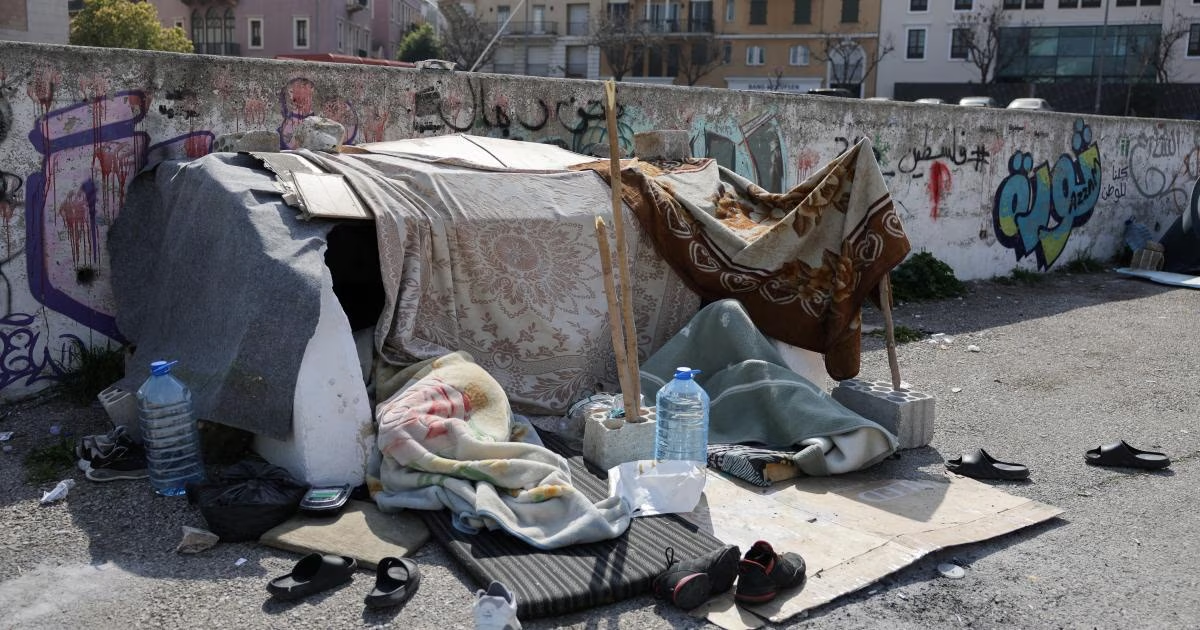
Government agencies are striving to clear public squares and main streets in Beirut and its suburbs of displaced persons' gatherings that have begun to impede traffic. This task is a primary concern for authorities attempting to maintain the flow of vital roads despite suffocating congestion and difficult security conditions.
On the relief front, informed sources described the volume of international aid reaching Lebanon as still very scarce and not meeting the minimum needs. Despite the arrival of some shipments from France, the European Union, and Jordan, the gap between available resources and increasing needs remains wide.
The Lebanese government is awaiting the arrival of additional aid promised by countries such as Qatar and Belgium, in an attempt to alleviate pressure on the health and shelter sectors. Observers believe that the international community's preoccupation with other regional issues may have contributed to the decline of the Lebanese crisis on the international priority scale.
The Lebanese government had launched an urgent appeal to the international community, demanding immediate financial support to confront the repercussions of the ongoing aggression. This appeal came during high-level meetings in which the Lebanese state affirmed its inability to face the catastrophe alone amidst the existing economic collapse.
For his part, UN Secretary-General António Guterres affirmed that Lebanon urgently needs about $350 million in emergency funding to address the displacement crisis. Guterres clarified that these amounts are allocated to secure urgent medical supplies for hospitals and to provide shelters equipped with the minimum necessities of life.
Medical needs are primarily concentrated in southern Lebanon and the southern suburb, where health facilities suffer from immense pressure and a shortage of staff and equipment. Human suffering continues to worsen as public roads turn into temporary shelters for families who could not find a place in overcrowded shelters.
Hezbollah's activities force the Israeli army to act against it with force, and residents must evacuate the areas immediately for their safety.
שתף את דעתך
New Israeli Escalation: Evacuation Warnings for Seven Neighborhoods in Beirut's Southern Suburb and Worsening Displacement Crisis