






American writer and analyst David Ignatius believes that the question of how the escalating conflict in the Middle East will end may not find a satisfactory answer in the foreseeable future, especially concerning Iran. In an article published by the "Washington Post," he suggested that the conflict might see a temporary de-escalation, including a ceasefire and the resumption of navigation in the Strait of Hormuz, but this would not end the root causes of the confrontation.
Ignatius pointed out that Iran's military power has suffered devastating blows, destroying most of its nuclear facilities, missile arsenal, and naval fleet, in addition to the elimination of several senior leaders. However, the writer believes that the Iranian regime remains standing and resilient, as deceased leaders have been replaced by others without any signs of an internal popular uprising to overthrow the authority.
The article predicted that US President Donald Trump would declare victory as usual, likening this announcement to tactical Israeli victories that failed to definitively eliminate adversaries in Gaza or Lebanon. He explained that superiority in firepower does not necessarily mean achieving political stability, citing previous American experiences in Afghanistan and Vietnam.
Ignatius warned that the United States might find itself caught in a cycle of "mowing the lawn," a term used by the Israeli occupation to describe repeated military operations that do not resolve the conflict. He emphasized that history proves that strategic bombing designed to break the will of peoples often leads to counterproductive results and increases adherence to national identity and resistance.
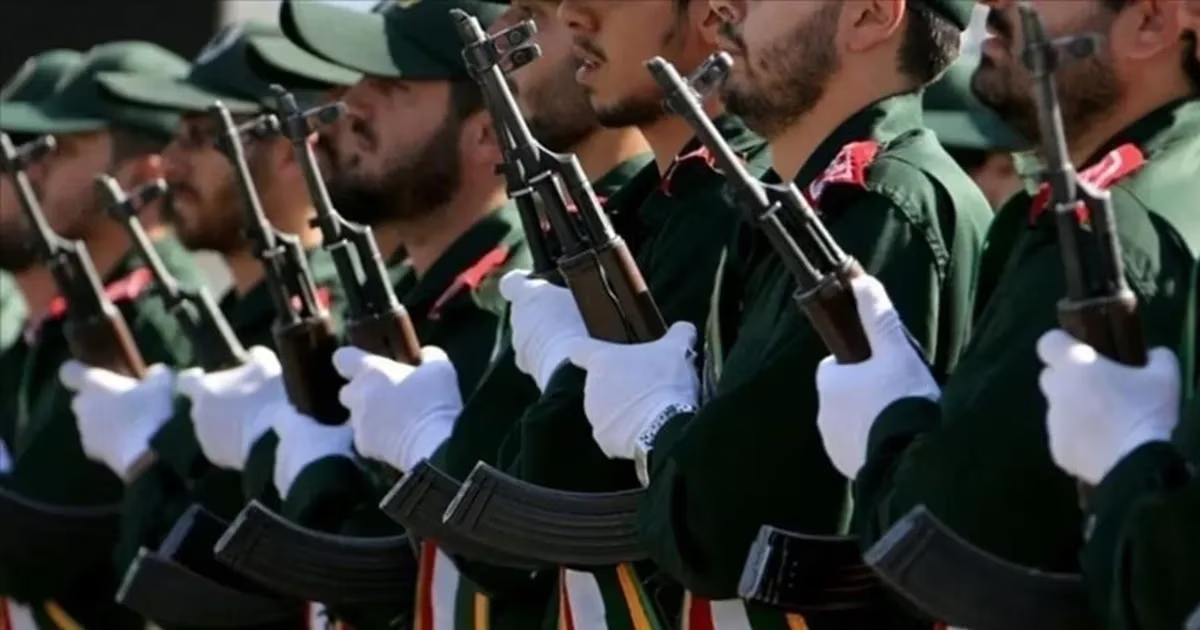
In his reading of the future of Iranian leadership, the writer indicated that the next phase might witness a shift towards a "second version" of the Islamic Republic, with the Revolutionary Guard controlling the levers of the state. He noted that the selection of Mojtaba Khamenei as his father's successor might fuel a desire for revenge, especially since he lost family members during the current war.
On the diplomatic front, Ignatius did not rule out the emergence of pragmatic figures within the Iranian regime attempting to find channels of communication with the Trump administration to alleviate pressure. However, he cautioned that this path might not meet the aspirations of popular forces who hoped for a radical change in the regime, which intelligence experts currently see as difficult to achieve.
The article quoted Gulf sources and Iranian officials confirming that Tehran's will to fight has not yet been broken, and that the regime is banking on the factor of time and the West's weaknesses. He explained that Iranians are closely monitoring American public opinion polls that show declining support for the war, which strengthens their position to continue the confrontation until their status is recognized.
The writer touched upon regional risks, indicating that Gulf countries, especially the UAE, might be forced to strengthen their independent defenses or open direct diplomatic channels with Tehran. He considered that complete reliance on the American umbrella might become costly and unreliable under Trump's policies, which tend to burden allies with financial protection costs.
Ignatius also warned of the possibility of a return of armed operations linked to Iranian networks abroad, describing this scenario as potentially more deadly than previous experiences in the Middle East. He stressed that the absence of a comprehensive political solution would make any military victory merely a temporary truce preceding a new round of violence.
The article criticized some statements made by officials in the Trump administration, such as Defense Secretary Pete Hegseth, which focus on striking Iran at its moment of weakness without considering the long-term effects. He pointed out that targeting cultural sites or civilian infrastructure could generate lasting popular anger that would be difficult to contain in the future.
Ignatius believes that the war has fundamentally changed the geopolitical reality, making a return to the pre-confrontation era impossible. He explained that the United States would have to remain on constant alert in the Gulf to ensure freedom of navigation, which contradicts Trump's desire to reduce foreign military commitments.
In concluding his analysis, the writer cited Kermit Roosevelt's memoirs about the 1953 coup, emphasizing that any real change in Iran must come from within and by the will of the people and the army. He called on the US administration to consider how to support the Iranian people instead of relying solely on military force, which has proven its limitations in achieving a decisive political victory.
Informed sources confirmed that concern prevails in decision-making circles regarding the economic consequences of continued tension in the Strait of Hormuz, despite overwhelming military superiority. Questions remain about Washington's ability to translate its field achievements into a sustainable peace agreement that guarantees regional security and definitively ends Tehran's nuclear ambitions.
The regional scene remains open to all possibilities, as American electoral calculations intertwine with the Iranian Revolutionary Guard's ambitions for survival. While Trump declares victory, on-the-ground data indicates that the confrontation has entered a new chapter of attrition warfare that could extend for many years.
If there is one lesson to be learned, it is that military success does not usually translate into political victory, as the adversary returns again and again.
שתף את דעתך
Ignatius: US Military Superiority Will Not End Conflict with Iran Soon