






Political and military circles in Israel are witnessing a remarkable shift in rhetoric regarding Hezbollah's military capabilities, following a series of qualitative attacks recently carried out by the party. Field sources reported that this development has reopened the debate within the security establishment about the accuracy of previous assessments that indicated a decline in the party's combat power.
Official Israeli assessments since the 2024 war had promoted the idea that 'Radwan Forces,' which represent the elite unit of the party, had suffered devastating blows that rendered them ineffective. These reports claimed that previous military operations, particularly what was known as the 'Pager Operation,' had led to significant paralysis in the party's command and control system.
Israeli optimism peaked with the start of the current confrontations, as officials in Tel Aviv considered the party incapable of launching large-scale attacks. This conviction was based on the nature of the initial responses, which Israel deemed limited, reinforcing the impression that the party's military arsenal had been significantly depleted.
However, these convictions began to fade after Hezbollah carried out an operation named 'Eaten Storm' last week. This operation was characterized by high coordination and simultaneous attacks launched from multiple axes, targeting wide areas in the occupied Galilee region, causing a shock in Israeli military circles.
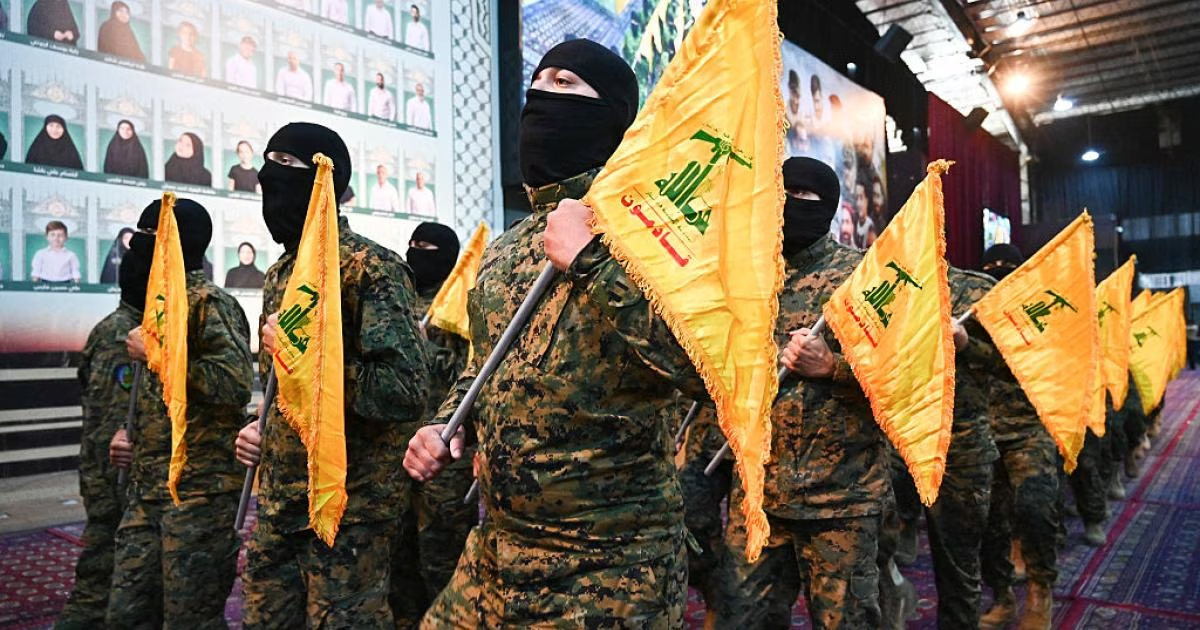
Press sources reported that recent intelligence reports showed an unexpected surprise for the security establishment, represented by the party's ability to redeploy units of the 'Radwan Regiments' in areas south of the Litani River. This information contradicts the official narrative that claimed the army's success in clearing border areas and destroying military infrastructure there.
In a related context, international media reports revealed a new Israeli approach aimed at expanding the scope of military operations deep into Lebanese territory. Sources quoted officials in Washington and Tel Aviv as saying that there is a serious study to extend the ground operation to the Litani River, under the pretext of eliminating the party's military presence there.
Data indicates that the occupation may adopt a 'scorched earth' strategy in southern Lebanon, similar to what it used in the Gaza Strip in recent months. This approach aims at comprehensive destruction of residential areas and infrastructure to ensure that military manifestations do not return to the border region, amidst warnings of catastrophic humanitarian consequences.
Domestically, criticism of the government and the army intensified from Israeli analysts and journalists who questioned the credibility of official statements. They considered that exaggerating Hezbollah's weakness was intended for domestic consumption, but the reality on the ground proved the existence of significant intelligence gaps.
On the ground, the occupation army continues its widespread aggression on Lebanese territories since the beginning of March, causing severe human and material losses. According to official statistics, hundreds of martyrs have fallen, including a large percentage of children and women, due to intensive air raids that targeted the southern suburbs, the Beqaa, and the South.
These developments coincide with a broader regional escalation that began in late February, where international powers engaged in direct confrontations. Hezbollah's response came by targeting sensitive military sites, confirming the continuation of the deterrence equation despite the fragile ceasefires that were discussed in previous periods.
Amidst the continued limited ground incursion that began on March 3, border villages are witnessing fierce clashes at point-blank range between party fighters and occupation forces. Sources confirm that the Lebanese resistance is showing great steadfastness in the face of advance attempts, which further complicates Israeli calculations for the next phase.
New field data came as a surprise to the security establishment, which had affirmed its success in keeping elite forces away from the borders.
שתף את דעתך
Operation 'Eaten Storm' Confounds Occupation's Calculations and Reveals Gaps in Northern Front Assessments