







Washington – Said Arikat – 3/14/2026
News Analysis
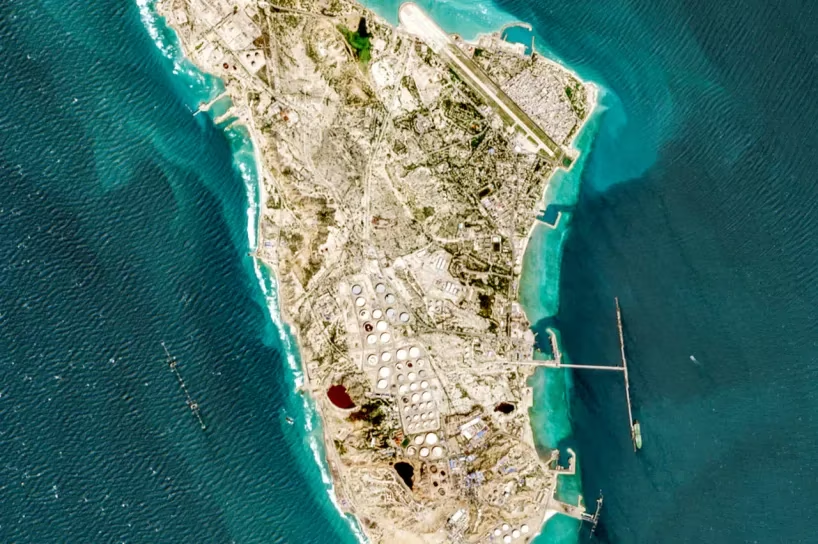
US President Donald Trump said on Friday that the US military had carried out one of the "most powerful airstrikes" in its modern history, confirming that US forces had completely destroyed "all military targets" on Iran's Kharg Island. The island is considered one of Iran's most vital economic centers, serving as the main export point for Iranian oil to global markets.
Trump explained that the military strike was precise and focused, noting that the US military refrained, "out of consideration for principles of decency," from targeting the island's oil infrastructure, even though about 90 percent of Iranian oil exports pass through these facilities.
However, the US President linked this decision to Iran's behavior in the Gulf waters, warning that Washington might reconsider exempting oil facilities if Iran or any other party obstructs international navigation. Trump wrote in a post on his "Truth Social" platform that the United States would immediately reconsider its decision if the free and safe passage of ships through the Strait of Hormuz was threatened in any way.
The targeting of Kharg Island, located in the Arabian Gulf, comes at a time when global energy markets are experiencing increasing tension since the outbreak of war on February 28. Oil prices have risen significantly amid fears that the military confrontation could turn into a direct threat to global energy supplies.
Iran had responded to the American strikes by targeting passing ships in the Strait of Hormuz, through which about 20 percent of the world's oil and gas supplies pass, which renewed international concerns about the potential disruption of one of the most important strategic energy corridors.
In a striking political development, Iran's new Supreme Leader, Mojtaba Khamenei, issued his first statement since taking office on Thursday, in which he affirmed that the Strait of Hormuz would remain closed and that Iran would continue to target US allies in the Gulf region.
In subsequent statements, Trump said that Iran "does not have the ability to defend any target Washington wishes to attack," adding that Tehran would not be able to possess nuclear weapons or threaten the United States, the Middle East, or the world. The US President also called on the Iranian army to lay down its arms, considering that this might be the only way to save what remains of the country.
For his part, US Secretary of Defense Pete Hegseth announced that US forces are preparing to carry out what he described as the "largest wave of airstrikes" over Iran and the capital Tehran since the beginning of the war.
Hegseth said during a press briefing at the Pentagon that the number of sorties and bombing waves had reached unprecedented levels, indicating that military operations are continuously escalating. He added that the US and Israeli armies have targeted more than 15,000 targets inside Iran since the outbreak of the war.
The Secretary explained that this number is equivalent to targeting more than a thousand targets daily, stressing that "no other military alliance in the world is capable of carrying out operations of this magnitude."
However, this decisive American rhetoric is met with increasing skepticism among a number of observers who believe that official statements in Washington are characterized by a degree of exaggeration in portraying the extent of military superiority and the results of airstrikes. The repeated assertion of the complete destruction of Iranian military capabilities contradicts multiple field indicators that suggest Tehran still retains effective deterrent capabilities.
In recent weeks, Iran has demonstrated the ability to carry out precise and painful strikes targeting a number of US military bases in the region, causing operational damage to some military facilities and raising the level of defensive readiness at US bases deployed in the Gulf and the Middle East.
Moreover, the Iranian response was not limited to American interests alone but extended to include strong strikes against sensitive Israeli targets. Multiple reports indicate that these attacks affected strategic facilities and vital infrastructure within Israel, causing widespread disruptions in economic activity.
According to initial estimates, the strikes led to the disruption of some ports, logistics centers, and economic facilities, causing a state of paralysis in commercial and financial sectors, and directly affecting the movement of commercial transactions.
Analysts believe that these developments reveal that the confrontation is no longer merely an American air campaign inside Iran but has turned into a multi-front regional conflict in which military considerations intertwine with economic and strategic calculations.
In this context, experts believe that the focus of American rhetoric on the idea of "overwhelming superiority" may be part of a psychological war aimed at consolidating the image of military decisiveness and enhancing deterrence. However, past experiences in Middle Eastern wars indicate that military superiority, especially in airstrikes, does not necessarily translate into rapid political results.
In asymmetric wars, weaker parties possess multiple tools for retaliation, such as ballistic missiles, drones, and targeting vital infrastructure and energy corridors. With the continued exchange of strikes in the Gulf and the Eastern Mediterranean, the war appears poised for further escalation, with all the wide-ranging repercussions this may have on the regional economy and global energy markets.
A growing number of analysts also point out that President Trump's contradictory statements, which sometimes change within a few hours, reflect a lack of real clarity in the war's objectives and strategy. Between threatening to expand strikes and sometimes calling for complete victory and a swift end to the conflict, American messages appear contradictory, which has fueled criticism within political and media circles in Washington. Some critics believe that Trump allowed Israeli Prime Minister Benjamin Netanyahu to push the United States into a wide-ranging war with Iran, which could entangle Washington in a long and complex regional quagmire from which it would be difficult to exit without significant political, military, and economic costs.
שתף את דעתך
War of Narratives in the Gulf: Washington Talks of Kharg's Destruction, Tehran Responds with Painful Strikes