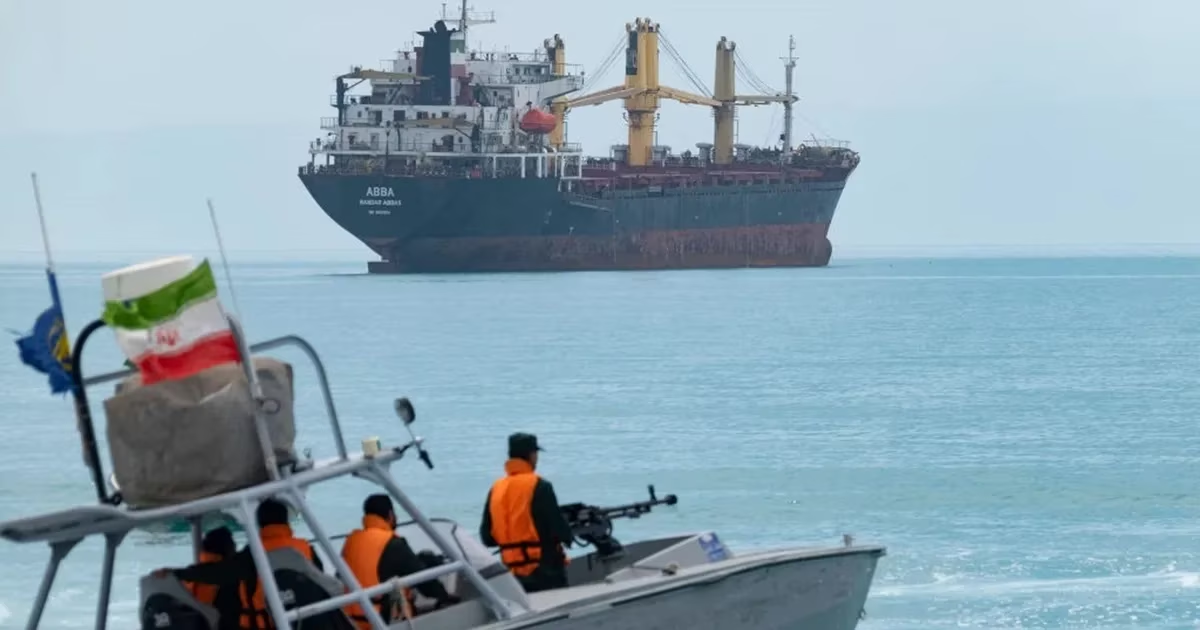







Warnings are escalating about the profound economic repercussions of the ongoing conflict in the region, as wars are no longer confined to military confrontations on the ground but have extended to impact the vital arteries of the globalized economy. Experts in shipping and logistics believe that any disruption in the maritime map, specifically in the Arabian Gulf region, will create a shock that transcends regional boundaries to affect every port in the world.
Logistics expert Raphael Ben Ari explained that global monitoring of developments with Iran tends to focus only on security aspects, ignoring a major economic drama unfolding behind the scenes. He pointed out that the Israeli reading of the scene confirms that the current escalation aims to impose a hefty global price, especially with the targeting of energy infrastructure, which is the lifeline of international trade.
The Strait of Hormuz stands out as one of the most dangerous chokepoints in the global economy, with approximately 30% of the world's oil and gas supplies passing through this narrow waterway. Sources confirmed that any actual threat to this passage immediately translates into sharp jumps in energy prices, which was clearly evident in the recent increases, reaching 20% for a barrel of oil.
Fuel prices are the primary driver of maritime transport costs, and therefore, any increase in energy prices quickly reflects on the cost of shipping goods and essential commodities. The issue is not limited to fuel prices but extends to include changing maritime routes and reassessing security risks, making the transport process more complex and costly for global companies.
After a period of relative stability and ships returning to the Suez Canal route, the current escalation has forced shipping companies to once again revert to the alternative route around Africa via the Cape of Good Hope. This alternative route significantly prolongs sea voyages and causes an increase in fuel consumption by up to 30% compared to the shorter route through Suez.
The economic equation resulting from the longer distance and higher fuel prices has led to a massive jump in transport prices, with the cost of transporting a single container from the Far East now increasing by thousands of dollars. Many global shipping lines have begun imposing additional fees under the names 'war surcharges' and 'fuel emergencies' to cope with the increasing financial burdens resulting from security tensions.
The insurance sector is one of the most sensitive elements in this crisis, as global insurance companies are reassessing the risks of sailing in areas classified as war zones. Sources reported that some reinsurance companies have begun to refrain from covering ships in the Gulf region, while other companies have raised insurance premiums tenfold their previous value.
These financial and security pressures have caused widespread disruptions in supply chains, with many shipping companies ceasing to accept transport requests destined for ports in Gulf countries. This halt has led to a backlog of shipments in alternative ports in Asia, such as Singapore, India, and Malaysia, creating a state of confusion in the flow of goods and products across continents.
The global trade system resembles an interconnected network, and any disruption at a vital point like the Arabian Gulf spreads like wildfire throughout the entire supply chain. Hundreds of ships, including giant oil tankers and container ships, are currently facing difficulties in continuing their usual routes, threatening shortages in supply and an increase in prices for the end consumer.
Despite this regional disruption, reports indicate that the Israeli occupation is trying to maintain the continuity of its commercial systems and seaports normally. The Shipping and Ports Authority continues to issue instructions to ensure the flow of goods, while customs, import, and export activities continue in an attempt to avoid complete economic paralysis.
In the air sector, Ben Gurion Airport still receives air cargo flights, with cargo planes belonging to local companies continuing to operate to secure essential needs. However, the allocation of some flights for rescue and evacuation operations has reduced the available space for cargo transport, placing an additional burden on the already strained air transport system.
Analysts believe that the global economy is still at the beginning of a wave of disruption, and that the continuation of the crisis in the Gulf region will inevitably lead to further congestion in global ports. These logistical pressures will ultimately lead to delays in the arrival of vital supplies, which could push global inflation rates to new record levels that are difficult to control.
International trade is by nature a complex and highly sensitive system to geopolitical shocks, and every military escalation is followed by a cascading economic reaction whose end cannot be predicted. Those who observe maritime traffic today realize that the world stands on the cusp of a transitional phase that may reshape global trade routes and impose a new economic reality characterized by high costs and high risks.
In conclusion, the Israeli reading confirms that the ongoing war is no longer a border conflict but has turned into a battle on the energy front and global supply chains. If the threat of closing vital waterways continues, the economic shock will affect every home in the world, placing the international community before the responsibility of confronting these repercussions before it is too late.
The escalation in the Middle East is not just a regional event, but an economic and logistical drama shaking international trade and placing the global energy economy at the heart of the confrontation.
שתף את דעתך
Israeli Reading: Closure of Sea Lanes Threatens Global Supply Chains and Raises Energy Prices