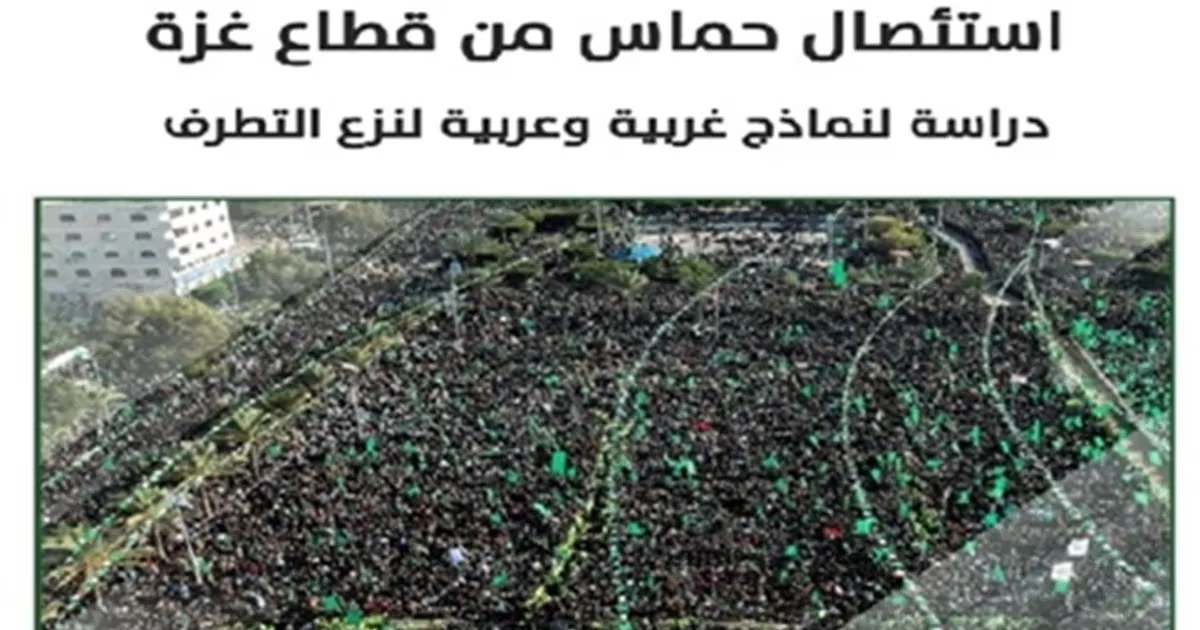







The Israeli Institute for National Security Studies (INSS) has published a new book that includes a comprehensive strategic approach to dealing with what it describes as the phenomenon of 'Hamasization' in the Gaza Strip. This study, prepared by researchers Ofer Guterman and Tara Feldman, is based on an in-depth analysis of international and Arab experiences in the fields of deradicalization and community rebuilding after armed conflicts.
Research Note No. 253, issued in early 2026, focuses on the necessity of combining security, political, and social tools to undermine Hamas's influence. Al-Zaytouna Centre for Studies and Consultations reviewed this paper in an analytical reading presented by Dr. Nihal Al-Sheikh Khalil, clarifying the dimensions of the Israeli vision for the future of the Strip.
The study traces the roots of what it calls 'radicalism' in Gaza to historical accumulations that began with the Nakba of 1948 and developed during the period of Israeli administration after 1967. The paper considers Hamas's rise in the 2006 elections and the subsequent siege in 2007 as the most prominent stage in solidifying the movement's presence within the societal structure.
The Israeli reading emphasizes that Hamas's strength is not limited to the military aspect but extends to include a wide network of religious and charitable institutions. This social penetration makes any attempt to reduce the movement's influence a task closely linked to changing the overall economic and social environment of the Strip's residents.
The study proposes a three-level approach that begins at the individual level through intellectual and social rehabilitation programs for individuals involved in the movement's frameworks. This step aims to dismantle direct ideological ties and provide alternative paths for integration into society away from previous organizational frameworks.
At the community level, the study calls for involving families, religious leaders, and traditional social networks in formulating and disseminating an alternative discourse. Research sources believe that confronting extremist ideology requires a social incubator that rejects violence and adopts civil concepts consistent with the proposed vision for the future.
At the institutional level, the paper emphasizes the necessity of radical reforms in governance, education, and judicial systems to enhance the rule of law. This vision focuses on creating economic and political 'attraction factors' that convince residents of the viability of alternatives to the governance model provided by Hamas over the past two decades.
The study recalls historical models of deradicalization, citing the experiences of Germany and Japan after World War II as successful examples of dismantling totalitarian ideologies. It illustrates how educational and media institutions were rebuilt in those countries to ensure that old regimes would not return to power.
In contrast, the study warned against repeating the failures of other international experiences, as happened in Iraq, Afghanistan, and Bosnia and Herzegovina. The paper attributed these failures to the persistence of deep social divisions and the weakness of national institutions that were supposed to lead the process of democratic and intellectual transformation.
At the regional level, the researchers observed varying Arab approaches to dealing with Islamist movements, ranging from purely security measures to political containment. The study pointed to models in the UAE, Saudi Arabia, Egypt, and Morocco, where attempts at cultural transformation occurred through educational curriculum and religious institution reforms.
For any program in Gaza to succeed, researchers stipulate the availability of a complex political and institutional environment, starting with the formation of an interim Palestinian administration that enjoys broad regional and international support. This administration must oversee major reconstruction projects and improve the living prospects of the population to ensure their loyalty to the new system.
The study identifies four integrated pathways to ensure the sustainability of results: the security path, a clear political horizon, economic reconstruction, and social transformation. Sources believe that the absence of any of these pathways will necessarily lead to the failure of the comprehensive strategy and a return to previous conditions.
Despite the detailed proposal, the study's authors acknowledge the difficulty of implementing this strategy on the ground given the current political complexities. The institutional reality in Gaza and the field entanglements pose serious challenges that may hinder the application of the international models reviewed in the research paper.
The study concluded that the primary purpose of presenting these scenarios is to stimulate broader academic and political discussions about the 'day after' the war. These proposals remain contingent on international consensus and the ability to find a Palestinian partner capable of implementing these radical transformations in the structure of Gazan society.
Any program to reduce Hamas's influence in Gaza requires complex political and institutional conditions, including the formation of an interim Palestinian administration with regional and international support.
שתף את דעתך
Israeli Study Outlines Scenarios for 'Dismantling Hamas' Influence' in Gaza Through International Strategies