






Hebrew media sources reported that the occupation's air defense systems faced unprecedented challenges in countering recent Iranian missile attacks. The sources confirmed that 11 missiles equipped with cluster warheads successfully penetrated the defensive shield and reached their targets, causing extensive material damage in various areas.
Military data indicates that this round witnessed a qualitative escalation compared to previous confrontations, as only 3 missiles of this type had previously succeeded in penetrating. Reports clarified that the wide dispersal area of these missiles complicates the processes of inventorying and dealing with the resulting damage in residential areas.
According to estimates, Iran has launched approximately 250 ballistic missiles since the beginning of the current round, with fragmented warhead missiles accounting for nearly half of this number. Despite continuous interception attempts, the record launch rate contributed to a number of submunitions reaching vital centers.
Sources observed one cluster missile hitting five different locations simultaneously, most notably in the Ramat Gan area where the submunitions created deep holes in house courtyards. Technical teams also recorded one submunition penetrating the roof of a fortified bunker, raising questions about the destructive capability of these munitions despite their small size.
Although the weight of a single fragmented submunition ranges from only 2 to 3 kilograms, its destructive impact is described as significant due to the high speed of the fragments. These explosions caused structural damage to old buildings over nine decades old, in addition to destroying private property and cars in the streets.
In a related context, sources confirmed the killing of ten settlers as a result of two conventional ballistic missiles falling on the Tel Aviv and Beit Shemesh areas. Conventional missiles are characterized by carrying warheads weighing hundreds of kilograms of explosives, leading to the complete collapse of buildings in the event of a direct hit.
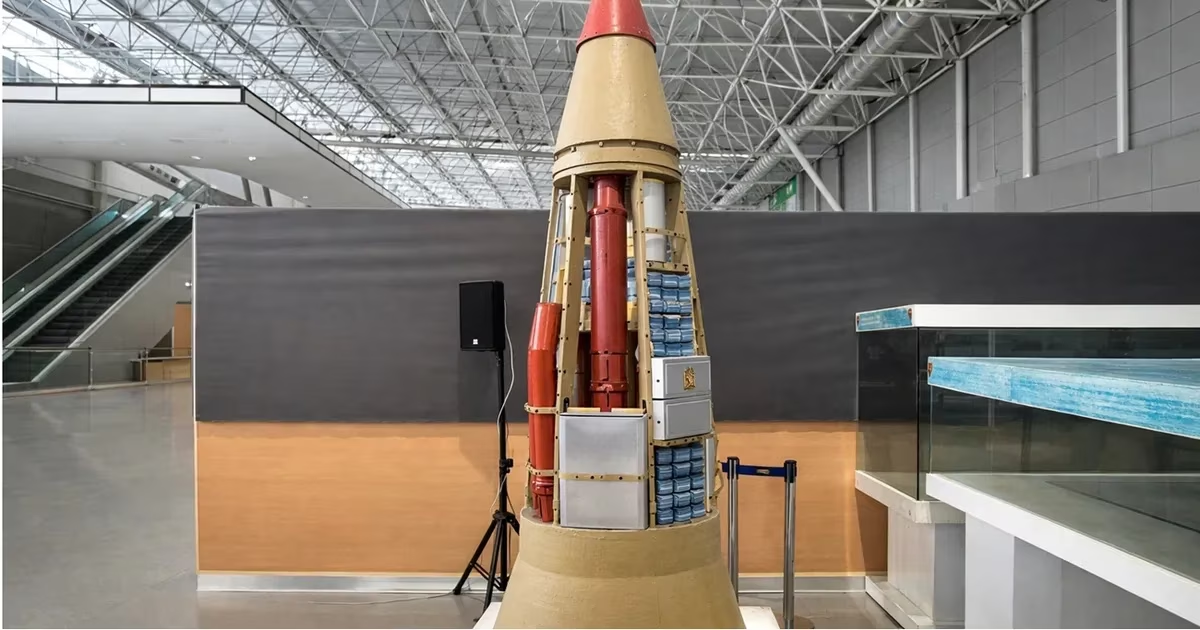
Technical reports explain the mechanism of Iranian cluster missiles, where the warhead opens at an altitude of up to 7 kilometers above ground level. This upper explosion leads to the dispersal of dozens of small munitions that cover wide areas, mimicking the effect of short-range missile barrages.
In the Gush Dan area, dozens of small craters resulting from the fall of these submunitions were observed, generating huge quantities of deadly fragments. In a remarkable incident in Tel Aviv, the force of the explosion from one of these submunitions completely dislodged a vehicle from its place and threw it a long distance.
Defense experts believe that the Iranian arsenal is increasingly relying on integrating cluster warheads into its long-range missiles directed towards the occupation. This list includes advanced 'Ghadr' and 'Emad' missiles, which possess high maneuverability and the ability to bypass defensive radars.
The danger of the 'Khorramshahr' missile stands out particularly, as reports indicate its ability to carry a warhead containing up to 80 submunitions. This qualitative development places the occupation's home front under a constant threat, making it difficult to predict where its fragments will fall or to limit their widespread destructive effects.
The cluster missile opens at an altitude of approximately 7 kilometers above ground level, causing smaller munitions to scatter and inflict widespread damage.
שתף את דעתך
Defensive Failure Against Fragmented Warheads: 11 Iranian Cluster Missiles Penetrate Airspace and Cause Widespread Destruction