






News Analysis
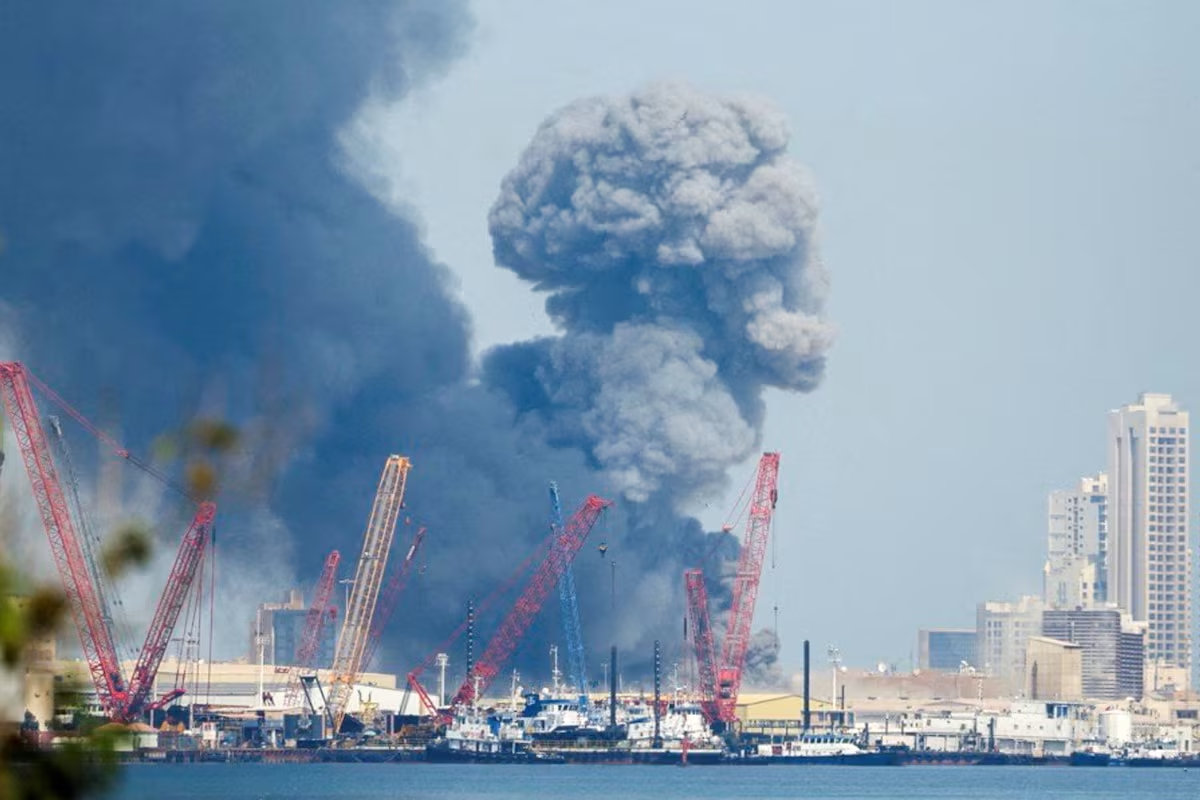
Washington, D.C- As the United States and Israel launched their war on February 28, 2026 against Iran, the countries of the Gulf Cooperation Council once again found themselves in an uncomfortably familiar position. Their strategic dilemma has shaped Gulf security policy for decades: they rely heavily on Washington for protection, yet they live in the immediate shadow of Iran. When crises erupt, Gulf leaders must reconcile alliance politics with geographic reality. Loyalty to a distant partner cannot override the risks faced at home.
A recent article published by The Economist asked whether Gulf states should join the attacks on Iran. The question reflects the widening gap between outside expectations and regional realities. In Washington and in Israel, the confrontation is framed as an opportunity to weaken a long standing adversary. In the Gulf it is seen differently: a war fought in their skies, against their infrastructure, and within reach of their cities.
Pressure from Washington has been anything but subtle. Influential voices on Capitol Hill, including Lindsey Graham, Tom Cotton, and Ted Cruz, have demanded that Gulf states join the military campaign alongside the United States and Israel. Some have hinted that American security commitments should be reconsidered if Gulf partners refuse to participate. The message is blunt: join the fight or risk losing the protection that has anchored Gulf security for decades.
Such rhetoric may resonate in Washington’s political arena, but it sounds very different in Gulf capitals. Calls for war are always easier when the battlefield lies thousands of miles away. For Gulf states, participation would mean inviting Iranian retaliation onto their territory. Ports, airports, oil installations, desalination plants, and crowded cities would become immediate targets.
This is why Gulf governments have chosen caution. Their military posture remains overwhelmingly defensive. Advanced air defense systems intercept missiles and drones, but Gulf states avoid launching attacks on Iran. The strategy is straightforward: defend national territory while avoiding steps that would turn the Gulf into the central battlefield of a regional war.
The economic stakes are enormous. Oil and gas facilities, shipping terminals, and financial centers form the backbone of Gulf prosperity and global energy markets. These assets are concentrated and exposed. Precision missile strikes on a handful of installations could shake markets and inflict immediate domestic damage. For governments whose stability rests on economic performance, the danger is existential.
Yet hesitation in Gulf capitals is not driven only by fear of retaliation. It also reflects doubts about the strategic logic behind the war promoted by Israel and its allies in Washington. Israel views Iran as its most serious regional adversary and has long argued for decisive action. But geography matters. While Israel sits at some distance from the Gulf battlefield, the Gulf states would absorb the immediate shock of escalation.
In effect, the countries most exposed to Iranian retaliation are being asked to carry the risks of a confrontation whose goals are defined elsewhere. For Gulf leaders this raises a simple question: whose war would they actually be fighting?
Doubts are reinforced by uncertainty about the durability of American strategy in the Middle East. For decades the partnership with Washington formed the cornerstone of Gulf defense policy. Yet recent history shows how quickly American priorities shift as administrations change and public opinion turns against foreign wars.
The legacy of the Iraq War and the War in Afghanistan still shapes regional thinking. Both conflicts began with promises of swift victories but evolved into prolonged campaigns that destabilized entire societies. Gulf leaders watched those outcomes carefully and concluded that dismantling a state is far easier than managing the aftermath.
That lesson looms even larger when Iran is considered. With more than eighty million people and complex political and ethnic dynamics, Iran is far larger and more intricate than either Iraq or Afghanistan. A severe weakening of the Iranian state could unleash instability across the region.
Competing factions, armed groups, and refugee flows would not remain inside Iran’s borders. Instability would spill outward into neighboring states and vital waterways such as the Strait of Hormuz. For Gulf governments the prospect of prolonged turmoil next door is far more dangerous than the uneasy balance that existed before the war.
The role of Israel adds another layer of political sensitivity. While several Gulf states normalized relations with Israel in recent years, overt military alignment against Iran carries risks. Many across the Arab and Muslim worlds would view such cooperation not as necessity but as participation in a conflict shaped largely by Israeli security priorities.
Even so, restraint brings its own dilemmas. Some policymakers argue that excessive caution could embolden Tehran and invite further missile or drone attacks. The challenge is to preserve deterrence without triggering a cycle of escalation that could spiral beyond control.
Even without direct participation, the Gulf remains central to the economic dimension of the conflict. Global energy markets depend heavily on the uninterrupted flow of oil and gas from the region. Any disruption reverberates through the world economy.
Ultimately Gulf reluctance reflects realism rather than weakness. From Washington and Israel the confrontation may appear as a strategic contest. From the Gulf it looks like a war whose costs would be immediate and devastating.
The most sober voices therefore ask a simple question: who will actually pay the price of this war? For the Gulf states the answer is painfully clear. The missiles will fall closest to them first if escalation continues unchecked tomorrow.
שתף את דעתך
Washington’s War, the Gulf’s Battlefield