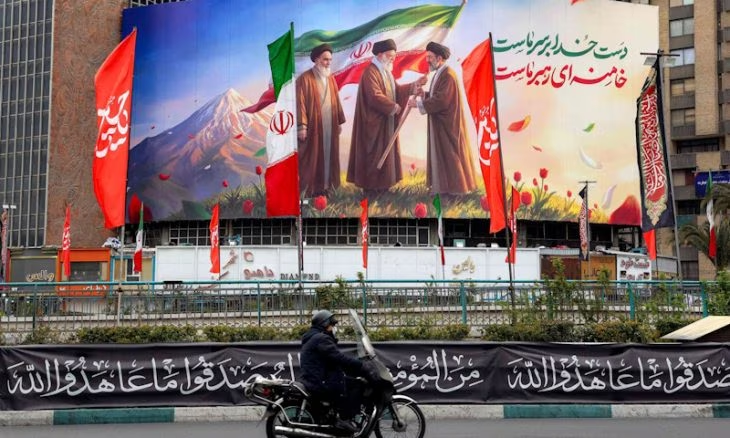







In an analysis published by the 'Financial Times', writer Gideon Rachman asserted that the strategy adopted by US President Donald Trump towards Iran, inspired by his experience in Venezuela, has suffered an early failure. He explained that the appointment of Mojtaba Khamenei as the new Supreme Leader of the Islamic Republic came as a shock to Washington's plans, which had hoped to engineer a new leadership aligned with its interests.
Rachman indicated that the military operation, dubbed 'Epic Rage', was essentially aimed at finding an Iranian figure to play the role of 'Delcy Rodriguez' in Venezuela. Trump's decision to launch this war was influenced by the rapid success he achieved in Caracas at the beginning of the year, where he was impressed by the ability of military force to shift balances and access oil resources.
The United States, in coordination with Israel, moved to overthrow the Iranian government, believing that the model of selecting a new leader for Venezuela could be literally applied in Tehran. Trump had previously stated that he wished to be directly involved in the process of appointing the new leadership, just as happened with Rodriguez's inauguration following the arrest of Nicolas Maduro.
These ambitions dissipated with the announcement of Mojtaba Khamenei, son of the late leader Ali Khamenei, who was assassinated at the beginning of the conflict, as the new Supreme Leader. Despite expectations that Israel would also seek to assassinate the son, reality dictates that the future of Iranian leadership is no longer subject to direct American will as planned.
The significant gap between the two models lies in the fact that Washington had a clear channel of communication with Rodriguez before acting in Venezuela, which made her inauguration easy. In contrast, the US administration lacks a ready successor in Iran, as the White House has not shown enthusiasm for the return of the exiled Shah's son, Reza Pahlavi, to power.
Trump revealed in statements described as tragic that most of the figures Washington had considered for leading the transitional phase had passed away. This absence of pragmatic alternatives capable of consolidating power made it impossible to proceed with the 'regime change' path favored by the current US president.
Jeremy Shapiro of the European Council on Foreign Relations described this policy as aiming to install a leader who executes orders without engaging in a complex nation-building process. This approach seems attractive to Trump because it promises quick geopolitical and commercial gains and avoids involvement in long-term conflicts that do not serve his 'America First' slogan.
While Venezuela quickly transformed from an ally of Russia and China to a state subservient to American interests, the scene in Iran appears completely different and more complex. US officials visited Caracas to conclude massive energy deals, while US forces remain stuck in an open military confrontation with Tehran.
The military intervention in Iran deviated from the rapid course seen in the Venezuelan model, where Maduro's capture took only a few hours. In the Iranian case, the conflict has exceeded its first week, with Trump speaking of operations that could extend for a month or more, with the possibility of having to send ground troops.
The attack on Iran turned into a widespread regional war, with more than a dozen countries subjected to mutual missile bombardment during the first days. These developments shattered Trump's hopes for quickly controlling the situation and finding a 'great and acceptable' leader to end the conflict on Washington's terms.
The economic repercussions of the war began to appear catastrophically on global markets, with oil prices soaring to record levels after the effective closure of the Strait of Hormuz. The rise in fuel prices puts immense political pressure on the White House, especially with crucial election dates approaching and growing public concern.
Rachman believes that Trump may find himself forced to choose between comprehensive military escalation or a rapid withdrawal to minimize political and economic losses. Trump possesses a unique ability to claim victory even in cases of clear failure, which he may resort to to justify any future retreat from his stated goals.
However, withdrawing from the Iranian confrontation will not be as simple as withdrawing from other issues, given the presence of about 40,000 US troops and strategic bases in the crosshairs. Allies and economic assets in the region are now at risk, making an end to the war on American terms questionable.
In conclusion, the 'Epic Rage' operation appears as a model of failure in assessing the adversary's strength and the absence of a political vision for the aftermath of a military strike. The gamble on the Iranian regime falling like dominoes proved unrealistic, placing the US administration in a strategic dilemma that could change the face of the region for years.
Trump revealed in a tragic irony that most of the Iranian figures Washington had considered installing as alternatives to the regime had died.
שתף את דעתך
Financial Times: The 'Regime Change' Model in Iran Stumbles, and Trump's Venezuelan Strategy Fails