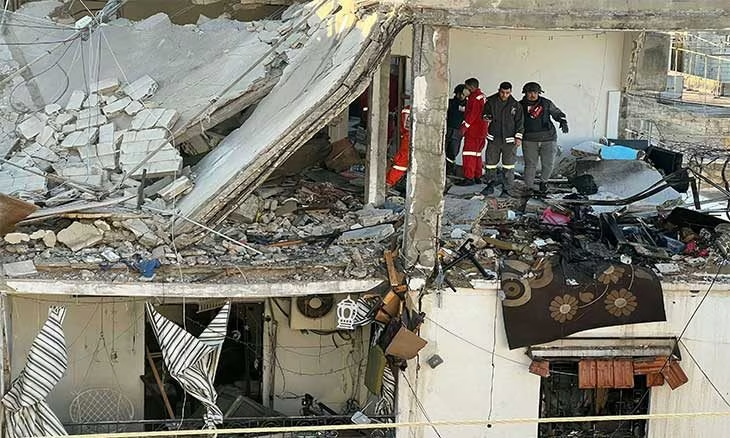







Analytical readings of the reasons for the American-Israeli military escalation against Iran point to a pivotal role played by Israeli Prime Minister Benjamin Netanyahu in solidifying President Donald Trump's decision. In a phone call on February 23, intelligence sources presented a hypothesis that an imminent meeting of the Iranian Supreme Leader and his senior advisors represented a golden opportunity to assassinate the entire leadership. This Israeli move linked Trump's ambitions for a quick victory with the 'decapitation' strategy, marketed as a final solution to the Iranian crisis.
Netanyahu's persuasion of Trump relied on what was called the 'Venezuelan example,' where the Iranian regime was portrayed as a fragile structure that would collapse once its top leadership was eliminated, much like how President Nicolas Maduro was dealt with. This analysis intersected with Trump's public statements, in which he announced the death of the Supreme Leader, describing the event as the greatest opportunity for the Iranian people to reclaim their country. It seemed Washington was betting that a military strike would force the remaining Iranian leadership to negotiate from a position of extreme weakness.
This scenario was accompanied by Netanyahu's exploitation of Trump's political need for an 'escape' from internal crises and thorny issues plaguing him in the United States. Observers believe that the decision was not merely a personal whim but was linked to a broader American strategy aimed at controlling global energy reserves and securing oil markets. However, the supposed success in Venezuela was the primary driver Netanyahu used to market the idea of eliminating the Iranian leadership as a low-cost strategic solution.
In contrast, Tehran did not remain silent, announcing the election of a new leader and initiating a series of intense retaliatory attacks that targeted Israeli depth and American bases in the region. Despite President Masoud Pezeshkian's attempts to de-escalate through diplomatic 'apologies' for some attacks, the reality on the ground indicates an unprecedented escalation. Iranian responses included targeting vital economic facilities, placing the entire region on the brink of a military and economic volcano.
A major problem emerged in Trump's handling of sensitive intelligence information, with security sources criticizing his statements that revealed secret details related to the major strike. These precedents in disclosing operational secrets, such as referring to Israeli agents visiting the Fordow nuclear facility, further complicated the security landscape. It appears that the overlap between the desire for political showmanship and the requirements of secret military operations led to counterproductive results that were not anticipated by planners in Washington and Tel Aviv.
Whether the war was a pre-planned strategic decision or a result of Netanyahu's success in exploiting Trump's weaknesses, the outcome is the United States entering a new 'earthquake zone.' Israel is striving to leverage this conflict to radically and permanently change regional power balances. However, the failure to achieve the 'rapid collapse' scenario of the Iranian regime opens the door to catastrophic possibilities that may not stop at the borders of the Middle East but extend to include major powers such as Russia and China.
The Arab region today suffers from the repercussions of this military gamble, as countries find themselves facing economic and security losses whose end cannot be predicted. The bet that 'decapitation' would end the war proved naive in the face of the complexities of Iranian institutions and their history of confrontation. Instead of the promised stability, these strikes have opened the floodgates of chaos, threatening to turn the conflict into a long-term war of attrition that drains everyone's resources.
Ultimately, the current scene shows that political arrogance can lead to historical catastrophes when the realities of geography and history are ignored in favor of quick deals. The Middle East, boiling on a hot plate, needs a vision that transcends the language of missiles and assassinations, especially as 'doomsday scenarios' are now on the table. If the hawkish mood in Washington does not change, the region is heading for major transformations that will redraw the political map with unprecedented destruction.
Netanyahu succeeded in exploiting the American president's weaknesses to push Washington back into the Middle Eastern earthquake zone.
שתף את דעתך
Netanyahu, Trump, and the 'Decapitation' Gamble: How Washington Slipped Towards Confrontation with Tehran?