






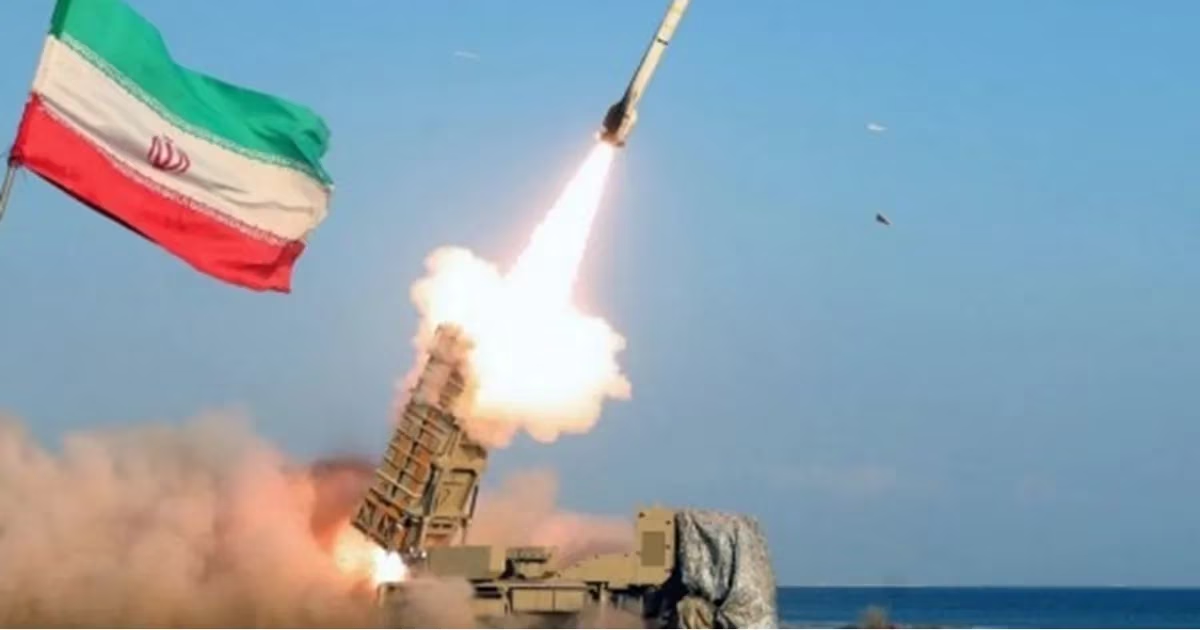
The military confrontation between Iran and the US-Israeli-led coalition entered a pivotal phase since its outbreak in late February 2026, with the initial days revealing an American strategy based on rapid international mobilization. Washington sought to expand the umbrella of military and logistical support, exceeding the direct capabilities available in the region to include a complex network of Western bases and allies.
In contrast, Tehran chose to fight this war by relying entirely on its deeply rooted defense institutions and local manufacturing capabilities, despite the severe blow it received at the beginning of the conflict. This disparity highlights a struggle between two models; the first relies on collective technological and logistical superiority, and the second is based on internal cohesion and strategic independence built over decades of sanctions.
The US administration realized early on that military operations against Iran's vast geography required massive infrastructure that extended beyond Israel's borders. This realization prompted Washington to activate its military agreements with Britain, which placed its strategic air bases at the disposal of American heavy bombers heading towards their targets deep within Iran.
Britain's 'Fairford' base and 'Diego Garcia' base in the Indian Ocean are vital strongholds in this war, providing safe air routes and maintenance and supply services. Without this logistical network, American operations would have faced enormous challenges in maintaining the intensity of air raids targeting vital Iranian facilities.
The European role was not limited to British logistical support but extended to direct French military action in the Mediterranean basin and the Gulf region. Paris sent the aircraft carrier 'Charles de Gaulle' to reinforce the Western naval presence, a move reflecting European concern about the war's repercussions on global energy security and international trade routes.
On the Iranian side, military institutions such as the Revolutionary Guard and the army showed an ability to manage the crisis despite the martyrdom of Supreme Leader Ali Khamenei and a number of senior commanders in the initial strike. This institutional cohesion reflects the nature of a system that has developed alternative command and control mechanisms capable of operating under conditions of total war and extreme pressure.
Iran's defensive strategy relies on the multiplicity of institutions and local production of missiles and drones, which reduced its need to request direct external military intervention. Observers believe that this approach expresses a historical political culture that tends towards self-reliance, which has led Tehran to engage in the confrontation with its independent national capabilities.
On the ground, Iran did not cease to retaliate, targeting American bases in the Gulf and vital facilities with ballistic missiles, raising the cost of the war for the American side to about one billion dollars daily. This financial attrition places increasing pressure on the US administration, which seeks to achieve its stated goals of overthrowing the Iranian regime.
Inside Israel, reports revealed enormous economic losses amounting to 9.4 billion shekels weekly due to the halt of wide sectors and the cost of military mobilization. Despite unlimited American support, the continuation of mutual shelling places the Israeli home front before unprecedented challenges in the history of regional conflicts.
In parallel with the regional war, the occupied Palestinian territories witnessed a dangerous escalation, as settlers exploited the world's preoccupation with the war to increase the pace of their attacks in the West Bank by 25%. These attacks resulted in the martyrdom of Palestinians in the village of Qaryout, in addition to forced displacement operations of Bedouin communities in the Jordan Valley.
Informed sources confirm that American participation in this war came in part to protect strategic interests and ensure Israel's security, although the actual decision to launch the attack was under direct Israeli pressure. This overlap of interests reinforces the 'organic' nature of the alliance linking Washington to Tel Aviv in confronting Iranian influence.
A comparison between the military capabilities of the two sides reveals that power lies not only in technology but also in the ability to bear long-term economic and human consequences. While the Western alliance possesses overwhelming air superiority, Iran has geographical depth and a distributed military infrastructure that makes it difficult to decisively win the battle with swift strikes.
This war is a real test of the theory of 'self-reliance' versus 'collective security,' as the world watches how a single country can withstand an international alliance that includes great powers. The field results so far indicate that the conflict may be prolonged, threatening to radically change the map of political balances in the Middle East.
In conclusion, the Palestinian arena remains the most affected by the repercussions of this conflict, as Palestinians fear the liquidation of their field issues under the cover of the rising smoke from the regional fronts. As the war continues, the question remains about the ability of international institutions to curb the escalation and prevent the region from sliding into a comprehensive catastrophe whose end cannot be predicted.
Power is not measured only by the size of alliances, but by a state's ability to rely on itself and manage its national resources in the face of extreme military pressures.
שתף את דעתך
Deterrence and Alliances: A Reading of the Major Military Confrontation Between Iran and the Western Alliance