






Iraq has once again slipped into a cycle of regional conflicts after a short period of relative stability, as its airspace and territories have become an open theater for the military confrontation that erupted between the United States, Israel, and Iran. Since the launch of the joint attack on Tehran on February 28th, the Iraqi arena has witnessed an unprecedented escalation, including airstrikes and reciprocal missile attacks.
Successive Iraqi governments since 2003 have sought to maintain a delicate balance in their relations between Washington and Tehran, but this balance is now threatened with complete collapse. Although neither the United States nor Israel officially admits to launching strikes inside Iraq, they are accused of targeting headquarters of armed groups allied with Iran.
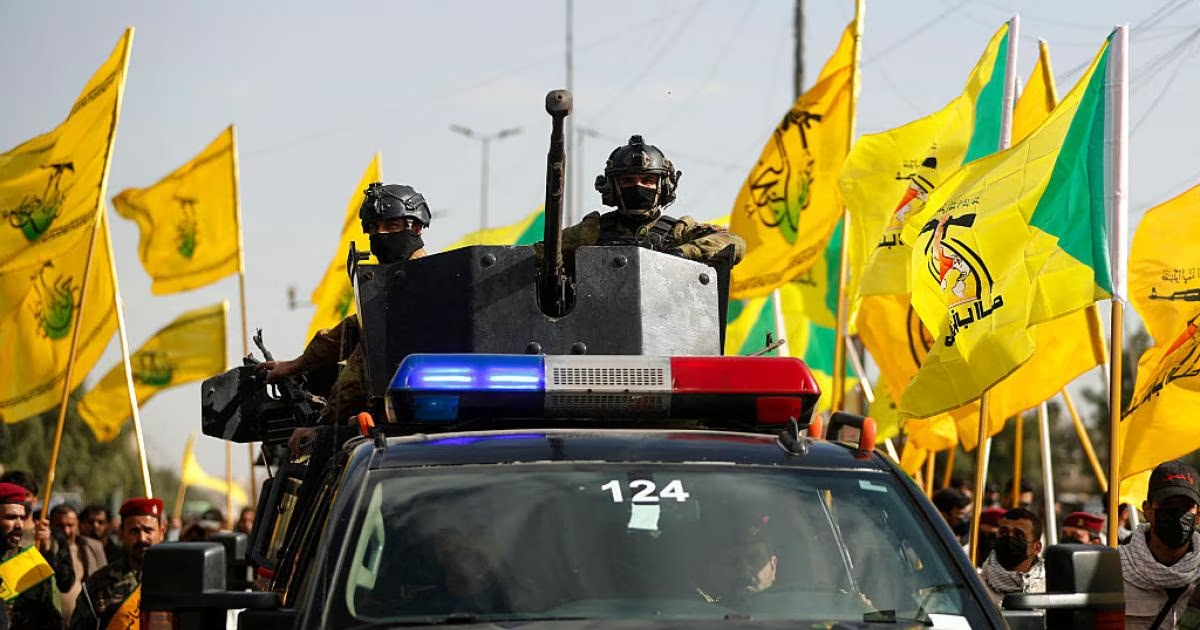
Iraqi armed factions have explicitly declared that they will not stand idly by in the face of attacks on Iran, and have already begun to carry out operations targeting what they described as 'enemy bases.' These factions have used drones and missiles to attack American military and diplomatic facilities across the country.
Pro-Iranian forces enjoy widespread influence within the Iraqi political system, possessing parliamentary representation and military wings operating under the Popular Mobilization Forces. However, some of these brigades, such as 'Hezbollah' and 'Sayyid al-Shuhada,' operate independently within the framework of the 'Islamic Resistance in Iraq' to implement agendas linked to the Tehran axis.
The Green Zone in Baghdad, specifically around the American embassy, has been subjected to repeated missile attacks that have been intercepted by air defense systems. Baghdad International Airport, which hosts American logistical support teams, has also not been spared from continuous targeting by drones and missiles launched by armed factions.
The scope of targeting has extended to economic interests, with oil fields managed by foreign and American companies in Basra and the Kurdistan Region being shelled. These attacks raise serious concerns about the stability of the energy sector, which represents the backbone of Iraq's ailing economy.
In the Kurdistan Region, air defenses in Erbil have daily intercepted unidentified drones flying over the city. The region hosts international coalition forces and a major American consulate, making it a constant target for factions seeking to expel foreign forces.
Washington has warned of the possibility of targeting hotels frequented by foreigners in the Kurdistan Region, amid escalating security tensions. The region has already recorded attacks targeting tourist facilities, reflecting the desire of some parties to exert maximum pressure on the Western presence there.
On another front, Tehran has exploited the current circumstances to intensify its strikes against the camps of opposing Iranian Kurdish factions located in northern Iraq. Iran accuses these groups of working for hostile intelligence agencies and participating in subversive operations within Iranian territory.
Five opposing Kurdish groups, including the Democratic Party of Iranian Kurdistan, announced the formation of a new political alliance aimed at overthrowing the regime in Tehran. This alliance seeks to benefit from international military pressure on Iran to strengthen the Kurds' position in determining their own destiny.
Press reports have circulated about the possibility of these Kurdish factions launching a ground attack on Iran with American support, which has greatly angered Tehran. The Iranian leadership has threatened to target all vital facilities in the Iraqi Kurdistan Region if its territory is used as a launching pad for any ground invasion.
For his part, US President Donald Trump tried to calm fears about the Kurdish escalation, emphasizing his desire not to complicate the military scene further than it already is. Trump indicated a friendly relationship with the Kurds, but ruled out supporting a ground attack that could open new, uncontrollable fronts of conflict.
The authorities in Baghdad and Erbil find themselves in a critical position, constantly emphasizing their rejection of turning Iraqi territory into a launching pad for aggression against neighboring countries. However, controlling armed factions or preventing foreign interventions seems an almost impossible task given the current balance of power.
Iraqi Prime Minister Mohammed Shia' al-Sudani issued strict directives to pursue those involved in missile attacks on diplomatic missions. Al-Sudani affirmed that the protection of embassies is the responsibility of the state, stressing that these actions harm Iraq's supreme interests and hinder the path of stability and development.
Targeting diplomatic missions and embassies operating in Iraq is an act that cannot be justified or accepted under any circumstances.
שתף את דעתך
Iraq in the Eye of the Storm.. How Did the Land of Two Rivers Turn into a Battleground for Score-Settling Between Washington and Tehran?