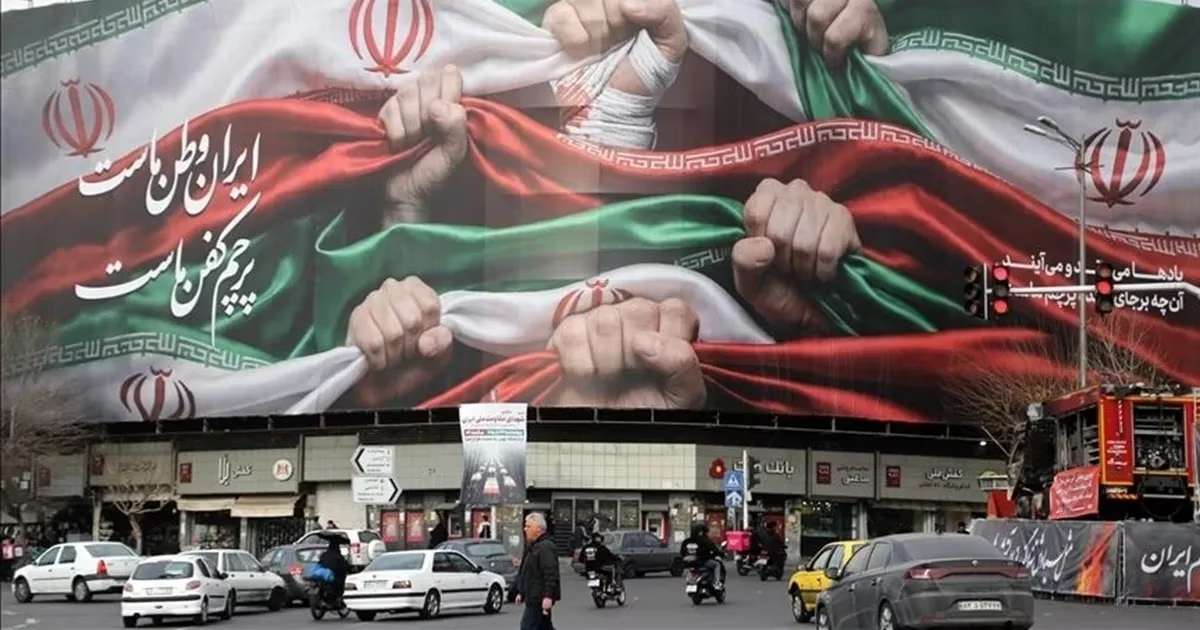







The hypothesis of concentrated air strikes as a tool to achieve rapid political collapse in Iran dominates Western strategic thinking, based on successful historical models in previous wars. However, this perception clashes with a complex geopolitical reality, as Iran is not merely a centralized military structure that can be crippled by a single blow, but rather a state with immense geographical depth and a solid combat doctrine.
This resilience dates back to ancient historical roots, where successive empires on the Iranian plateau realized that independence required the ability to absorb initial military shocks. From the Achaemenid era to conflicts with the Romans and Ottomans, the vast geography and multiple population centers remained an impenetrable barrier against any complete control.
The Iran-Iraq War in the 1980s served as the real laboratory that reshaped the modern Iranian military mind. Under suffocating international isolation and a severe shortage of advanced weapons, the leadership in Tehran drew a lesson: relying on external forces to ensure national security is a losing gamble.
From this lesson, a long-term project was launched to build a local defense industrial base, primarily focused on bridging the technological gap through asymmetric means. Instead of draining resources into building an air force that would be difficult to secure under sanctions, the compass turned towards developing a terrifying missile arsenal capable of achieving deterrence.
Iran's missile arsenal today is the largest in the region, designed to overcome advanced air defense systems through maneuverability and saturation techniques. Missiles such as 'Khorramshahr' stand out as strategic deterrent tools due to their heavy warheads and their ability to reach distant targets with increasing accuracy.
In addition to missiles, drones have emerged as a crucial element in Iranian military doctrine, providing a low-cost means of carrying out precise strikes. In this context, Tehran relies on a 'quantitative saturation' strategy aimed at exhausting enemy defenses through a barrage of synchronized drones and missiles.
What distinguishes the Iranian situation is its state of 'strategic independence,' as the country is not part of international military alliances such as NATO. This reality has pushed it to build an autonomous defense system that makes the cost of any attack on it extremely high, prompting adversaries to hesitate before engaging in an all-out confrontation.
Iran's topographical nature plays a pivotal role in protecting its military capabilities, as its geography varies between rugged mountain ranges and vast deserts. These terrains have enabled Tehran to construct underground 'missile cities' and fortified bases that are difficult to fully target even with the latest bunker-buster bombs.
Analytical sources confirm that the purpose of these fortified facilities is to ensure the continuity of the ability to retaliate even after being subjected to intense waves of aerial bombardment. This means that any conflict that might begin as a quick surgical operation would quickly turn into a regional war of attrition whose effects would extend over vast areas.
Compared to its situation in the 1980s, Iran today appears more prepared to manage long-term conflicts thanks to its advanced industrial base. It no longer relies on the black market for weapons but has become a source of military technologies used in various international conflicts, which enhances its leverage.
At the core of Iran's strategy is the principle of 'denying the enemy victory,' a defensive concept that seeks to transform any hostile technological superiority into a financial and military burden. By integrating geographical depth with missile capabilities, Tehran has created an equation that makes war an option with uncertain outcomes.
Experts indicate that any military assessment that ignores Iran's resilience may fall into the trap of miscalculations that preceded major wars. History proves that states with vast areas and ideological centrality do not fall to air strikes, no matter how destructive their power.
Ultimately, the idea of a 'blitzkrieg' against Iran remains merely a risky strategic gamble in the presence of a complex network of defenses and offensive capabilities. The transformation of the conflict into an open regional confrontation is the most likely scenario, which major powers fear and take into account.
Based on current data, Iran's military power is specifically designed to confront invasion or concentrated bombing scenarios. This design makes any attempt to militarily subdue the state a complex operation that far exceeds merely controlling the skies or destroying vital facilities.
The true power of the Iranian state lies not only in achieving a quick victory but in preventing the enemy from achieving a swift victory and turning the conflict into a war of attrition.
שתף את דעתך
Why does the 'blitzkrieg' strategy fail against Iran? A reading of military doctrine and geographical depth